Six Wild Discoveries from JWST

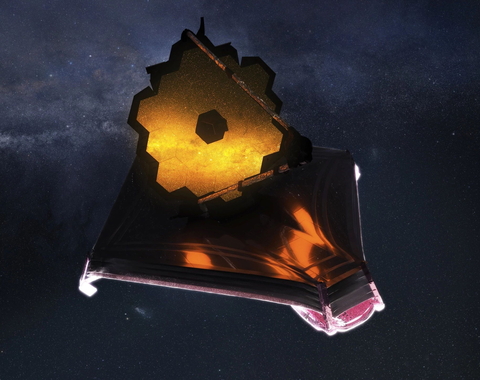
When the James Webb Space Telescope (JWST) launched on Christmas Day 2021, it promised to revolutionize our view of the cosmos. Three years later, it's delivering in spectacular fashion—from planets that rain diamonds to the chemical fingerprints of cosmic dawn.
Carnegie Science astronomers have been at the forefront since Day One—Carnegie's Alan Dressler actually chaired the committee that first conceived the telescope back in the 1990s. Today, Carnegie scientists have led or been a part of more than two dozen JWST research teams (with a whopping 1,328 total allocated observation hours) and have made some genuinely exciting discoveries.
Here are six of the wildest so far.
1. Our First Look at Moons in the Making
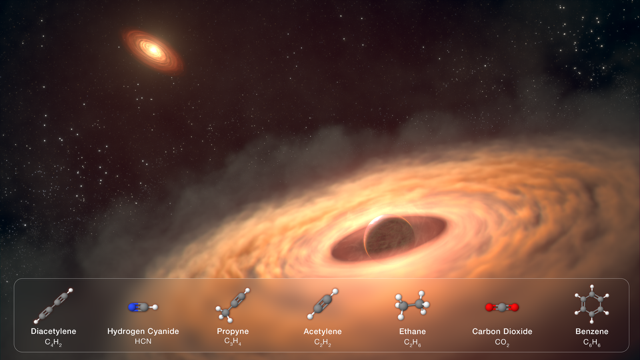
Jupiter has nearly 100 moons. Saturn has more than 140. But we had never actually seen how gas giants make moons—until now!
Carnegie's Sierra Grant used JWST to peek inside the disk of gas and dust swirling around a baby gas giant called CT Chamaeleontis b. It was humanity's first-ever detailed look at a moon-forming disk, and it immediately revealed something weird: the moon-making material around the planet is completely different from the planet-making material around its host star. Seven different carbon-containing molecules, including benzene, are floating around in the disk surrounding the planet. The star's disk? Zero detectable carbon molecules.
Why it matters: This rapid chemical evolution, which is happening on million-year timescales (fast for outer space!), might explain one of our Solar System's biggest mysteries: why are Jupiter's moons so wildly different from each other? Why does Europa have a subsurface ocean while Io is covered in volcanoes and Titan is carbon-rich? Turns out the chemistry can change dramatically even within a single planetary system.
Carnegie Scientist: Sierra Grant, Postdoctoral Fellow, Earth & Planets Laboratory
Program: 3886 (Cycle 2) - Probing carbon chemistry and dust in the planet-forming zones of brown dwarf disks
Observation Hours: 42.1
Summary: First detailed spectroscopy of moon-forming disks around gas giants
2. A Lava Ball That Shouldn't Have an Atmosphere
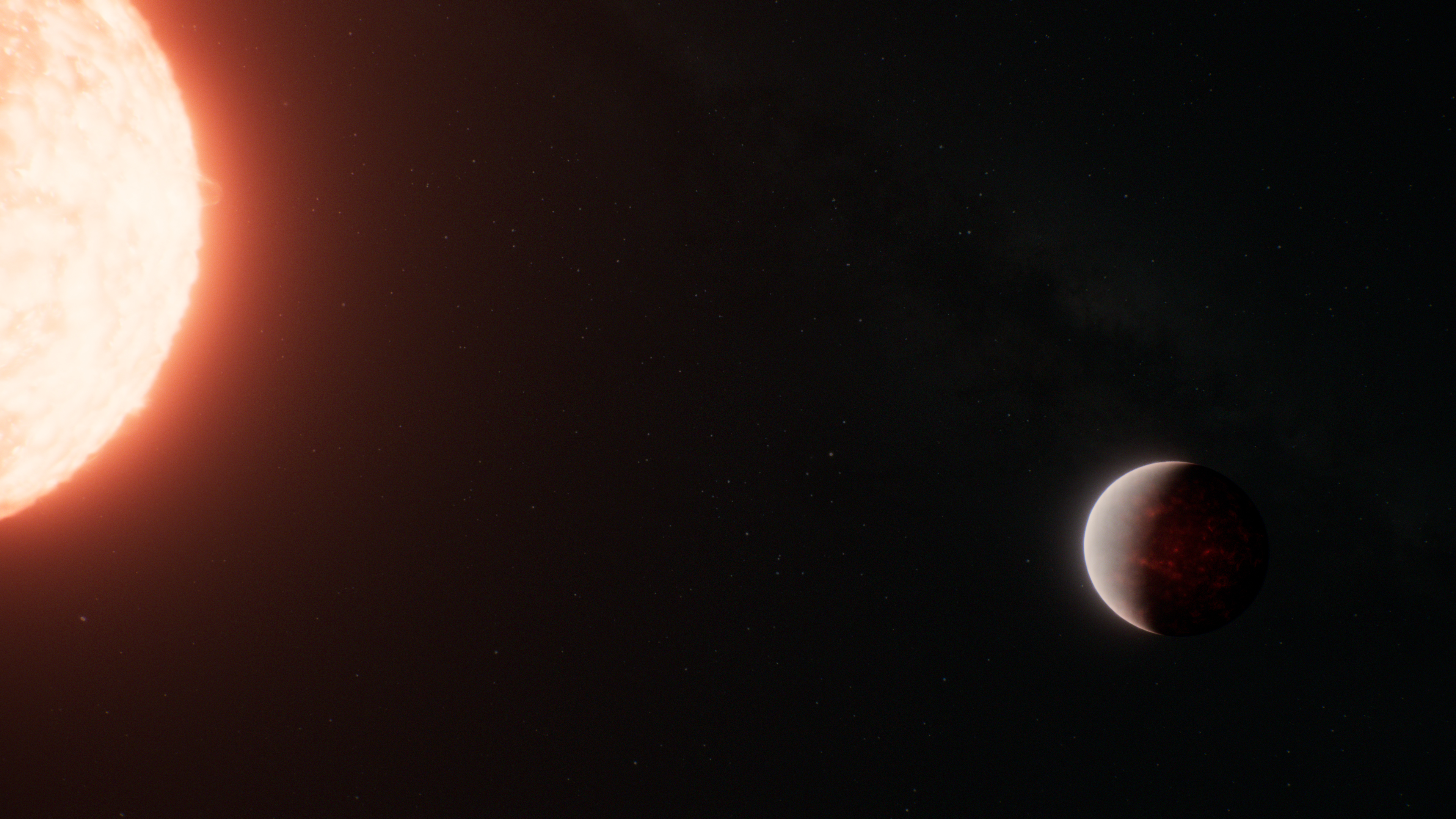
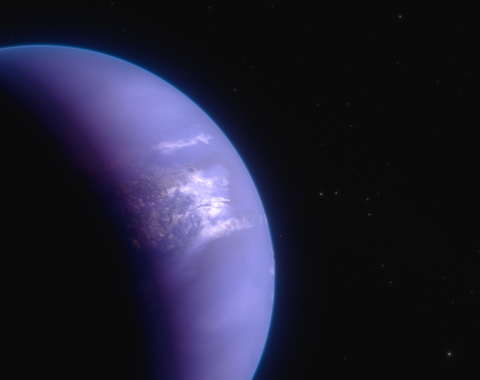
Meet TOI-561 b: a planet that's twice as old as our Sun, orbits its star in just 10.56 hours, and has a surface temperature of 3,200 degrees Fahrenheit. Its entire surface is likely a magma ocean, with gravity permanently locking one half of the planet in scorching starlight while the other side is stuck in the dark. By every exoplanet rule we thought we knew until now, it should be a bare rock. Small, hot planets shouldn’t be able to hold onto atmospheres.
Except it appears that TOI-561 b did.
A team led by Carnegie's Johanna Teske, Nicole Wallack, and Anjali Piette (now at the University of Birmingham) found the strongest evidence yet of a thick atmosphere around a rocky exoplanet. How'd they know? Temperature. If it were a bare rock, it would be 4,900 degrees Fahrenheit. Instead, it's only 3,200 degrees Fahrenheit, which points to an atmosphere distributing heat and helping cool off the planet's dayside.
Why it matters: There's an incredible exchange between what is above and below the surface of the magma ocean, which could mean the planet is constantly burping out gases that it previously ingested. "It's really like a wet lava ball," says co-author Tim Lichtenberg of the Kapteyn Astronomical Institute of the University of Groningen.
This completely upends our understanding of how rocky planets can maintain atmospheres in extreme conditions, which has big implications for habitability around other stars.
Program: Phase Curve Observations of TOI-561 b To Study Atmosphere-Interior Exchange - 3860 (Cycle 2)
Observation Hours: 44.3
Summary: Detecting atmospheres on ultra-hot super-Earths
3. A Lemon Planet That Rains Diamonds
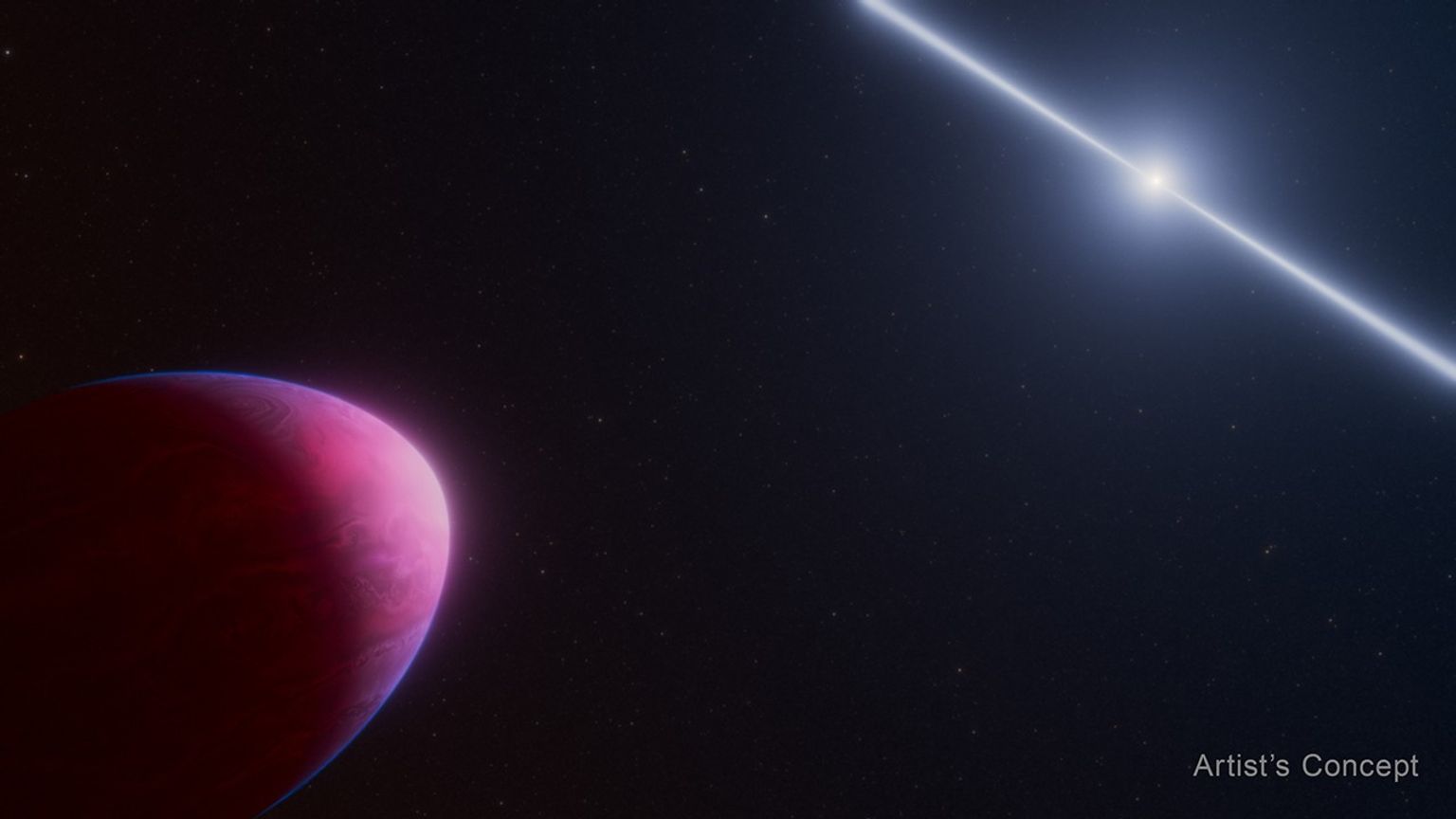
"What the heck is this?" That was Carnegie astronomer Peter Gao's actual reaction when the team saw data from exoplanet PSR J2322-2650b. And honestly, fair question.
This Jupiter-sized planet orbits a pulsar—a dead star spinning so fast it completes one rotation in milliseconds. The pulsar's gravity is so intense that it's squeezing the planet into a lemon shape. But here's the truly bizarre part: its atmosphere is made of pure molecular carbon. Not carbon dioxide. Not methane. Just straight-up C₃ and C₂ molecules floating around with helium. Soot clouds drift through the air and, deep inside, those carbon clouds condense and rain down as diamonds.
Why it matters: Out of 150 planets astronomers have studied with JWST, exactly zero others have any detectable molecular carbon in their atmospheres. This planet breaks every formation model we have. We literally cannot explain how it came to exist. It's a completely new type of world!
Peter Gao
Staff Scientist
Earth & Planets Laboratory
Program: Unveiling the Nature of the Impossible Planets - 2454 (Cycle 1)
Observation Hours: 15.2
Summary: Studying the lemon-shaped planet with a carbon atmosphere
4. Baby Galaxies Speedrunning Star Formation
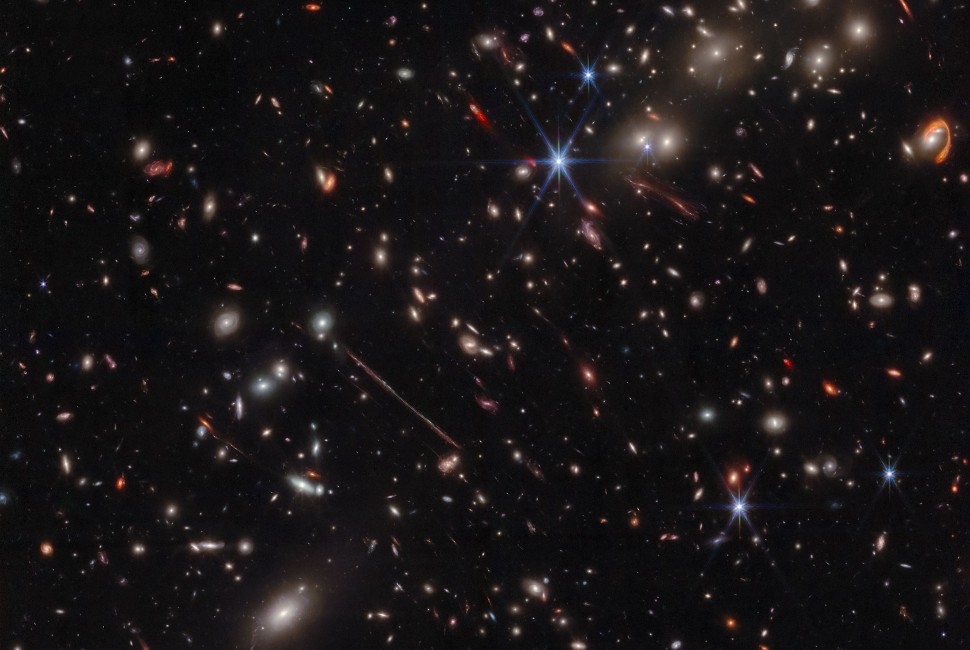
Carnegie's Alan Dressler helped dream up JWST in the 1990s. More recently, he used data from the GLASS-JWST Early Release Science program to study galaxies from just two billion years after the Big Bang and found that they're making stars way faster than predicted.
These infant galaxies had "bursty" star formation—they'd suddenly produce stars at rates much faster than anticipated that early in the universe's history, when things were still getting organized. But somehow, nature was doing it anyway. And there are a lot more of them than Dressler predicted, too! He says astrophysical theorists are going to have to step up and offer some new explanations for what JWST saw.
Why it matters: "This is the first chapter in our origin story," Dressler says. Understanding these bursts of activity helps us piece together how the first stars formed and how they collected into the massive galaxies we see today. It's like discovering that baby galaxies went through growth spurts, which changes our entire timeline of cosmic evolution.
5. The Immaturity of Teenage Galaxies
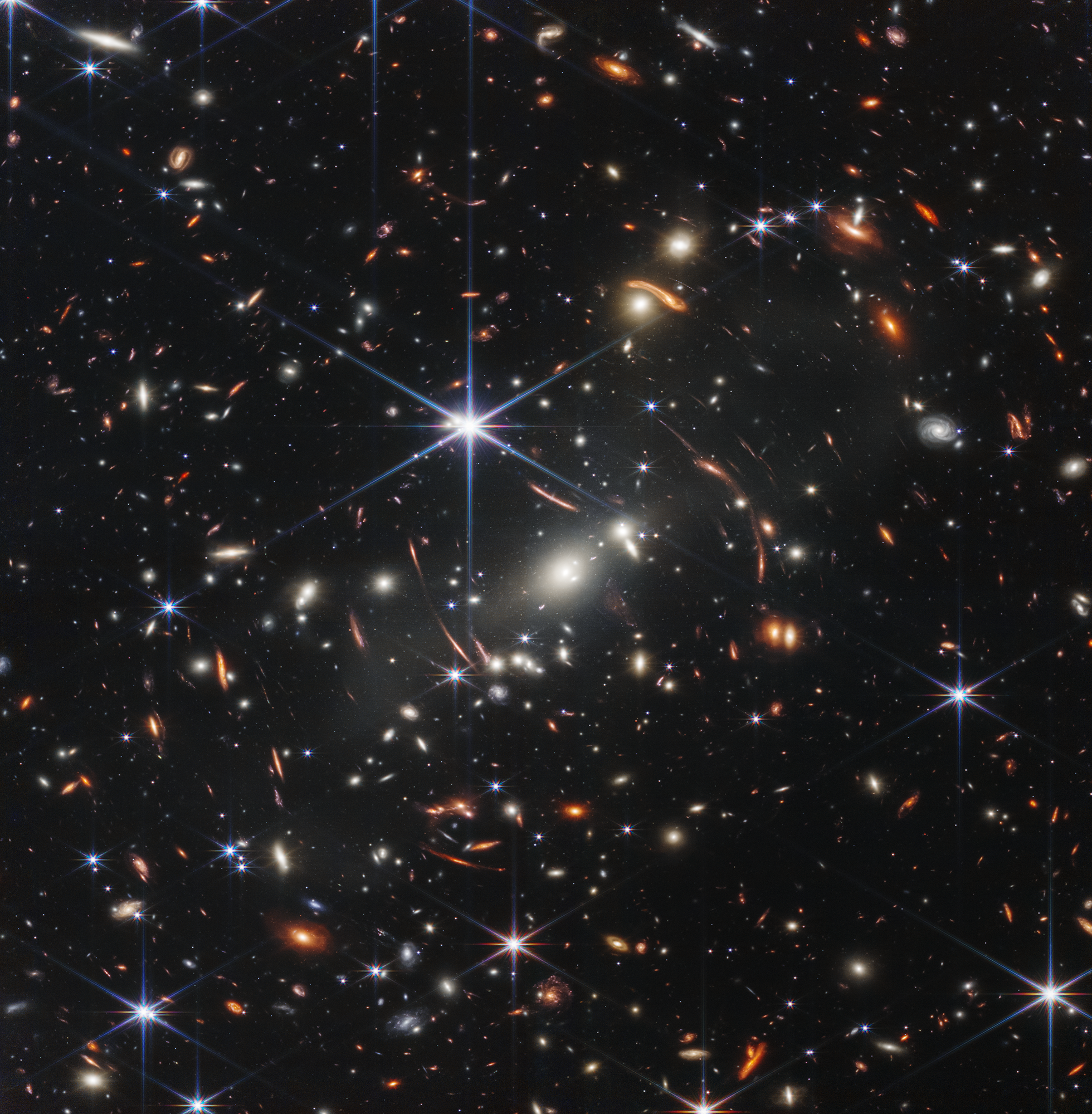
When a team led by Carnegie’s Gwen Rudie and Allison Strom (now at Northwestern University), along with Northwestern CIERA Postdoctoral Fellow, Noah Rogers, used JWST to study 33 "teenage" galaxies from 2 to 3 billion years after the Big Bang, they got more than they bargained for! (In a good way.)
They were hunting for chemical signatures of young, dynamic star-forming galaxies, hoping to measure their oxygen content. After using JWST to stare at them for more than a day, they not only found the oxygen signals they were seeking, but also those of sulfur and argon. The surprise? These early galaxies had widely varying oxygen levels but were always deficient in sulfur and argon—a very different chemical environment from what we see in more local galaxies (and our own Sun).
All three elements are produced when the most massive stars go supernova, ending their lives in fiery explosions. These particularly violent events happen quickly after stars form. But they are not the only type of supernovae out there; some require a little maturity. Certain supernovae that happen when a galaxy has gained a little temporal distance from its wild, star-forming youth can also produce sulfur and argon. So what does their low abundance in these young galaxies tell us? That they have some growing up to do—they’re chemically immature.
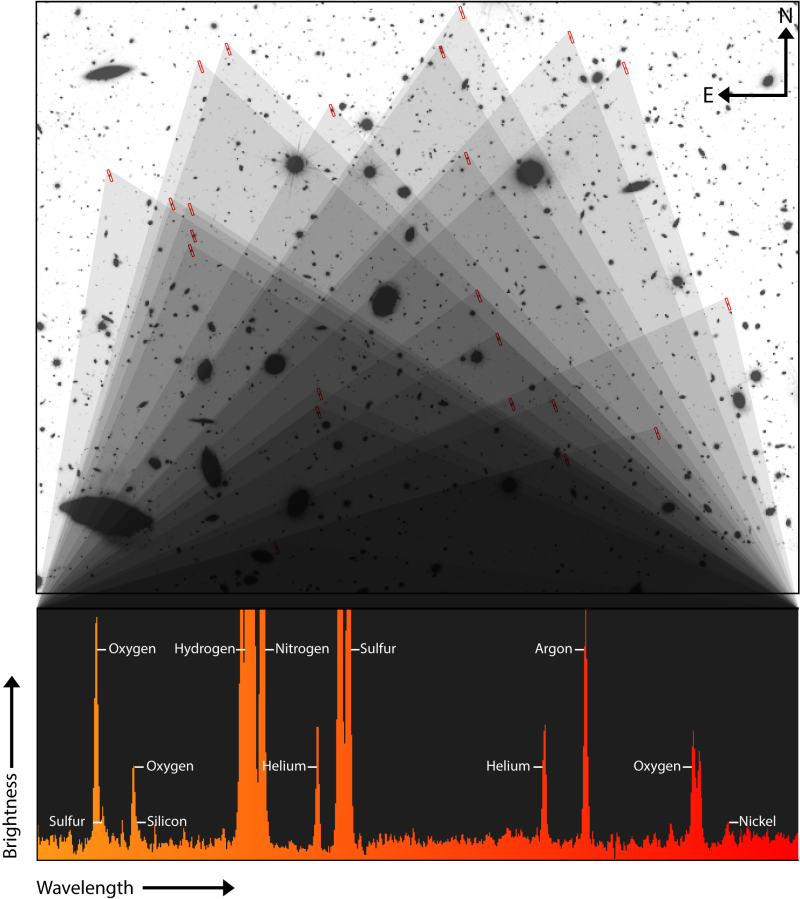
Why it matters: Now we know how these early galaxies grew up! The JWST observations reveal important details about the kinds of stars that formed in these systems (chemically immature ones, duh!) and about the systems’ overall development. By getting a peek at which elements appear in these young galaxies, astronomers can track how star formation evolved in the early universe. Now, scientists are using these findings to analyze data from galaxies even earlier in the universe's history.
The project was named CECILIA after Cecilia Payne-Gaposchkin, who figured out what stars are made of nearly 100 years ago and initially faced unfair criticism before her work was finally recognized.
Carnegie Scientists: Gwen Rudie, Allison Strom
Program: CECILIA: A Direct-method Metallicity Calibration for Cosmic Noon through the Epoch of Reionization - 2593 (Cycle 1)
Observation Hours: 39.2
Summary: Measuring chemistry in ancient galaxies
6. Giant Planets Orbiting Tiny Stars
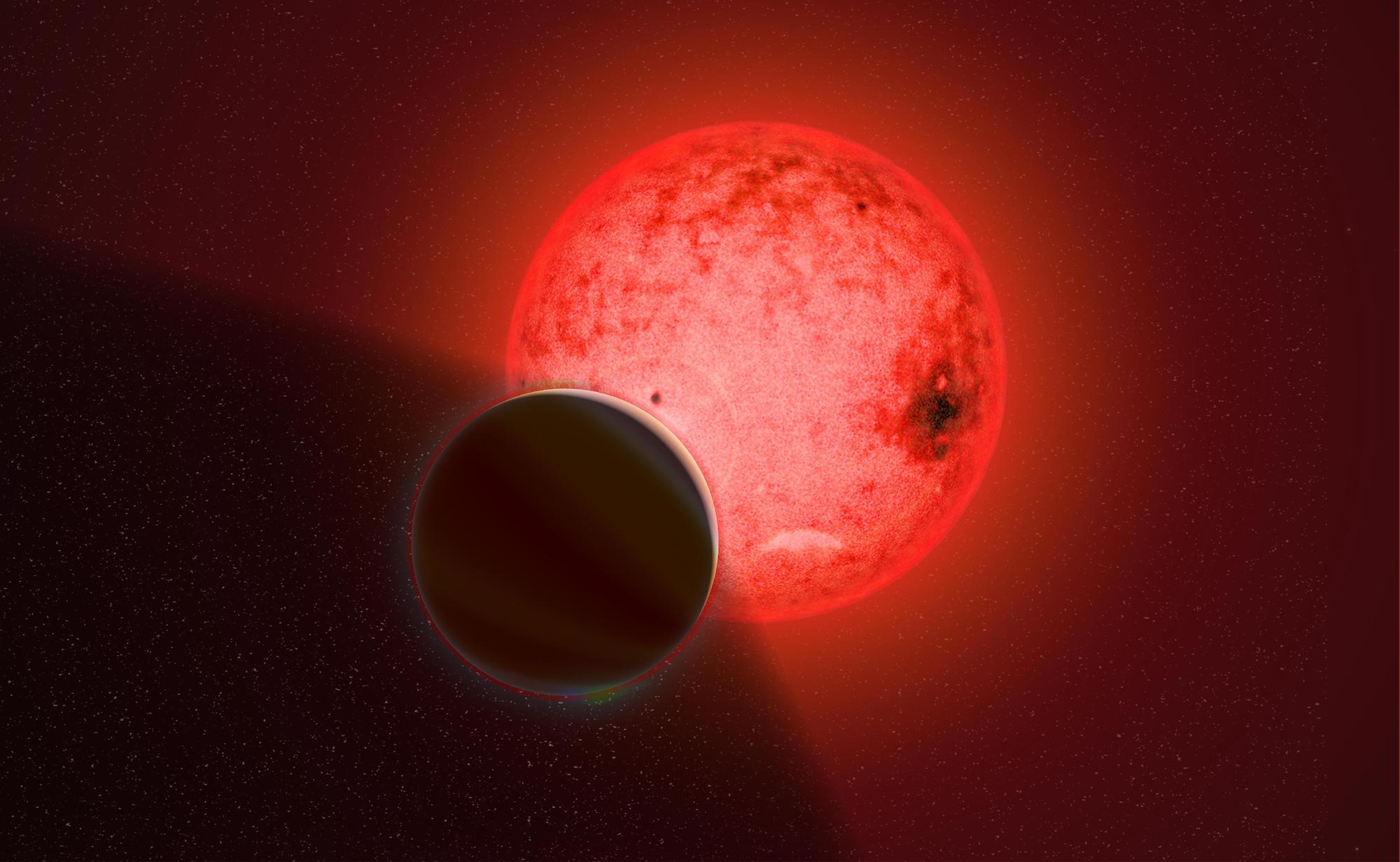
Gas giants like Jupiter and Saturn shouldn’t be able to form around small, cold stars, but Giant Exoplanets around low M-dwarfs (GEMS) exist anyway!
As part of a large effort using ground-based telescopes and now JWST, a team led by Carnegie's Shubham Kanodia and including Nicole Wallack, is trying to understand what's going on with these strange duos. One such planet is TOI-5205b—a Jupiter-sized planet orbiting a star that's only 40 percent the mass of our Sun.
While observing TOI-5205b’s atmosphere, the GEMS team found something unexpected: it's very metal-poor and surprisingly carbon-rich; they detected methane and hydrogen sulfide. Even weirder, the planet's interior is much more metal-rich than its atmosphere—about 10 times more—meaning that the inside and outside aren't mixing. This suggests that this planet likely formed in a way very different from gas giants in our Solar System.
Why it matters: TOI-5205b is one of seven impossible planets Kanodia is studying in the largest exoplanet program in JWST Cycle 2—"Red Dwarfs and the Seven Giants." "It's a real mystery how these objects form," Kanodia says. “Each one is rewriting the rules of planet formation. If giant planets can form around tiny stars, we need to understand the knobs to turn in our models to stretch them enough to explain these objects.”
Carnegie Scientists: Shubham Kanodia & Nicole Wallack
Program: Red Dwarfs and the Seven Giants: First Insights into the Atmospheres of Giant Exoplanets around M-dwarf Stars - 3171 (Cycle 2)
Observation Hours: 139.8
Summary: Largest exoplanet program in Cycle 2. Studying giant planets around tiny red dwarf stars.
What Else Carnegie Scientists Are Working On
These discoveries are just the headline acts. Carnegie scientists are leading more than a dozen other JWST programs right now, including:
Solving the mystery of dead galaxies.
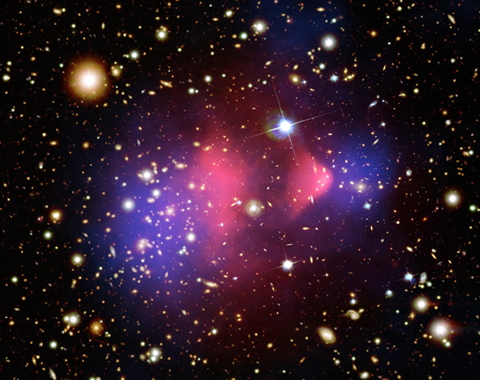
Carnegie astronomers Drew Newman, Allison Matthews, and Aliza Beverage, along with USC graduate student Sai Gangula, have been studying why some galaxies stopped forming stars billions of years earlier than others. While most young galaxies were bursting with star formation, a few just...quit. Thanks to a phenomenon called gravitational lensing, in which a massive object's gravity bends light and gives us a magnified view of the distant universe, the team is using JWST to get the most detailed picture ever of some of the galaxies and learn more about what processes shut down star formation.
4903 (Cycle 3) - Early Quiescent Galaxies Under the Magnifying Glass
Watching the universe's lights turn on.
Peter Senchyna is studying galaxies from right before the universe was fully reionized—the era when the first stars cleared away the cosmic fog and "turned the lights on" for the first time. Like Newman, he's also using gravitational lensing, in which a massive galaxy cluster acts as a natural telescope, to see this ancient galaxy and other samples from the universe’s first generations of hot, massive stars.
8792 (Cycle 4): Unlocking the massive stars behind the most spectacular fireworks displays in the early Universe
Refining the universe's expansion rate
Barry Madore and Wendy Freedman are using JWST to measure the Hubble Constant—the rate at which the universe is expanding. Different measurement methods have been giving conflicting results, creating a "crisis in cosmology." Their JWST observations aim to resolve this fundamental disagreement about how fast our universe is accelerating.
6876 (Cycle 4): An Stellar (JAGB/Carbon star) Distance to the Coma Cluster: Establishing Four New Determinations of the Hubble Constant
JWST Programs at Carnegie Science
1717 (GO) — Feedback around Supermassive Black Holes in Dusty Nuclei | 37.5 Hours
Jeff Rich | Co-I
2061 (GO) — Nucleosynthesis, Astrophysics, and Cosmology with IR Observations of a Gravitational Wave Counterpart
Anthony Piro | Co-I
Joshua Simon | Co-I
2110 (GO) — Ultra-deep continuum spectroscopy of quiescent galaxies at 1.0<z<2.5: chemical abundances and stellar kinematics | 22.7 Hours
Aliza Beverage | Co-PI
Andrew Newman | Co-I
2278 (GO) — Illuminating Ice: A 3D View of Water Ice During Planet Formation | 7.6 Hours
Alycia Weinberger | Co-I
2345 (GO) — Resolved Studies of a Unique Lensed Quiescent Galaxy at z=2: Testing Models of Assembly History, Quenching, and IMF Variations | 14.1 Hours
Andrew Newman | PI
Shannon Patel | Co-I
2454 (GO) — Unveiling the Nature of the Impossible Planets | 15.2 Hours
Peter Gao | PI
Anthony Piro | Co-I
Shreyas Vissapragada | Co-I
2594 (GO) — The twin paradox: assessing planetary radius evolution with a CH4 thermometer | 17.4 Hours
Jessica Spake | PI
3154 (GO) — Testing the C/O Ratio Prediction for Hot Jupiters from Disk-Free Migration | 10.4 Hours
Johanna Teske | Co-I
3171 (GO) — Red Dwarfs and the Seven Giants: First Insights into the Atmospheres of Giant Exoplanets around M-dwarf Stars | 139.8 Hours
Shubham Kanodia | PI
Peter Gao | Co-I
3990 (GO) — A NIRCam Pure-Parallel Imaging Survey of Galaxies Across the Universe | 600.0 Hours
Andrew Newman | Co-I
4217 (GO) — Probing Early Dust Formation in the Universe via Stripped-Envelope Supernovae | 9.8 Hours
Chris Burns | Co-I
Nidia Morrell | Co-I
Mark Phillips | Co-I
4265 (GO) — Unveiling the interplay between the circumgalactic and interstellar media in a complex protocluster environment at z=4.5 | 17.2 Hours
Jorge Gonzalez Lopez | PI
4520 (DD) — Near- and Mid-IR Observations to Probe Dust Formation in the Remarkably Nearby Stripped-Envelope Supernova 2023dbc | 6.8 Hours
Chris Burns | Co-I
Mark Phillips | Co-I
4598 (GO) — Silver Bullet for Dark Matter | 16.9 Hours
Stacy Kim | Co-I
Andrew Robertson | Co-I
4903 (GO) — Early Quiescent Galaxies Under the Magnifying Glass | 52.9 Hours
Andrew Newman | PI
5916 (AR) — TUNES: The Unintentional NIRISS Escape Survey
Shreyas Vissapragada | PI
6213 (GO) — Unraveling cosmic dust origins: JWST revelations from legacy observations of SN 2023dbc | 16.1 Hours
Chris Burns | Co-I
Mark Phillips | Co-I
6665 (GO) — DISCS: Direct Imaging Survey of Circumgalactic Structure | 17.3 Hours
Mandy Chen | Co-I
Gwen Rudie | Co-I
6796 (GO) — Resolving Multi-phase Outflow/Inflow and the abundance structure in a Sub-L* Dwarf Galaxy at z=6.1 | 61.1 Hours
Jorge Gonzalez Lopez | Co-I
7041 (GO) — The CLASSYIR Treasury: Unveiling the Cosmic Engines Powering Galaxies with JWST/MIRI | 83.0 Hours
Peter Senchyna | Co-I
7538 (GO) — Giants in the making: the composition of circumplanetary disks with JWST MIRI-MRS | 60.5 Hours
Sierra Grant | Co-PI
7683 (GO) — A Parched Giant orbiting a Red Dwarf: Fact or Fiction? | 22.6 Hours
Shubham Kanodia | PI
Nicole Wallack | Co-PI
Peter Gao | Co-I
Johanna Teske | Co-I
8696 (GO) — Ammonia and methane on a temperate giant planet orbiting a late M dwarf | 6.9 Hours
Peter Gao | Co-I
8877 (GO) — The Core of the Matter: Constraining the Formation History of a Super-Jupiter | 25.9 Hours
Nicole Wallack | PI
Shreyas Vissapragada | Co-I
Michael Greklek-McKeon | Co-I
9025 (GO) — The Warm Jupiter Opportunity for Understanding Giant Exoplanet Evolution | 59.7 Hours
Peter Gao | PI
12470 (DD) — The first James Webb Space Telescope Observations of an early-time, nearby tidal disruption event | 5.2 Hours
Brenna Mockler | Co-I
What's Next?
Carnegie scientists already have new JWST observations on the calendar, and each new discovery has the potential to completely change the way we see our place in the universe.
Observatories Director Michael R. Blanton puts it this way: "JWST has already allowed us to uncover the mysteries of the cosmos in ways we never imagined. From the first galaxies to distant exoplanets, Carnegie scientists are leading the charge on many of these efforts. And we're only just getting started.”
"There are more exciting results on the horizon,” adds Earth & Planets Laboratory Director Michael Walter. “We're poised for a wave of Carnegie-led JWST science in the coming years."
Translation: The universe has plenty more “impossible” things to show us!
Keep Exploring
Sierra Grant – Moon-forming disk
https://carnegiescience.edu/news/astronomers-get-first-ever-peek-gas-giants-moon-forming-environment
Johanna Teske & Nicole Wallack – Lava world atmosphere
https://carnegiescience.edu/ultra-hot-lava-world-has-thick-atmosphere-upending-expectations
Peter Gao – Diamond planet
https://science.nasa.gov/missions/webb/nasas-webb-observes-exoplanet-whose-composition-defies-explanation/
Alan Dressler – “Bursty” star formation
https://carnegiescience.edu/news/jwst-alan-dresslers-dream-come-true
Gwen Rudie – Ancient galaxies with nickel
https://carnegiescience.edu/remarkably-detailed-view-teenage-galaxies-just-2-3-billion-years-after-big-bang-revealed-jwst
Shubham Kanodia – Giant planets around red dwarfs
https://arxiv.org/html/2502.06966v1
Peter Senchyna – Reionization galaxies
https://iopscience.iop.org/article/10.3847/1538-4357/adfd57