Building a roadmap for detecting life on distant worlds

Astronomers have found more than 6,000 planets in the Milky Way and calculate that hundreds of billions of planets exist in our galaxy alone—which could be extrapolated to predict a mind-blowing number of planets throughout the cosmos.
Faced with this profusion of distant worlds, scientists are experiencing renewed vigor around one of humankind’s oldest questions: Are we alone in the universe?
In 2021, Carnegie Science Vice President for Research Anat Shahar founded an interdisciplinary initiative to develop a framework for answering this fundamental query. Called the AEThER project—for Atmospheric, Empirical, and Theoretical Research—the endeavor focused on the galaxy’s most-common type of planet: sub-Neptunes.
Picking a Target:
“Sub-Neptunes are important for understanding habitability because they represent the transition between a rocky planet and a gas giant,” Shahar explains.
Although these worlds, which are more massive than Earth but smaller than Neptune, dominate the known exoplanet population, there is no analog for them in our own Solar System.
Adds Shahar: “We want to determine which rocky exoplanets which rocky exoplanets have the ingredients we think a planet needs to host and sustain life.”
To answer this, Shahar and the nearly 40 members of the AEThER team set out to link observations of rocky planet atmospheres made by astronomers to an understanding of the solid planet below built through theoretical modeling and laboratory experimentation.
“Our goals are ambitious because the challenge is multi-faceted,” Shahar says. “Habitability means more than just a planet’s distance from its star or the gases detected in its atmosphere.”
In fact, habitability is the product of a planet’s entire life story—how it formed, what it’s made of, how its interior evolved, and how those characteristics shaped its atmosphere and surface over billions of years.
In order to understand the nature of exoplanetary systems and select the most promising candidate worlds for habitability, it is critical to pursue an interdisciplinary approach that includes astronomy, astrophysics, cosmo- and planetary chemistry, planetary physics and dynamics, experimental and theoretical petrology, and mineral physics.
This is why Shahar brought together a diverse team of scientists who are pursuing bold questions about the potential for life on other planets.

This artist’s concept shows what the hot sub-Neptune exoplanet TOI-421 b could look like. TOI-421 b orbits a Sun-like star roughly 244 light-years from Earth in the constellation Lepus (the Hare). The planet is in between Earth and Neptune in terms of size, mass, and density, and its star is slightly smaller and cooler than the Sun. This illustration is based on spectroscopic data gathered by JWST, as well as previous observations from other telescopes on the ground and in space. Credit: NASA, ESA, CSA, Dani Player (STScI)

This is an artist's concept of the exoplanet GJ 9827d, which could be a sub-Neptune or a super-Earth. Observations with the Hubble Space Telescope showed that it is the smallest exoplanet where water vapor has been detected in the atmosphere. Credit: NASA, ESA, Leah Hustak (STScI), Ralf Crawford (STScI)

An illustration showing how some Earth’s signature features, such as its abundance of water and its overall oxidized state could be attributable to interactions between the molecular hydrogen atmospheres and magma oceans on the planetary embryos that comprised Earth’s formative years. Credit: Edward Young/UCLA and Katherine Cain/Carnegie Science

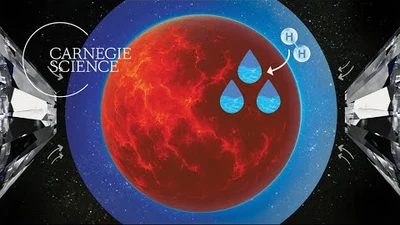
An artist's concept illustrating CArnegie-led laboratory experiments demonstrating that water is naturally created during the planet formation process. By squeezing and heating planetary analog materials between the tips of two diamonds, scientists from Carnegie, IPGP, and UCLA demonstrated that interactions between a young planet's atmosphere and its primitive magma ocean generates water and dissolves hydrogen into the magma melt. This work has major implications for our understanding of planetary habitability and the search for exoplanets that could host life. Credit: Navid Marvi/Carnegie Science.
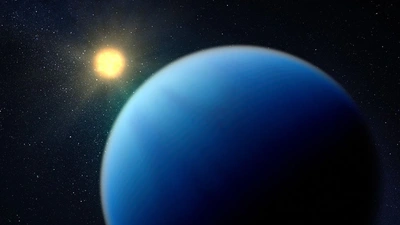
Artist's concept of TOI-421 b
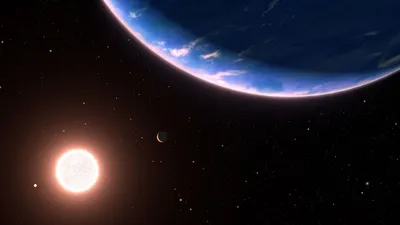
Artist's concept of GJ 9827d
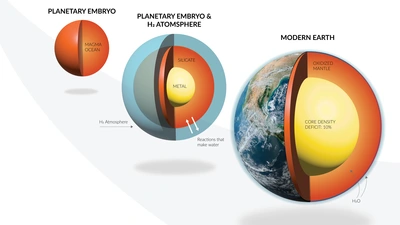
Modeling the planetary embryos of our planet's formative period
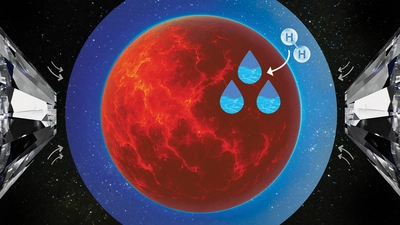
Water is a natural consequence of planet formation
How It Started:
The seed for AEThER was planted when Shahar and Earth and Planets Laboratory colleagues Peter Driscoll, Alycia Weinberger, and George Cody published a 2019 essay in Science urging the research community to recognize the vital importance of a planet’s interior dynamics in creating an environment that’s hospitable for life.
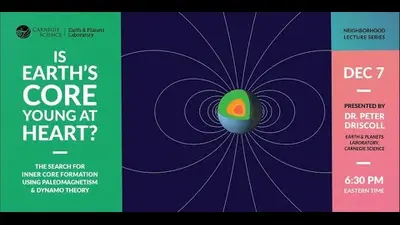
During a 2023 public program on the formative history of Earth’s core, Driscoll—an expert in geophysics and geodynamics—told the audience that our planet’s interior is central to maintaining its habitable surface over billions of years.
If we want to understand rocky planets, in general, and look for an Earth equivalent out there in the Milky Way, he explained, we need to consider how our home world cooled and differentiated into layers after its formation. Two key questions, according to Driscoll are: does mantle convection and melting reach the planet’s surface and can enough heat be transported out its core to drive a magnetic field?
“Earth has plate tectonics, it has liquid water on its surface, and it has had a magnetic field for as long as we can tell,” he said the following year in a Carnegie news video. “And it also has life, of course, and I don’t think these things are coincidences.”
It all starts with the formation process. Planets are born from the rotating ring of dust and gas that surrounds a young star. The elemental building blocks from which rocky planets form—silicon, magnesium, oxygen, carbon, iron, and hydrogen—are universal.
But their abundances and the heating and cooling they experience in their youth will affect their interior chemistry and, in turn, things like ocean volume and atmospheric composition. A global magnetic field may also be needed to shield the atmosphere from the solar wind in order for a planet to retain water for billions of years.
“One of the big questions we need to ask is whether the geologic and dynamic features that make our home planet habitable can be produced on planets with different compositions,” Driscoll explained.
The AEThER project fully kicked into gear when Shahar was selected for an initial grant of $1.5 million from the Alfred P. Sloan Foundation, which was renewed for another $1.5 million in 2025.
This funding enabled Shahar to assemble a team of experts from an array of international research institutions that currently includes Johns Hopkins University, University of Birmingham, MIT, University of Chicago, University of Groningen, UCLA, ETH Zurich, University of Rochester, University of Maryland, IPGP, and NASA Ames.
How It’s Going:
So far, they have published at least 60 papers in major research journals ranging from The Astrophysical Journal and Monthly Notices of the Royal Astronomical Society to Nature and the Journal of Geophysical Research.
This breadth reflects the scope of the undertaking, although much of the early efforts were focused on modeling and several key laboratory experiments.
Shahar and UCLA’s Edward Young, a member of the AEThER team, along with Hilke Schlichting showed that our planet’s water could have originated from interactions between the hydrogen-rich atmospheres and magma oceans of the planetary embryos that comprised Earth’s formative years.
Then she and former Carnegie postdoc Francesca Miozzi, now at ETH Zurich, performed experimental tests of this theory, demonstrating that large quantities of water are created as a natural consequence of planet formation.
These results were compared with atmospheric signals seen of low-mass planets seen by JWST, with water being the most prevalent.
Simultaneously, other experts were bringing together meteorite analysis, studies of planet-forming disks around distant stars, and simulations and experiments to understand how planets obtain other critical raw materials for life, including carbon and nitrogen.
Together, this enables a three-pronged approach to understanding what makes a planet habitable:
- Probing planetary interior dynamics and bulk composition in the lab and using models.
- Observing and characterizing of the diversity of exoplanet atmospheres using space- and ground-based telescopes
- And observational and analytical efforts to understand how planets acquire and retain so-called volatiles—planetary constituents that evaporate easily but are necessary for a planet to be considered capable of hosting life.

AEThER Principal Investigator Anat Shahar kicks off a three-day workshop hosted at the Earth & Planets Laboratory in early 2023.

The AETher team took their first-ever group photograph during a three-day in-person workshop in 2023.

Zhongtian Zhang presents at a three-day AEThER Conference hosted on the Carnegie Science Earth & Planets Laboratory campus in 2024. Throughout the meeting, theorists, observers, experimentalists, planetary scientists, astronomers, and Earth scientists discussed their contributions to the project's goals.

In the summer of 2024, the AEThER team reunited at the Earth & Planets Laboratory for a conference. This group photo was taken on the lawn of Carnegie's Broad Branch Road campus in Washington, D.C.
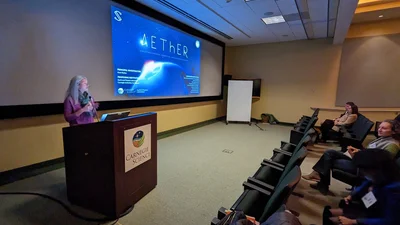
Anat Shahar opens the AEThER workshop in 2023
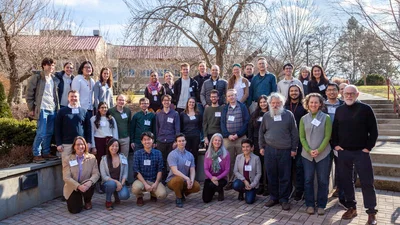
AEThER workshop group photo 2023
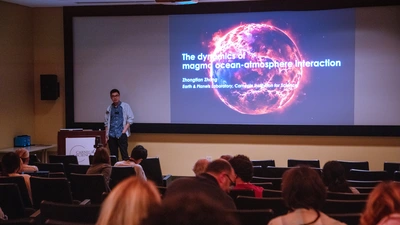
Zhongtian Zhang at 2024 AEThER conference
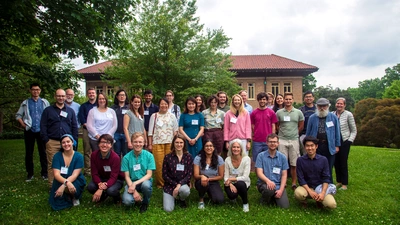
AEThER conference group photo in 2024
A Carnegie Story:
The AEThER project is an ambitious extension of Carnegie’s long-standing excellence in studying every aspect of planets—from their interior dynamics to their atmospheres—in the lab, using sophisticated mathematical models, and at the telescope.
“Atmospheres carry the signals telescopes can measure, but those messages are shaped by deep, often hidden, planetary processes. By building a strategic and considered pathway for experts in complementary disciplines to act in concert, AEThER is creating a field map for distinguishing between atmospheric features of abiotic origin and genuine signs of life,” says Carnegie Science President John Mulchaey.
This work builds on Carnegie’s natural tendency to cross disciplinary boundaries as colleagues from different fields engage in the common areas of the Earth and Planets Laboratory campus in Washington, D.C.
Weinberger, an astronomer, said at a 2024 memorial symposium for legendary Carnegie Science President Maxine Singer that when she joined the institution in 2001, there were just a handful of scientific staff members who thought about exoplanets. But by 2024, that number had tripled to 15, Weinberger noted, in part due to hiring “young, broad-minded and curious scientists, as is the Carnegie way.” But also, because colleagues from other disciplines naturally started collaborating and contributing to exoplanet, planet-formation, and Solar System research.
Now, this type of work touches nearly everyone at EPL and several at the Carnegie Science Observatories, too, she concluded.
Fundamentally, the story of AEThER is an only-at-Carnegie story.
“Carnegie’s commitment to empowering scientific researchers to follow their curiosity where it leads, traverse disciplinary boundaries, and pursue bold new research ideas enables us to establish new opportunities for leadership within the greater scientific enterprise,” Shahar concluded. “The best part? There’s still more great science on the way.”
Carnegie AEThER Team Members















AEThER Bibliography
Scaling laws for the geometry of an impact-induced magma ocean - EARTH AND PLANETARY SCIENCE LETTERS
A Revision of the Formation Conditions of the Vredefort Crater - JOURNAL OF GEOPHYSICAL RESEARCH-PLANETS
Reduced Late Bombardment on Rocky Exoplanets around M Dwarfs - ASTROPHYSICAL JOURNAL LETTERS
CO2 Ocean Bistability on Terrestrial Exoplanets - JOURNAL OF GEOPHYSICAL RESEARCH-PLANETS
Large planets may not form fractionally large moons - NATURE COMMUNICATIONS
The Detectability of Rocky Planet Surface and Atmosphere Composition with the JWST: The Case of LHS 3844b - ASTRONOMICAL JOURNAL
Constraining the Thickness of TRAPPIST-1 b's Atmosphere from Its JWST Secondary Eclipse Observation at 15 μm - ASTROPHYSICAL JOURNAL LETTERS
Rocky Planet or Water World? Observability of Low-density Lava World Atmospheres - ASTROPHYSICAL JOURNAL
Atmospheres as windows into sub-Neptune interiors: coupled chemistry and structure of hydrogen-silane-water envelopes - MONTHLY NOTICES OF THE ROYAL ASTRONOMICAL SOCIETY
Earth shaped by primordial H2 atmospheres - NATURE
Short-lived radioisotope enrichment in star-forming regions from stellar winds and supernovae - MONTHLY NOTICES OF THE ROYAL ASTRONOMICAL SOCIETY
Conclusive Evidence for a Population of Water Worlds around M Dwarfs Remains Elusive - ASTROPHYSICAL JOURNAL LETTERS
The distribution of volatile elements during rocky planet formation - FRONTIERS IN EARTH SCIENCE
An improved model of metal/silicate differentiation during Earth's accretion - ICARUS
Planetary Impacts: Scaling of Crater Depth From Subsonic to Supersonic Conditions - JOURNAL OF GEOPHYSICAL RESEARCH-PLANETS
Fleeting but Not Forgotten: The Imprint of Escaping Hydrogen Atmospheres on Super-Earth Interiors - ASTROPHYSICAL JOURNAL
Toward a Unified Injection Model of Short-lived Radioisotopes in N-body Simulations of Star-forming Regions - ASTROPHYSICAL JOURNAL
Magma Ocean Evolution at Arbitrary Redox State - JOURNAL OF GEOPHYSICAL RESEARCH-PLANETS
Modeling Noncondensing Compositional Convection for Applications to Super-Earth and Sub-Neptune Atmospheres - ASTROPHYSICAL JOURNAL
Under the light of a new star: evolution of planetary atmospheres through protoplanetary disc dispersal and boil-off - MONTHLY NOTICES OF THE ROYAL ASTRONOMICAL SOCIETY
Carbon Cycle Instability for High-CO2 Exoplanets: Implications for Habitability - ASTROPHYSICAL JOURNAL
New Insights into the Internal Structure of GJ 1214 b Informed by JWST - ASTROPHYSICAL JOURNAL LETTERS
Convective shutdown in the atmospheres of lava worlds - MONTHLY NOTICES OF THE ROYAL ASTRONOMICAL SOCIETY
Distinguishing Oceans of Water from Magma on Mini-Neptune K2-18b - ASTROPHYSICAL JOURNAL LETTERS
JWST COMPASS: A NIRSpec/G395H Transmission Spectrum of the Sub-Neptune TOI-836c -ASTRONOMICAL JOURNAL
No Thick Atmosphere on the Terrestrial Exoplanet Gl 486b - ASTROPHYSICAL JOURNAL LETTERS
Thermal and magnetic evolution of an Earth-like planet with a basal magma ocean - PHYSICS OF THE EARTH AND PLANETARY INTERIORS
JWST COMPASS: The 3-5 μm Transmission Spectrum of the Super-Earth L 98-59 c - ASTRONOMICAL JOURNAL
Geodynamics of Super-Earth GJ 486b - JOURNAL OF GEOPHYSICAL RESEARCH-PLANETS
JWST Thermal Emission of the Terrestrial Exoplanet GJ 1132b - ASTROPHYSICAL JOURNAL LETTERS
JWST COMPASS: NIRSpec/G395H Transmission Observations of the Super-Earth TOI-836b - ASTRONOMICAL JOURNAL
Large Interferometer For Exoplanets (LIFE) XIV. Finding terrestrial protoplanets in the galactic neighborhood - ASTRONOMY & ASTROPHYSICS
Not All Sub-Neptune Exoplanets Have Magma Oceans - ASTROPHYSICAL JOURNAL LETTERS
The Cosmic Shoreline Revisited: A Metric for Atmospheric Retention Informed by Hydrodynamic Escape - ASTROPHYSICAL JOURNAL
3D Modeling of Moist Convective Inhibition in Idealized Sub-Neptune Atmospheres - ASTROPHYSICAL JOURNAL
Magma Ocean Interactions Can Explain JWST Observations of the Sub-Neptune TOI-270 d - ASTROPHYSICAL JOURNAL
The Magnetically Induced Radial Velocity Variation of Gliese 341 and an Upper Limit to the Mass of Its Transiting Earth-sized Planet - ASTROPHYSICAL JOURNAL
JWST COMPASS: A NIRSpec G395H Transmission Spectrum of the Super-Earth GJ 357 b - ASTRONOMICAL JOURNAL
Population-level Hypothesis Testing with Rocky Planet Emission Data: A Tentative Trend in the Brightness Temperatures of M-Earths - ASTROPHYSICAL JOURNAL
JWST COMPASS: The First Near- to Mid-infrared Transmission Spectrum of the Hot Super-Earth L 168-9 b - ASTRONOMICAL JOURNAL
Most Super-Earths Have Less Than 3% Water - ASTROPHYSICAL JOURNAL
JWST NIRISS transmission spectroscopy of the super-Earth GJ 357b, a favourable target for atmospheric retention - MONTHLY NOTICES OF THE ROYAL ASTRONOMICAL SOCIETY
Bioverse: Potentially Observable Exoplanet Biosignature Patterns under the UV Threshold Hypothesis for the Origin of Life - ASTROPHYSICAL JOURNAL
Absence of a Runaway Greenhouse Limit on Lava Planets- ASTROPHYSICAL JOURNAL
NcorpiON : A O ( N ) software for N-body integration in collisional and fragmenting systems - NEW ASTRONOMY
Tungsten isotope evolution during Earth's formation and new constraints on the viability of accretion simulations - EARTH AND PLANETARY SCIENCE LETTERS
Self-limited tidal heating and prolonged magma oceans in the L 98-59 system - MONTHLY NOTICES OF THE ROYAL ASTRONOMICAL SOCIETY
Fundamentals of Interior Modelling and Challenges in the Interpretation of Observed Rocky Exoplanets - SPACE SCIENCE REVIEWS
Synthesis of Gold Hydride at High Pressure and High Temperature - ANGEWANDTE CHEMIE-INTERNATIONAL EDITION
A Thick Volatile Atmosphere on the Ultrahot Super-Earth TOI-561 b - ASTROPHYSICAL JOURNAL LETTERS
Present-day Earth mantle structure set up by crustal pollution of the basal magma ocean - SCIENCE ADVANCES
Experiments reveal extreme water generation during planet formation - NATURE
Reliable Detections of Atmospheres on Rocky Exoplanets with Photometric JWST Phase Curves - ASTROPHYSICAL JOURNAL LETTERS
JWST COMPASS: NIRSpec/G395H Transmission Observations of the Super-Earth TOI-776 b - ASTRONOMICAL JOURNAL
Collisional erosion of mantle silicate during accretion can set the elevated Fe/Mg ratio of Earth - ICARUS
Novel Physics of Escaping Secondary Atmospheres May Shape the Cosmic Shoreline - ASTROPHYSICAL JOURNAL
Soot Planets Instead of Water Worlds - ASTROPHYSICAL JOURNAL LETTERS
Water Enrichment of Forming Sub-Neptune Envelopes Limited by Oxygen Exhaustion - ASTROPHYSICAL JOURNAL
Electrical conductivities of (Mg,Fe)O at extreme pressures and implications for planetary magma oceans - NATURE ASTRONOMY
Mantle convection and nightside volcanism on lava world K2-141 b - MONTHLY NOTICES OF THE ROYAL ASTRONOMICAL SOCIETY
Related Public Programs
Planetary Habitability: The Origin of Water - Dr. Anat Shahar
Is Earth’s core young at heart? Search for inner core formation using paleomagnetism & dynamo theory

Come not between a dragon and its wrath | Neighborhood Lecture Series
What makes a planet habitable?
