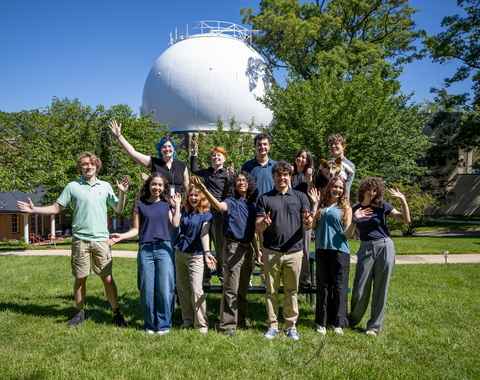
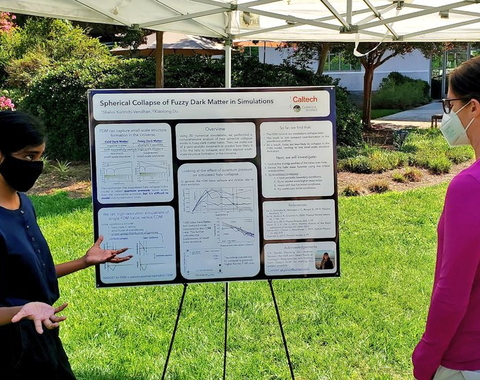
Say "Hello" to the 2026 CASSI Interns

The 2026 CASSI (Carnegie Astrophysics Summer Student Internship) cohort has arrived! This summer, 16 undergraduate students are joining Carnegie Science's Observatories in Pasadena for 10 weeks of paid, hands-on astronomical research, professional development, and the kind of immersive experience that can set the course for a career in astronomy.
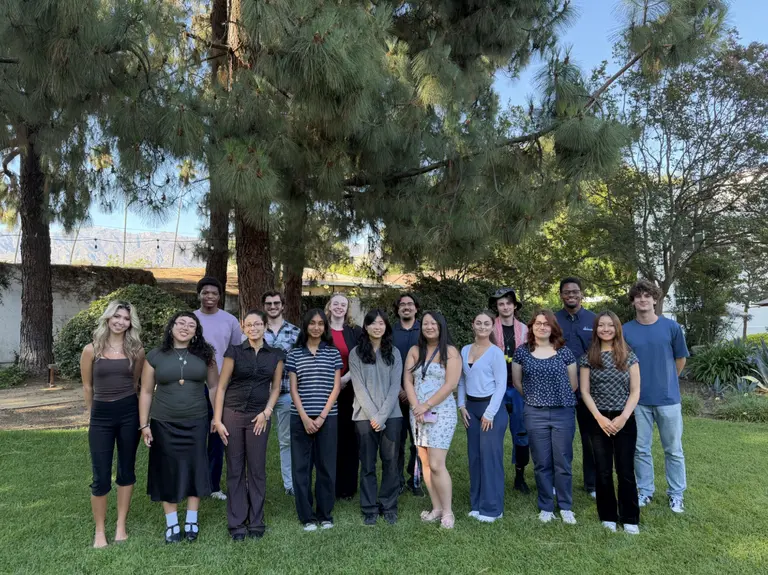
This year's class comes from community colleges, public universities, and private research institutions to work on pressing scientific questions alongside Carnegie astronomers and engineers in Pasadena. Their projects span the cosmos: over the next 10 weeks they'll be hunting for atmospheres escaping distant exoplanets, chasing black holes both modest and monstrous, mapping the gas that flows in and out of galaxies, decoding the lives of stars from dense clusters to dying white dwarfs, and helping to build the instruments that make the next generation of discoveries possible.
Meet the 2026 CASSI Interns
Selassie Ackah
Selassie, a student at Caltech, is working with Andrew Benson to understand how often galaxies like the Milky Way host a pair of bright satellite galaxies like our own Large and Small Magellanic Clouds. The Magellanic Clouds are a familiar sight in the southern sky, but astronomers still don't know whether such close, massive companion galaxies are common or a cosmic rarity. Using computer models that trace how galaxies assemble over billions of years, Selassie will help pin down where the Milky Way falls on that spectrum, uncovering a clue to how typical our galaxy really is.
Kiera Aston
Kiera, also from Caltech, is working with Grace Olivier to hunt for intermediate-mass black holes—an elusive "missing link" between the small black holes left behind by dying stars and the supermassive giants that reside in the centers of all massive galaxies. Astronomers suspect these middleweight black holes may hide in blue compact dwarf galaxies, small and metal-poor systems that resemble the universe's earliest building blocks. By measuring how the light from these galaxies brightens and fades over time, Kiera will help flag the most promising candidates for closer study.
Tosha Babenko
Tosha, from the University of California, Los Angeles, is working with Ava Morrissey to search for hydrogen streaming away from the atmosphere of a young, Neptune-sized planet beyond our Solar System. Young planets are bombarded by intense radiation from their host stars, which can strip away their lightest gases. Catching that escape in the act helps explain why some worlds hold onto thick atmospheres while others are whittled down toward bare rock. Tosha's project is a companion to the helium-escape hunt happening elsewhere in this year's cohort.

Defne Balsari
Defne, a student at Vanderbilt University, is working with Maude Gull to study massive stars locked in tight, fast orbits around a companion—measuring how quickly the two circle each other and mapping where such pairs land on the color-magnitude diagram, the chart astronomers use to track a star's brightness, temperature, and stage of life. Most massive stars are born with at least one partner, and the way these pairs tug on, trade material with, and sometimes collide with one another shapes everything from supernova explosions to the gravitational waves now being detected across the universe.

Krista Caballero
Krista, from the University of California, Santa Barbara, is working with Madeleine McKenzie to investigate when stars in globular clusters—ancient, tightly bound swarms of hundreds of thousands of stars—first begin to show "chromospheric" activity, the magnetic churning in a star's outer layers that drives starspots and flares. Because globular clusters are among the oldest structures in the galaxy, tracing how this activity switches on across different stars opens a window onto both how stars age and how the early Milky Way came together.

Bonnie Chi
Bonnie, from Diablo Valley College, is working with Sunny Wong to model how pairs of magnetic white dwarfs—the dense, Earth-sized embers left when stars like our Sun run out of fuel—gradually spiral toward one another. As these compact partners draw closer, they ripple spacetime with gravitational waves and can eventually merge, making them valuable laboratories for testing physics under extreme conditions and likely targets for future space-based gravitational-wave observatories.
Xavier Cid
Xavier, a student at the University of California San Diego, is working with Keerthi Vasan to map the gas being driven out of galaxies during "Cosmic Noon," the era roughly 10 billion years ago when the universe was forming stars at its furious peak. These outflows—powered by exploding stars and feeding black holes—carry gas and heavy elements out of galaxies and help regulate how quickly they grow. Using the Keck Cosmic Web Imager, Xavier will chart the different temperature phases of this outflowing gas to better understand the forces that shaped galaxies into the ones we see today.
Geronimo! Coffin
Geronimo!, a student at the University of California Santa Cruz, is working with Josh Simon to search for planets orbiting metal-poor stars. These ancient objects formed in the early universe when very little material with elements heavier than helium had been produced. Because we think these elements are needed to build rocky worlds, planets are thought to be rarer around such stars. Finding them would test our ideas about how early in cosmic history planet formation first became possible.
Eric David
Eric, a student at Pasadena City College, is working with Maren Cosens to study stellar feedback—the way newborn stars pump energy, radiation, and material back into the gas clouds around them—in the Milky Way's nearest galactic neighbors, the Magellanic Clouds. This feedback helps decide where and how the next generation of stars forms. Eric will trace it using data from the Local Volume Mapper, a facility built at Carnegie’s Las Campanas Observatory as part of the Sloan Digital Sky Survey’s fifth generation. It captures sweeping, detailed maps of glowing gas across these nearby galaxies.

Charis Hall
Charis, another Caltech student, is working with Mandy Chen to detect the circumgalactic medium—the vast, faint halo of gas surrounding every galaxy that acts as both its fuel reserve and its exhaust. This gas is so dim that Charis will combine, or "stack," observations of many distant quasars taken with the European Southern Observatory’s MUSE instrument, adding their light together to coax out a signal too weak to see in any single image. Mapping this hidden gas helps reveal how galaxies pull in fresh material to keep forming stars.
Inchara Jagadeesh
Inchara, from the University of California Riverside, is working with William Schoenell, Drew Newman, and Gwen Rudie to build an exposure time calculator for MIRMOS, a powerful new infrared instrument being developed for Carnegie's Magellan telescopes in Chile. The tool does essential planning math, telling astronomers how long they'll need to observe a faint, distant target to gather usable data. This essential piece of code will shape how efficiently the entire instrument gets used once it sees first light.
Esther Kim
Esther, also from the University of California, Santa Cruz, is working with Jack Piotrowski to build and test a metrology system for a new instrument project called Via, which will reveal the Milky Way’s galactic halo in unprecedented detail. The metrology system will keep the telescope's optics and instruments aligned to within a fraction of a hair's width, enabling sharp, trustworthy data.
Julia Mirani
Julia, a student at the College of San Mateo, is working with Kiersten Boley to measure the chemical makeup of stars known to host planets and use it to infer what those planets look like deep inside. Because a planet and its star condense from the same cloud of material, a star's elemental "fingerprint" offers clues to a planet's hidden interior, including its core, its mantle, even its capacity to hold water.
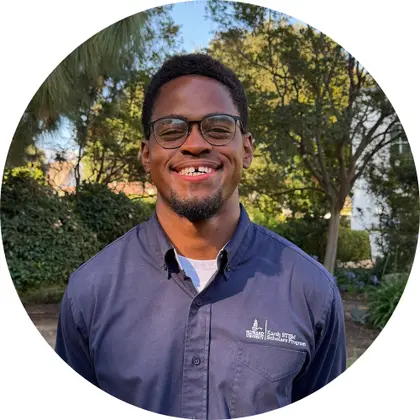
Melusi Ngeleka
Melusi, a student at Howard University, is working with Samantha Wu to model the radio waves produced when a black hole tears apart a passing star in a violent flash astronomers call a tidal disruption event, or TDE. As the shredded stellar material swirls into a disk and flings out high-speed jets and winds, it can glow brightly in radio waves, and modeling that emission helps reconstruct what happens in the chaotic environment around a feeding black hole.

Eliana Schiller
Eliana, a student at the University of Chicago, is working with Steve Shectman—who designed and built the twin Magellan telescopes at Carnegie’s Las Campanas Observatory in Chile—on the mechanical structure of a new spectrograph called FALCON. Spectrographs split incoming light into its component colors, the key to revealing what distant objects are made of, how fast they're moving, and how far away they are. Designing the rigid framework that holds it rock-steady is essential to making those measurements reliable.
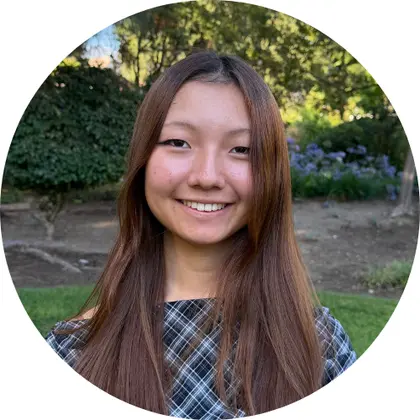
Gwyneth Tenn
Gwyneth, from the University of Southern California, is working with Jessica Spake, who in 2018 made the first-ever detection of helium escaping an exoplanet's atmosphere, to look for that same telltale leaking helium around a young, Neptune-sized world. Tracking how quickly young planets shed their atmospheres helps untangle one of the biggest puzzles in exoplanet science: why planets of certain sizes are common while others are strangely rare.