Biophysicist Moh El-Naggar named Carnegie’s second Biosphere Sciences and Engineering Director

Pasadena, CA—Biophysicist and microbiologist Mohamed “Moh” El-Naggar—who investigates how microbes exchange energy and electrons with their environments—will lead Carnegie Science’s Biosphere Sciences and Engineering division, which just completed a major milestone in its relocation to Southern California, where biologists are in the process of setting up new labs on the Caltech campus.
This move represents the final stage of Carnegie’s long-planned consolidation of its biology division in Pasadena and evolution of its research partnership with Caltech. First announced in 2020 and finalized in 2023, the expanded alliance between Carnegie Science and Caltech was conceived to strengthen the two institutions’ historical collaborations in astronomy and the physical sciences, advance bold new directions in the life sciences, and burnish the greater Los Angeles area’s reputation as a hub for high-impact research.
El-Naggar—who will join Carnegie Science in October, while retaining a faculty appointment at USC where he is a Dean's Professor of Physics and Astronomy and Professor of Physics, Chemistry, and Molecular and Cellular Biosciences—will complement and enhance Carnegie’s efforts in biology at this critical juncture.
“I am thrilled to welcome Moh as our new BSE Director,” said Carnegie Science President John Mulchaey. “His interdisciplinary background perfectly aligns with our strategic vision for maintaining Carnegie’s longstanding leadership within the scientific enterprise. His bold approach to pursuing cutting-edge questions means he has the expertise to help us build on our 124-year tradition of excellence in biology and open up exciting new avenues of research at Carnegie.”
After joining Carnegie Science in October, El-Naggar will maintain his collaborations with the USC Dornsife College of Letters, Arts, and Sciences, where his research group investigates microbial electron transfer and “living electronics,” and he will continue to advise USC graduate students and postdoctoral researchers.
El-Naggar’s appointment builds on a longstanding relationship between Carnegie Science and USC. In astronomy, the two institutions have developed a close research partnership that includes the Carnegie-USC Graduate Fellowship, through which USC doctoral students conduct thesis research alongside Carnegie astronomers in Pasadena. The fellowship currently includes 12 USC students and could potentially be expanded in the future to welcome those in the biological sciences.
As a Caltech alumnus who completed his Ph.D. in 2007, El-Naggar already has strong relationships with the institute’s faculty and is well positioned to help bring to fruition deeper collaborations between Carnegie and Caltech.
Six BSE Staff Scientists have already been appointed to joint Faculty Associate positions at Caltech’s Biology and Biological Engineering and Geological and Planetary Sciences divisions. Two of these are BSE Staff Scientists who arrived early in Carnegie’s consolidation process already have fully functioning research operations in place, studying marine biogeochemistry and probing symbiotic relationships between squid and bioluminescent bacteria that reside in their guts.
Three Caltech graduate students have passed through Carnegie’s labs so far and one lab has an incoming Caltech Stanback Fellow. Other BSE Staff Scientists are in the process of standing up their local research facilities, where they will probe microbial community dynamics, photosynthetic efficiency, ecosystems responses to a changing climate, and more.


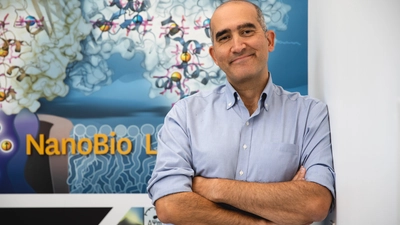
Moh El-Naggar outside his USC lab. Photo is courtesy of Olga Burymska/USC.
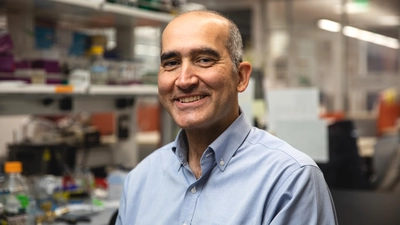
Moh El-Naggar in a laboratory setting. Photo courtesy of Olga Burymska/USC.
After completing his Ph.D. at Caltech (under the late David Goodwin, a professor of mechanical engineering and applied physics), El-Naggar’s USC career began with a postdoctoral fellowship in 2006, followed by a faculty appointment in 2009. He also previously served as divisional dean in Natural Sciences and Mathematics and interim dean of the university’s Dornsife College of Letters, Arts, and Sciences, which was when he first connected with Carnegie researchers.
His research team investigates electron transfer and energy conversion in living organisms, particularly the chemical and energetic interactions that occur when bacterial communities interface with rocks and minerals. These intersections between biological processes and biogeochemical cycles underpin a new understanding of how our Earth System is shaped by microbial dynamics.
More recently, El-Naggar’s research team has focused on “living electronics”—the possibility of building programmable cells that can be integrated into traditional electronics.
Although the reactions and processes his team studies are microscopic, their work has major implications for origins-of-life research, as well as sustainable energy and environmental remediation. This background makes El-Naggar the perfect fit for refining and developing Carnegie’s Blueprint for Discovery, linking the synthesis of molecules in stellar forges to the formation and evolution of planets and the conditions that enabled life to arise, thrive, and shape our world in turn.
“The Carnegie model has long empowered top scientific minds to take deep intellectual risks, sparking breakthroughs that rewrote the textbooks,” said El-Naggar. “As biology becomes more quantitative and collaborative, we enter an era of convergence where the biggest questions defy boundaries. Uniting our teams in Pasadena positions us to drive fundamental biology forward and tackle our most pressing challenges: the health of our planet and its inhabitants. I am thrilled to lead this next chapter—honoring Carnegie’s legendary past by taking on the defining frontiers of our future.”


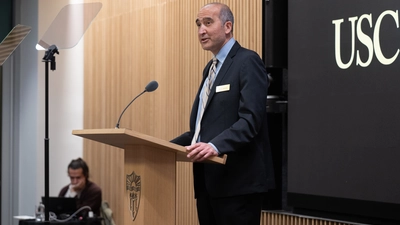
Moh El-Naggar gives remarks at an event in Washington, D.C. Photo is courtesy of USC Dornsife.
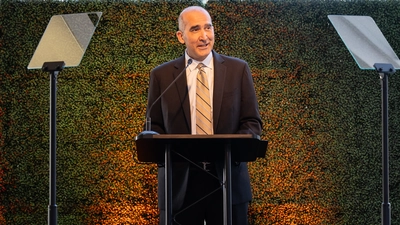
Moh El-Naggar gives remarks at a Silicon Valley event. Photo is courtesy of USC Dornsife.
From their new home base in Pasadena, Carnegie scientists under El-Naggar’s leadership will address some of the most fundamental questions about the interconnected nature of life on Earth, linking genomes to ecosystems and community dynamics to planet-scale processes.
As it enters its next phase, the Carnegie-Caltech alliance reflects a mutual commitment to develop research programs in Pasadena that will better promote collaboration between Carnegie and Caltech.
“We are delighted that Moh is returning to the Caltech campus,” said Caltech Provost David Tirrell. “His multidisciplinary approach to science is a perfect fit for both Carnegie and Caltech, and the right foundation for building our institutional partnership for the future.”
Collaboration between Carnegie and Caltech scientists is already robust in part due to two joint postdoctoral fellowship programs—the Carnegie-Caltech Brinson Fellowship in Observational Astronomy and the Carnegie-Caltech Theoretical Astrophysics Fellowship. Additionally, the Carnegie Science Observatories and Caltech collaborate extensively on outreach efforts as key facilitators of Pasadena’s City of Astronomy programs.
Looking ahead, the expanded alliance will provide new opportunities to build on decades of intersecting work in the physical sciences and advance a new approach studying the natural world.
Furthermore, the potential for an expansion of Carnegie’s ongoing relationship with USC, facilitated by El-Naggar, would help grow Carnegie’s already strong reputation as a connection-building institution where new fields of investigation are defined and cross-disciplinary, multi-institution projects can flourish.
“Moh is an extraordinary scientist whose work has always crossed traditional boundaries, bringing together physics, chemistry, and biology to tackle fundamental questions,” said James Bullock, dean of the USC Dornsife College of Letters, Arts and Sciences. "By remaining an important part of the USC Dornsife scientific community as he takes on this ambitious new role, he will help bring our already closely connected scientific communities even closer together.”
Additionally, BSE’s ongoing presence in Pasadena will enable Carnegie to expand upon existing relationships with the Jet Propulsion Laboratory, The Huntington, and other local research organizations, making a powerful contribution to Southern California’s robust intellectual ecosystem.
“Carnegie is committed to leading bold new research endeavors that will empower our scientists to expand the frontiers of knowledge and build new connections across the greater Los Angeles research community,” Mulchaey concluded. “I am confident that Moh’s skills as a pioneering scientist and veteran administrator will help us achieve these crucial goals.”
