Object 26 | Sunspot Drawings

Past the thick vault door, in the solar section of Carnegie Science's Plate Archives, stands a wall of large wooden cabinets. Swing open one of the doors and you'll find long, narrow binders filled with sheets of white paper, each one covered in careful pencil drawings that together trace the restless surface of our life-giving star. There are tens of thousands of drawings, stacked and labeled, reaching back to January 4, 1917.
The drawings document sunspots: darker, cooler regions on the surface of the Sun, where intense magnetic activity suppresses the normal upward flow of hot gas, leaving areas that appear as dark freckles against the blazing photosphere. Sunspots follow an 11-year cycle, growing in number during solar maximum—when the Sun's magnetic poles reverse and its surface becomes speckled with spots—and nearly vanishing during solar minimum. The pencil drawings in Carnegie's Plate Archives document those movements over more than a century, day by day.
A pencil drawing on paper may seem primitive, but these Mount Wilson sunspot drawings are irreplaceably valuable to researchers from NASA and elsewhere, because of their length and consistency. Taken together, they constitute the longest continual record of sunspot activity with magnetic data ever made, and the 26th object in our #Carnegie125 series.

Taken together, the sunspot drawings constitute the longest continual record of sunspot activity with magnetic data ever made, and the 26th object in our #Carnegie125 series. Credit: Carnegie Science

Past the thick vault door, in the solar section of Carnegie Science's Plate Archives, stands a wall of large wooden cabinets holding the sunspot drawings. Credit: Carnegie Science

Swing open one of the doors and you'll find long, narrow binders filled with sheets of white paper, each one covered in careful pencil drawings that together trace the restless surface of our life-giving star. Credit: Carnegie Science

There are tens of thousands of sunspot drawings, stacked and labeled, reaching back to January 4, 1917. Credit: Carnegie Science
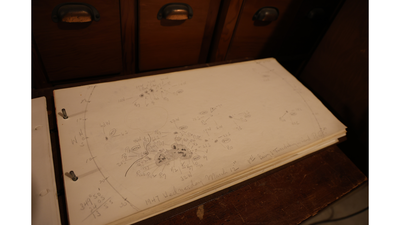
Sunspot Drawing
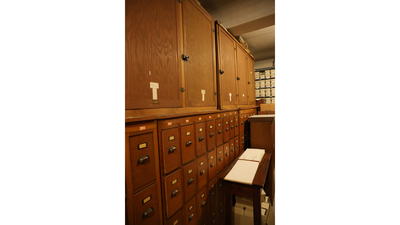
Plate Archives
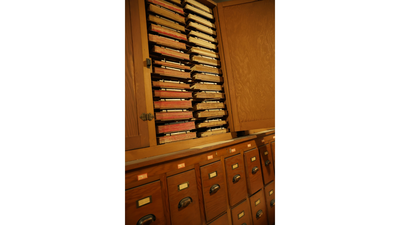
Binders
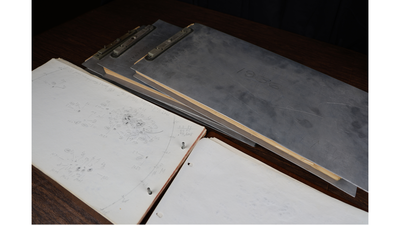
Sunspot Drawings
Hale and the Mount Wilson Solar Observatory
Carnegie's Mount Wilson Observatory was founded in December 1904 by George Ellery Hale, an astronomer of rare ambition who convinced the institution to fund his vision for a solar astrophysical observatory in the mountains above Pasadena. Though the observatory would become home to the optical telescopes that enabled Edwin Hubble and other Carnegie experts to transform our understanding of the universe, its original name, “Mount Wilson Solar Observatory,” reflected Hale’s initial focus on solar research.
A spectroscopic laboratory and three solar telescopes rose quickly on the mountain: the Snow Telescope, then the 60-foot tower, then the great 150-foot tower, which was completed in 1912. Each extended Hale's capacity to peer at the solar surface and decode what he found there.
Hale, who had been fascinated by sunspots since he was a child and projected them onto a piece of white cardboard attached to his first telescope, a 4-inch device, set to work exploring their mysteries. He would write: “No archaeologist, whether Young or Champollion deciphering the Rosetta Stone, or Rawlinson copying the cuneiform inscription on the cliff of Behistun, was ever faced by a more fascinating problem than that which confronts the solar physicist engaged in the interpretation of the hieroglyphic lines of sunspot spectra.”
In late June 1908, using Mount Wilson’s 60-foot tower, Hale documented something no one had observed before: the Zeeman effect in a sunspot. The Zeeman effect is a phenomenon in which a spectral line splits into several components in the presence of a magnetic field. Hale had discovered magnetic fields in sunspots—the first ever detected beyond Earth.
The 150-foot tower, with its 17-inch solar image and powerful Littrow spectrograph, designed to study the position, strength, and polarity of magnetic fields, allowed Hale to push the field further. In 1914, he discovered that sunspot polarities in the Sun’s northern and southern hemispheres reverse from one solar cycle to the next. Thus, revealing that the full solar magnetic cycle takes 22 years—today referred to as the Hale cycle—not 11, to complete. Subsequent work with fellow Carnegie astronomer Seth Nicholson confirmed a consistent pattern of polarity alignment in sunspot pairs that switched orientation with each cycle. The finding became known as the Hale-Nicholson law, and it remains a foundational principle of solar physics to this day.

Andrew Carnegie and George Ellery Hale in front of the 60-inch telescope at Mount Wilson Observatory in 1910. Carnegie's Mount Wilson Observatory was founded in December 1904 by Hale, an astronomer of rare ambition who convinced the institution to fund his vision for a solar astrophysical observatory in the mountains above Pasadena. Credit: Carnegie Science/Huntington Library

Aerial view of Mount Wilson Observatory in 1932. Though the observatory would become home to the optical telescopes that enabled Edwin Hubble and other Carnegie experts to transform our understanding of the universe, its original name, “Mount Wilson Solar Observatory,” reflected Hale’s initial focus on solar research. Credit: Carnegie Science/Huntington Library

George Ellery Hale at the spectrograph of the 60-foot solar tower telescope, Mount Wilson Observatory, circa 1908. In late June 1908 Hale documented something no one had observed before: the Zeeman effect in a sunspot. He had discovered magnetic fields in sunspots—the first ever detected beyond Earth. Credit: Carnegie Science/Huntington Library
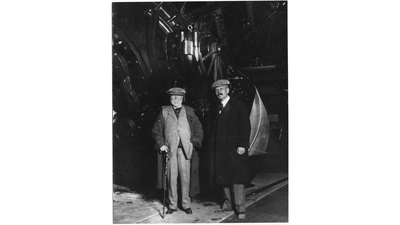
Carnegie and Hale
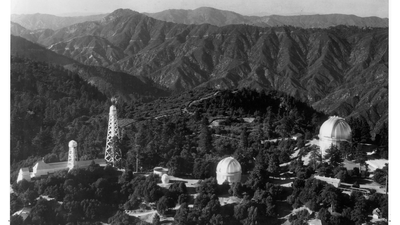
Mount Wilson Observatory
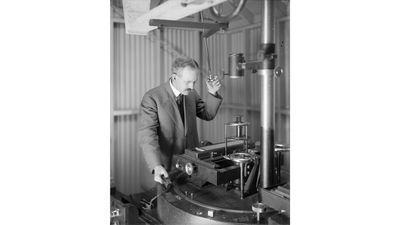
Hale at Spectrograph
A Daily Record Begins
To track the polarities of sunspots and follow how they changed from day to day and cycle to cycle, Hale needed a systematic record. And so, early in 1917, a program of daily sunspot drawings was begun at the 150-foot tower.
The first drawing was made on January 4, 1917, by Ferdinand Ellerman, one of Carnegie’s original solar astronomers. Ellerman sat at the drawing table at the base of the tower and traced the sunspots projected onto his paper by the Sun's own light. With this first sunspot drawing, he produced a hand-drawn document of the solar disk as it appeared that day, marked with the position, shape, and magnetic character of each spot he could see.
The daily program of recording sunspots in this manner has continued at Mount Wilson, with few interruptions, ever since.

The 150-foot tower telescope at Mount Wilson Observatory, circa 1925. To track the polarities of sunspots and follow how they changed from day to day and cycle to cycle, Hale needed a systematic record. And so, early in 1917, a program of daily sunspot drawings was begun at the 150-foot tower. Credit: Carnegie Science/Huntington Library

Sunspots photographed from Mount Wilson Observatory. The sunspot drawings document these darker, cooler regions on the surface of the Sun, where intense magnetic activity suppresses the normal upward flow of hot gas, leaving areas that appear as dark freckles against the blazing photosphere. Credit: Carnegie Science

The first Mount Wilson Observatory sunspot drawing, made on January 4, 1917, by Ferdinand Ellerman, one of Carnegie’s original solar astronomers.
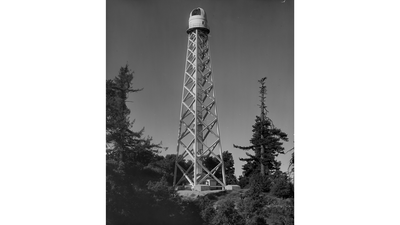
150-foot Tower
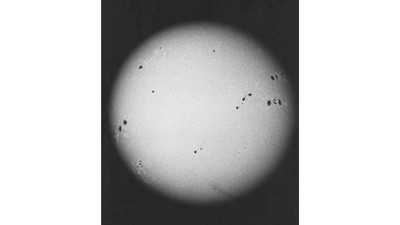
Sunspots
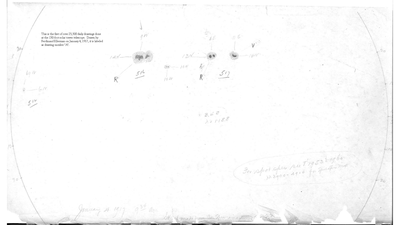
First Drawing
Tracing the Sun
The process begins at the top of the 150-foot tower. The observer rides an open-air elevator to the summit to adjust the two flat mirrors that track the Sun and reflect its light down the shaft to the observing room below. Back on the ground, the solar image arrives as a 17-inch disk of light on the drawing table. There the observer picks up a pencil and draws.
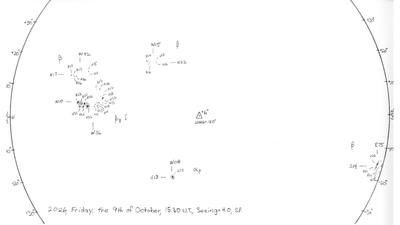
Each drawing is made on a standard sheet of 25.5-by-50-centimeter paper, with solar north at the top and solar east to the right. The observer traces both the umbra, the dark central core of each sunspot, and the penumbra, its lighter surrounding halo. The drawing covers the central band of the solar disk, from about 35 degrees north to 35 degrees south, where sunspots predominantly appear; spots at higher latitudes are captured in small annotated inset boxes. Notations on each sheet include the date and time of observation, the observer's initials, and a rating of atmospheric seeing conditions. Once the drawing is complete, the observer measures the magnetic field strength and polarity of each spot using a spectrograph, annotating those readings directly onto the paper.
The earliest drawings were less precise, intended only as guides to identify which spots had been measured. Hale and Nicholson themselves acknowledged in their 1938 publication of the first decades of data that the drawings should be considered approximate. Over time, as the collection grew and the observers developed a sense of pride in the effort, the drawings accumulated rich detail and accuracy.

Ferdinand Ellerman at the focus of the 150-foot tower at Mount Wilson Observatory, circa 1920. With this first sunspot drawing in 1917, Ellerman produced a hand-drawn document of the solar disk as it appeared that day, marked with the position, shape, and magnetic character of each spot he could see. Credit: Carnegie Science/Huntington Library

Ferdinand Ellerman and two passengers riding the bucket to the top of the 150-foot tower at Mount Wilson Observatory, circa 1925. The sunspot drawing process begins at the top of the 150-foot tower. The observer rides an open-air elevator to the summit to adjust the two flat mirrors that track the Sun and reflect its light down the shaft to the observing room below. Credit: Carnegie Science/Huntington Library

Ferdinand Ellerman at the coelostat on top of the 150-foot tower telescope at Mount Wilson Observatory in 1925. Credit: Carnegie Science/Huntington Library
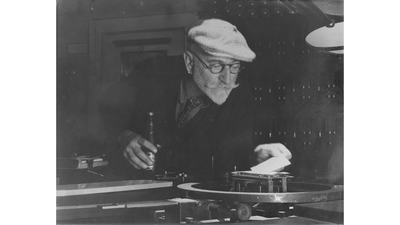
Ellerman at Focus
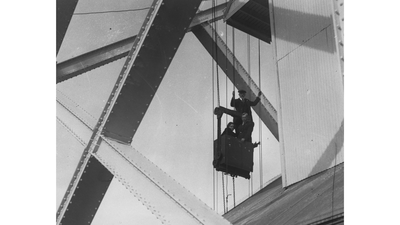
Ellerman in Elevator
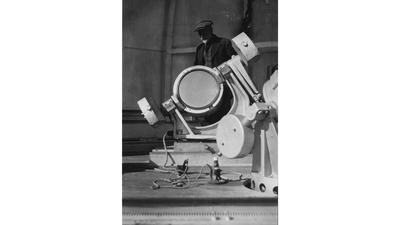
Ellerman Adjusts Mirrors
The Record Continues
Mount Wilson's solar program remained active for decades, even as the observatory dropped “Solar” from its name in 1917 and expanded increasingly into peering at objects beyond the bounds of our own Solar System. Carnegie observers including Joseph O. Hickox, Thomas A. Cragg, and Larry Webster, kept the sunspot drawing program going for almost 70 years.
But in 1984, Carnegie Science announced it would relinquish management of the historic telescopes on Mount Wilson, which were no longer suited to deep-sky observing in the light-polluted skies above Los Angeles, and moved its astronomy research to Carnegie’s Las Campanas Observatory in Chile. Management of the observatory was turned over to the Mount Wilson Institute. A memorandum of understanding between Carnegie Science and UCLA signed in late 1985 ensured that the solar program could continue at the 150-foot tower, with UCLA taking over day-to-day operations of the telescope.

Joseph O. Hickox viewing a solar image in the 150-foot tower at Mount Wilson Observatory in 1949. Carnegie observers including Joseph O. Hickox, Thomas A. Cragg, and Webster, kept the sunspot drawing program going for almost 70 years. Credit: Carnegie Science/Huntington Library

Larry Webster and Robert Howard at the magnetograph in the 150-foot tower at Mount Wilson Observatory in 1979. Credit: Carnegie Science/Huntington Library
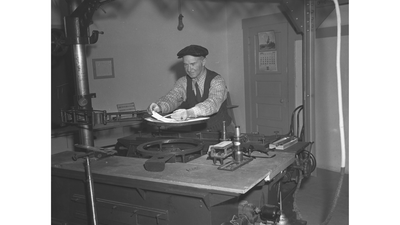
Hickox
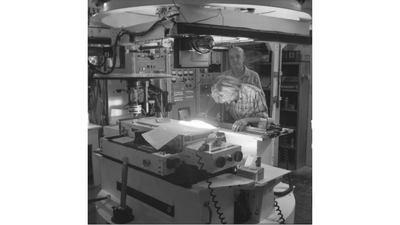
Webster and Howard
Today, the program of daily sunspot drawings continues, carried forward by a single observer, Steve Padilla, who this year celebrated his fifth decade working as a solar astronomer on the mountain.
Padilla first came to the mountain as a Carnegie solar observer in August 1976, then one of three observers who alternated runs at the150-foot tower and time at the Carnegie Observatories's Pasadena offices working with solar data. After Carnegie’s withdrawal from Mount Wilson, Padilla stayed with the solar program, working for many years as a UCLA solar astronomer at Mount Wilson before transitioning to a volunteer role in 2014. For half a century—excluding a brief interlude in the early 2000s— he has continued the tradition that Ellerman began. In addition to keeping the sunspot program going, Padilla also shares the history of the 150-tower and provides demonstrations as a part of Mount Wilson Institute’s outreach and public programming efforts. "In a way," he has said, "you could say these drawings are a little daily work of art."
Each clear morning on Mount Wilson, Padilla rides the open elevator to the top of the 150-foot tower to adjust the mirrors, before returning to the observing room to trace the day’s sunspots. Each sheet Padilla produces joins tens of thousands of others in Carnegie Science’s Plate Archives, pencil drawings that stretch from 1917 to the present day, recording the rise and fall of solar cycles across generations of observers. The collection has been digitized and is available online to researchers and the curious through the Mount Wilson Observatory website.

Steve Padilla creating a sunspot drawing in the 150-foot tower at Mount Wilson Observatory. Today, the program of daily sunspot drawings continues, carried forward by a single observer, Padilla, who this year celebrated his fifth decade working as a solar astronomer on the mountain. Credit: Courtesy of Steve Padilla

A recent sunspot drawing created by Steve Padilla. Each clear morning on Mount Wilson, Steve Padilla rides the open elevator to the top of the 150-foot tower to adjust the mirrors, before returning to the observing room to trace the day’s sunspots.

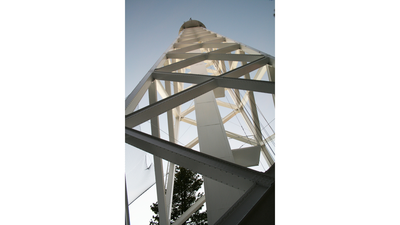
The 150-foot tower at Mount Wilson Observatory. In addition to keeping the sunspot program going, Steve Padilla also shares the history of the 150-tower and provides demonstrations as a part of Mount Wilson Institute’s outreach and public programming efforts. Credit: Carnegie Science
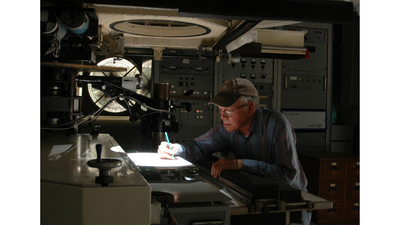
Steve Padilla
Padilla Sunspot Drawing
150-foot Tower
More Than Pencil and Paper
Reflecting on his work, Padilla notes that: “when people come up here they're kind of perplexed in a way that this old traditional drawing still gets done. There's something curious about it. People say, ‘Well, why don't you just take a picture of the image?’ But there's more to it than that. There's information in the fact that we've done it for 109 years in the same way, with consistency, with the same telescope. As a long term data set, even in the simple form of information there, there's value to that.”
Long-term studies are central to solar cycle science, and the sunspot drawings tucked away in the Carnegie Plate Archives offer experts a way to draw from the same dataset, collected consistently in the same way, for more than a hundred years.
The first sheet, drawn by Ellerman in January 1917, dates to Carnegie's founding era of solar astronomy, when Hale's discoveries were reshaping our understanding of the Sun. The tens of thousands of drawings that followed, now stacked in those wooden cabinets, document the Sun's behavior across more than a century of cycles. What began as Hale's effort to understand the nature of sunspots has become an irreplaceable scientific record, one that continues to grow thanks to the efforts of Steve Padilla on every clear morning over Mount Wilson.