Object 29 | Pyrex Glass

This Thanksgiving, when homemade goods from steaming apple pies to gooey mac and cheese come out of ovens across the country, many of these seasonal favorites will be found in Pyrex glass dishes. Few cooks and bakers would guess that the story of those dishes runs through a laboratory built to study our planet’s depths. More than a century ago, Corning Glass Works made its first household product, a pie plate, from the new heat-resistant glass it would soon sell as Pyrex. Behind that glass were years of work by Corning researchers with some help from an unexpected source: Arthur L. Day, the first director of Carnegie Science's Geophysical Laboratory.
Pyrex is Object 29 in our #Carnegie125 series. Developed in Corning’s laboratories, it built on basic research by Day and his colleagues into how rocks melt and form at extreme temperatures, the kind of knowledge Corning needed to make glass that could take the heat. It’s a good example of how basic research aimed at understanding the natural world can end up somewhere no one planned, even on the Thanksgiving table.

Eight of the first twelve pieces of Pyrex-brand ovenware, released in 1915. Few cooks and bakers would guess that the story of Pyrex dishes runs through a laboratory built to study our planet’s depths. Credit: The Corning Museum of Glass

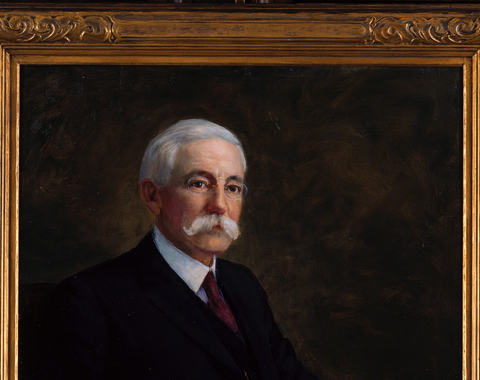
Behind Pyrex glass were years of work by Corning researchers with some help from an unexpected source: Arthur L. Day, the first director of Carnegie Science's Geophysical Laboratory. Credit: Carnegie Science
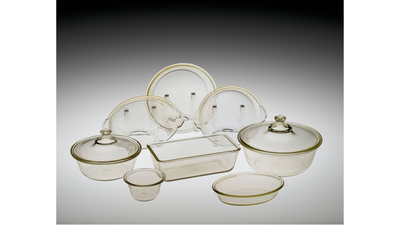
Pyrex-brand ovenware
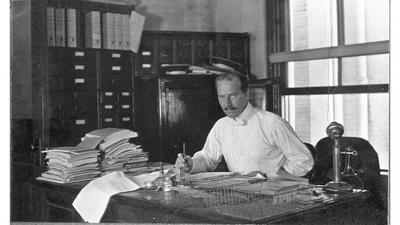
Arthur Day
A laboratory for the planet's interior
Carnegie Science’s Geophysical Laboratory was established in 1905 to investigate fundamental questions about how rocks form under the heat and pressure found deep within the Earth. Under Day’s direction, the young laboratory’s physicists, chemists, and geologists used furnaces and high-pressure apparatus to study silicates, the silicon-and-oxygen compounds that dominate the Earth's crust.
As historian Regina Lee Blaszczyk wrote in "Imagining Consumers: Manufacturers and Markets in Ceramics and Glass, 1865-1965": “The Geophysical Laboratory’s directive for investigating the structure and formation of the Earth's crust meant that its staff…collectively possessed the most comprehensive understanding of silicate chemistry under one roof in the nation.” The laboratory didn’t keep what it learned to itself. Its scientists published their results in a steady stream of papers, which were readily available to other scientists and anyone else who could use them.
The glass industry was a natural, if unplanned, beneficiary of that research. The main components of commercial glass are silica, soda, and lime, which are among the most common oxides in the Earth's crust. Glassmaking comes down to melting these materials and controlling how they cool; adjusting the ingredients, even slightly, changes the glass's character. It turns out that understanding how molten rock behaves also means understanding glass.

Arthur Day and his colleague E. S. Shepherd experiment using an electric arc furnace, circa 1906. Carnegie’s Geophysical Laboratory was established in 1905 to investigate fundamental questions about how rocks form under the heat and pressure found deep within the Earth. Credit: Carnegie Science

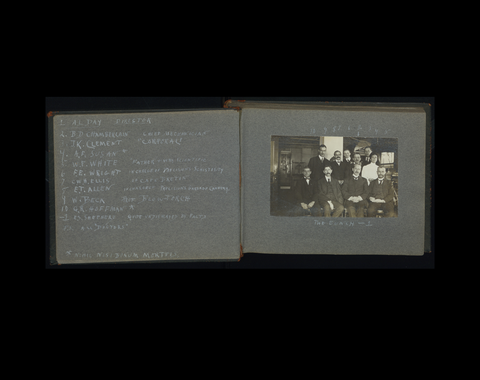
The initial staff members of the Geophysical Laboratory, circa 1906. Under Day’s direction, the young laboratory’s physicists, chemists, and geologists used furnaces and high-pressure apparatus to study silicates, the silicon-and-oxygen compounds that dominate the Earth's crust. Credit: Carnegie Science

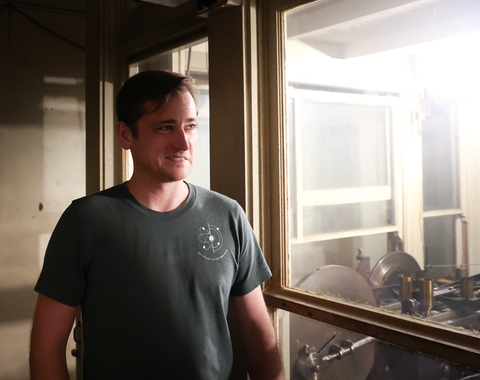
View of Arthur Day’s Carnegie laboratory with gas thermometer furnace left of center. The glass industry was a natural, if unplanned, beneficiary of Day’s research. It turns out that understanding how molten rock behaves also means understanding glass. Credit: Carnegie Science
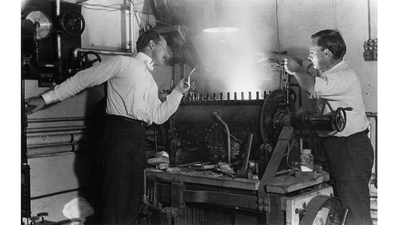
Experiment
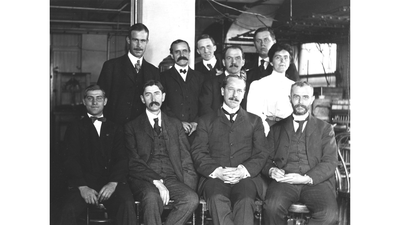
Staff
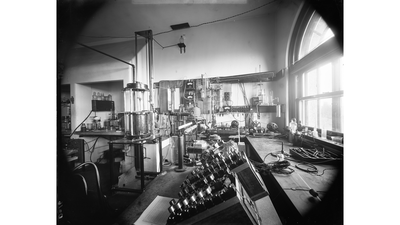
Laboratory
A geophysicist in the glassworks
Before joining the Geophysical Laboratory, Day trained in physics at Yale University, spent several years at Germany's Imperial Institute of Physics and Technology, and worked at the U.S. Geological Survey, where he measured the melting points of rock-forming minerals and published influential work on feldspar and silica. As Blaszczyk noted, in the early 1900s “few persons in the United States understood the chemical and physical behavior of the silicates under high temperatures better than Arthur Day.”
That expertise appealed to Corning, whose managers were eager to bring scientific methods to glassmaking, then still more of a craft than a science. Around 1905, a former Yale classmate of Day’s, George Buell Hollister, then a production manager at Corning, suggested bringing Day in as a technical consultant. One of Day’s first contributions was installing thermocouples in the pots where the glass was melted, which let the company track the temperature of its melts precisely–reportedly the first time such instruments had been used in American manufacturing.
It was the beginning of a 30-year collaboration. Day would continue to advise Corning until his retirement from Carnegie in 1936, bringing to the glassworks what he was learning in the laboratory.
Day took on the challenge of devising better inner globes for the Corning arc lamps that lit city streets, experimenting with hard, heat-tolerant glasses that combined silica with boric oxide. Meanwhile, at the Geophysical Laboratory, he and his Carnegie colleague E. S. Shepherd co-authored an early, influential study of quartz glass in 1906, exploring the potential capabilities of glass rich in silica.
That same year, Corning's own staff took Day’s research in a new direction and used it to make lantern globes tough enough for the railroads, which needed glass that could survive storms, freezing nights, and the sudden shock of temperature swings. The result, marketed in 1909, was Nonex, short for "non-expansion" glass. As Blaszczyk put it, Day “used his knowledge of silicate chemistry to unlock doors to the mysteries of high-temperature mineral behavior, allowing Corning’s scientists to develop stronger and more stable glasses.”
Day helped shape Corning’s own research program, too. In 1908 he persuaded Eugene C. Sullivan, a friend and former U.S. Geological Survey colleague, to lead the company’s chemical laboratory, which grew into one of the country’s early industrial research labs. Decades later, the glass technologist Frank W. Preston credited the pair, Day for his research at the Geophysical Laboratory and Sullivan for his work at Corning, with “laying the foundations of American glass technology.”

Corning's own staff took Day’s research in a new direction and used it to make lantern globes tough enough for the railroads, which needed glass that could survive storms, freezing nights, and the sudden shock of temperature swings. Credit: Corning Incorporated Department of Archives & Records Management, Corning, NY

The glass technologist Frank W. Preston later credited Arthur Day (left) for his research at the Geophysical Laboratory and Eugene C. Sullivan (right) for his work at Corning, with “laying the foundations of American glass technology.”
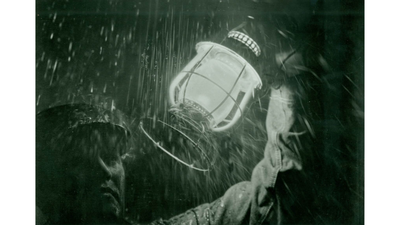
Railroad lantern
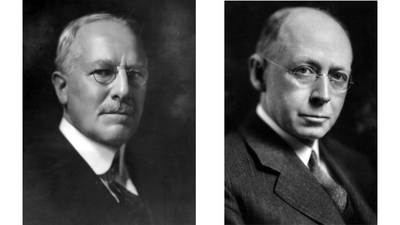
Day and Sullivan
Glass that could survive an oven
The railroad globes turned out to be almost too successful. They broke so rarely that sales of replacements began to fall, and Corning went looking for new uses for its tough glass. Household goods seemed like a natural fit. Thanks in part to Day's research, Corning already knew how to make glass that could survive an oven.
Some of the earliest kitchen tests took place in a Corning employee's home. In 1913, after an earthenware casserole cracked in her oven, Bessie Littleton asked her husband, Jesse, a physicist who had just joined Corning as its physical research lead, to bring home something sturdier. She baked a sponge cake in the cut-down bottom of a battery jar made from the company's heat-resistant glass and was struck by how evenly it cooked. Over the following weeks she put the glass through the paces, cooking everything from steak to custard in whatever jars and lamp parts the glassworks could spare.
Sullivan and his Corning colleague William C. Taylor spent the next two years perfecting the product, including developing a lead-free formula safe for food. In 1915, the initial line of a dozen Pyrex glass dishes went on sale. The line launched a new consumer products division for the company, and Pyrex went on to become an icon in American kitchens.

Jesse T. and Bessie “Becky” Littleton in 1912. Thanks in part to Day's research, Corning already knew how to make glass that could survive an oven. Some of the earliest kitchen tests took place in the home of Corning’s physical research lead Jesse Littleton and his wife Bessie. Credit: Corning Incorporated Department of Archives & Records Management, Corning, NY.

Eight of the first twelve pieces of Pyrex-brand ovenware, released in 1915. Sullivan and his Corning colleague William C. Taylor spent two years perfecting the product, including developing a lead-free formula safe for food. Credit: The Corning Museum of Glass

The first Corning advertisement for Pyrex featured in the October 1915 issue of Good Housekeeping Magazine. The line launched a new consumer products division for the company, and Pyrex went on to become an icon in American kitchens. Credit: The Corning Museum of Glass
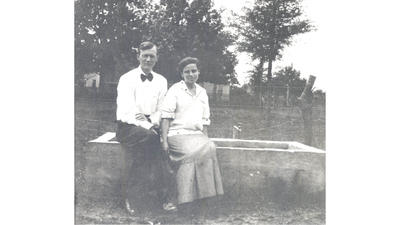
Littletons
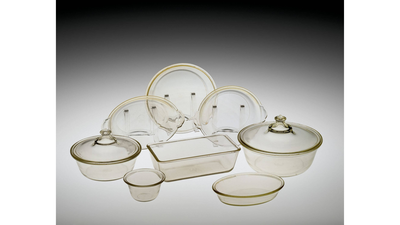
Pyrex-brand ovenware
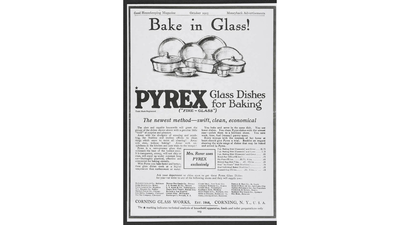
Advertisement
Optical glass for a nation at war
The knowledge of Day and his Geophysical Laboratory colleagues soon found a far more urgent use. Before World War I, the United States bought nearly all of its high-quality optical glass from Germany, and the war cut off that supply. With American entry into the conflict drawing closer, the country suddenly needed glass for rangefinders, gun sights, periscopes, and field glasses, but no American manufacturer knew how to make it to the required standard.
Day saw the problem coming. In March 1917, he sent Carnegie President Robert S. Woodward a set of proposals for how the Geophysical Laboratory could serve the war effort, with optical glass first on the list. Within weeks, the same request came from another direction: George Ellery Hale, the founding director of Carnegie’s Mount Wilson Observatory, who was then working with the National Research Council, asked the laboratory to take on the problem, and Day agreed.
Working with the optical firm Bausch & Lomb, the Geophysical Laboratory's scientists applied what they knew about molten silicates—tight control over composition, temperature, and uniformity. By October 1917, Bausch & Lomb was turning out nearly 40,000 pounds of government-accepted glass a month. By the armistice, Day and the laboratory had overseen the production of at least 90 percent of the optical glass used in American military instruments.

Inspecting glass plates at the Bausch and Lomb Optical Co. in Rochester, NY. When World War I cut off America’s supply of German optical glass, Carnegie’s Geophysical Laboratory stepped in. Credit: Carnegie Science

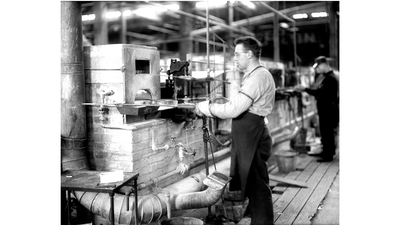
A worker stirs an optical glass melt by hand. Working with the optical firm Bausch & Lomb, the Geophysical Laboratory's scientists applied what they knew about molten silicates—tight control over composition, temperature, and uniformity. Credit: Carnegie Science

A Bausch & Lomb worker molds and presses glass. By October 1917, Bausch & Lomb was turning out nearly 40,000 pounds of government-accepted glass a month. Credit: Carnegie Science

A Bausch & Lomb worker grinds and polishes glass. By the armistice, Day and the laboratory had overseen the production of at least 90 percent of the optical glass used in American military instruments. Credit: Carnegie Science
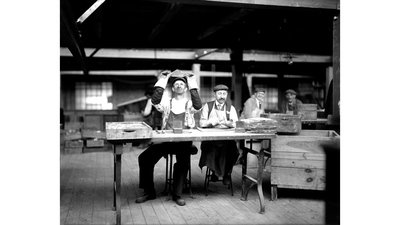
Inspecting glass
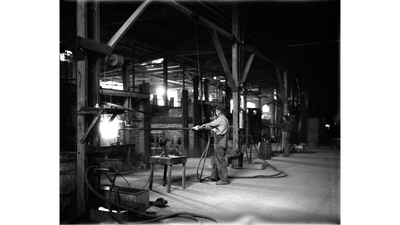
Stirring glass
Molding glass
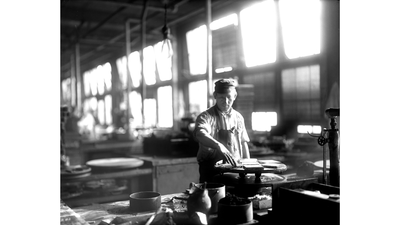
Grinding glass
A mirror for the stars
The Geophysical Laboratory kept studying glass after the war. In 1920, Carnegie’s Leason Adams and E. D. Williamson published a landmark theory of annealing, the slow, controlled cooling that keeps glass from cracking under internal stress. It laid the groundwork for modern annealing methods throughout the glass industry. In 1935, Carnegie’s George Morey followed with a study of annealing Pyrex itself, which showed that the formula needed to change for very large castings.
That research arrived at just the right moment. In the 1930s, Hale returned with another glass problem: he needed a 200-inch mirror for a new telescope at Palomar Observatory. An earlier attempt in fused quartz had failed, so the project turned to Pyrex. Corning took on the job, and its researchers could draw on decades of glass expertise from the Geophysical Laboratory. Corning's first attempt at the 200-inch disk was ruined by a faulty mold. The second, poured on December 2, 1934, spent nearly a year cooling as electrical controls slowly brought its temperature down. The disk became the heart of the Hale telescope at Palomar Observatory, which was jointly run by Carnegie and Caltech until 1980. Later, Pyrex mirror glass would also serve astronomers at the du Pont Telescope at Carnegie's Las Campanas Observatory in Chile.

In the 1930s, Corning took on the job of creating a 200-inch Pyrex disc for the new telescope at Palomar Observatory, pictured here crated and leaving Corning, NY for trip to Pasadena. Credit: Caltech Archives and Special Collections

The disk became the heart of the Hale telescope at Palomar Observatory, which was jointly run by Carnegie and Caltech until 1980. Credit: Caltech Archives and Special Collections

Corning’s Pyrex mirror glass, shown here during transport, would also serve astronomers at the du Pont telescope at Carnegie's Las Campanas Observatory in Chile. Credit: Carnegie Science

Here the Pyrex telescope glass disc for the du Pont telescope is optically figured. The telescope saw first light at Carnegie’s Las Campanas Observatory in 1977. Credit: Carnegie Science
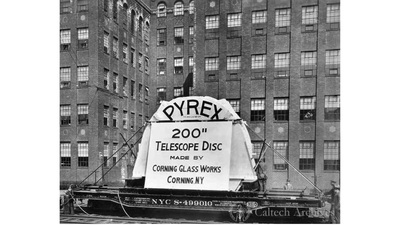
200-inch disc
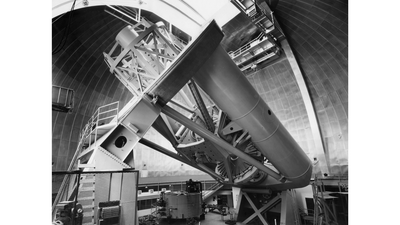
Hale telescope
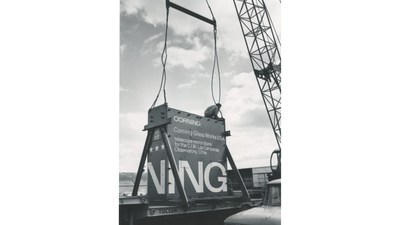
du Pont disc
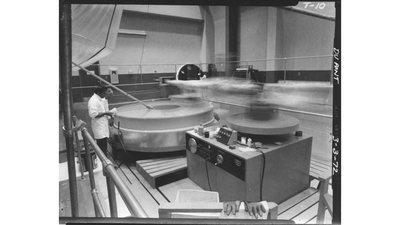
du Pont disc
Pure science, practical payoff
The Geophysical Laboratory was never in the business of making products. Its job was pure science, in line with the mission of Carnegie Science: “to advance investigation, research, and discovery.” Industrial benefits were a byproduct, but as Pyrex shows, sometimes an enormous one.
No one at Carnegie set out to build a better pie plate. They set out to understand how molten rock behaves. That knowledge, published for anyone to use, helped make the glass that ended up in millions of kitchens and in some of the largest telescope mirrors on Earth.
Explore all the objects in the #Carnegie125 series.