Time's Second Arrow
They will explain how the natural process of selection for function has shaped the universe since its inception, and how this new law could possibly help us identify life on other planets, fight cancer, and—perhaps—even understand the purpose and meaning of life on Earth in a new way.
In-person attendees have a chance to win a copy of their new book, Time's Second Arrow: Evolution, Order, and a New Law of Nature, published by W. W. Norton!

Carnegie Science researchers Robert M. Hazen and Michael L. Wong will take the stage at the Greenewalt Auditorium at the Earth & Planets Laboratory (5241 Broad Branch Road NW, Washington, D.C.) to discuss their newly proposed law of nature — one they argue has been quietly shaping the universe since its very beginning. The event begins at 6:30 PM EDT and will be moderated by Regina G. Barber, co-host of NPR's beloved Short Wave science podcast.
About the Talk
Most people are familiar with the first arrow of time: entropy, the tendency of systems to move from order toward disorder. But Hazen and Wong argue there is a second, complementary arrow — a process they call selection for function — that drives the universe in the opposite direction, generating the remarkable complexity we see in minerals, organisms, ecosystems, and beyond.
In their new book, Time's Second Arrow: Evolution, Order, and a New Law of Nature, published by W. W. Norton, the authors make the case that this principle isn't unique to biology. It operates throughout the cosmos, and understanding it could transform fields as varied as astrobiology, oncology, and the philosophy of science. Could it help us identify life on other planets? Offer new strategies for fighting cancer? Even offer a new lens for understanding the meaning of life on Earth? Hazen and Wong think the answer may be yes.
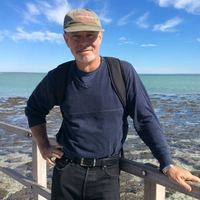
In more than four decades of original mineralogical research, Robert M. Hazen has explored the boundaries of the mineralogical sciences from mineral physics to biomineralization to mineral evolution. His mineralogical research, incorporated into more than 400 publications and 25 books, spans the areas of high-pressure and temperature crystallography, equations of state and mineral physics, mineral surface chemistry, the roles of minerals in prebiotic chemistry, and the mineralogical co-evolution of the geosphere and biosphere. |
|
Attend In Person or Online
The lecture is free and open to the public. Attendees can join in person at the Greenewalt Auditorium or register to watch the livestream from anywhere in the world. In-person guests will also have the chance to enter a raffle to win a signed copy of Time's Second Arrow.
This event is part of the Carnegie Science Earth & Planets Laboratory Neighborhood Lecture Series.
Register to Attend in Person Register to Watch Online