Swope telescope: five decades of observing and reinvention


The Swope telescope at Carnegie Science’s Las Campanas Observatory in Chile—one of the world’s leading centers for astronomical observation—has witnessed significant scientific and technological advances since it saw first light in 1971. But it has also been the setting for human stories that accompany that evolution, including many career highlights for the observatory’s Resident Astronomer Nidia Morrell, who has dedicated more than two decades to observing the sky through this instrument.
Her experience allows us to explore not only the telescope’s recent history but also the profound changes that observational astronomy has undergone in recent decades.
A Historic Telescope in Constant Evolution
The Swope Telescope, installed at Las Campanas Observatory in 1971, was the first instrument to operate at this site and has since become a key component of observational astronomy in Chile and around the world. It is a one-meter-diameter reflecting telescope with an advanced optical design that allows for high-quality imaging across a wide field of view.
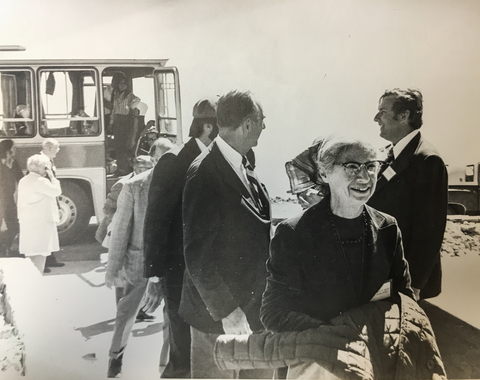
Named in honor of Carnegie astronomer Henrietta Swope, whose donation made its construction possible, this instrument has not only contributed to important discoveries, such as the observation of transient phenomena and cosmic events, but has also stood out for its technological adaptability, incorporating new detectors and instruments over time.
This combination of history, precision, and constant updating has kept it relevant for more than five decades as a fundamental telescope for scientific research.
A Life Linked to the Telescope
Argentinian astronomer Nidia Morrell arrived at Las Campanas Observatory in 2002 as a visiting scientist and has been there ever since. At the Observatory, she has operated telescopes such as the du Pont and the Swope, and has participated in historic observations, such as the optical counterpart of the gravitational wave event GW170817.
Her work at Las Campanas is not limited to observation. Morrell also processes and analyzes data, collaborates on scientific publications, and participates in international projects.
Morrell arrived at Las Campanas at a time when knowledge was passed directly from one astronomer to another. Her early experiences were marked by collaborative work and hands-on training in the field.

Nidia Morrell in her beloved Swope telescope at Las Campanas, getting ready for a night of observing.

In addition to her long-standing observational experience, Nidia Morrell also shares her expertise with astronomy lovers of all ages through outreach activities in both Chile and the United States. In 2024, she was part of a cohort of Carnegie astronomers who participated in educational and outreach programming in Dallas, Texas, for the Great North American Eclipse as part of the institution's partnership with the Perot Museum of Nature and Science.
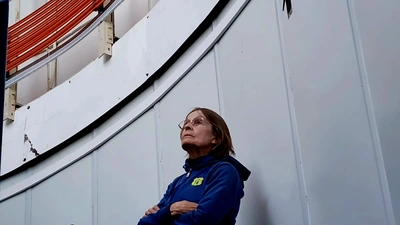
Las Campanas Resident Astronomer Nidia Morrell
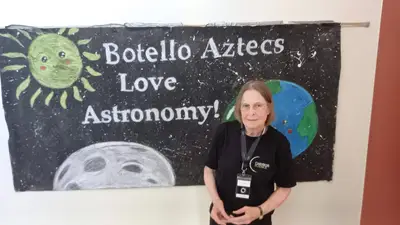
Nidia Morrell at the Eclipse
The early years: observing the sky with less technology
In those days, observing nights required a direct connection with the environment.
“Information wasn’t available on the web like it is now,” Morrell explains. “There were weather stations, but the data wasn’t posted online, nor did we have information from other telescopes, as we do now.”
Assessing sky conditions was, for the most part, a visual task: “We’d go out to assess the sky conditions with the naked eye.”
Despite subsequent changes, some elements have remained the same.
“They weren’t very different from how they are now, at least with this telescope,” she notes, highlighting the continuity in Swope’s observational approach.

The interior of the Swope dome during construction of the telescope at Las Campanas Observatory. It saw first light in 1971. Credit: Carnegie Science

The Swope was the first telescope installed at Las Campanas Observatory after Carnegie Science established the facility in 1969.
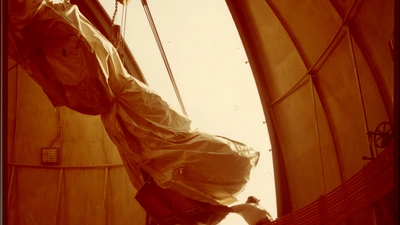
Interior view of Swope contstruction
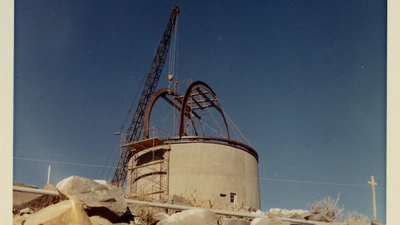
Swope Telescope Under Construction
The technological revolution: detectors, automation, and new instruments
One of the most significant changes in the recent history of the Swope Telescope has been the evolution of its detectors. When Morrell began working at Las Campanas, the telescope was already using CCD technology to make digital images, but with significant limitations.
The technological leap, Morrell explains, is reflected in image readout times: images are now read in 37 seconds, whereas before they could take more than two minutes. These kinds of improvements have made it possible to optimize observation time and increase data quality.
At the same time, the telescope has undergone structural and operational upgrades that have transformed the observing experience. These include the installation of new detectors, a new instrument mounting base, and the modernization of the control system. The latter has made it possible to integrate tasks that were previously performed separately—such as opening the dome, controlling ventilation, or moving the telescope—into a single platform, making the process more streamlined and efficient.
In addition to these improvements, the development of new instruments is shaping the telescope’s future. One of them is Henrietta, a low-resolution infrared spectrograph designed to study exoplanet atmospheres, which will soon be added to Swope.
“The fact that there are major projects involving Swope makes me very happy, because I foresee a great future for this telescope, one that will outlast my time here. I think Henrietta Swope would be very happy too,” Morrell says.
From the chemistry lab to the computer
The transition from photographic plates to digital data marked a turning point in astronomy. The traditional process was complex: manual preparation of plates, installation in the telescope, and subsequent development to access the data.
“The next day, you had to develop the plates, and only then could you see what you had observed the night before,” recalls Morrell. Today, by contrast, data acquisition is immediate. “It’s a matter of pressing a button, and you can see the data on the computer right away.”
This change has not only accelerated processes but has also expanded scientific possibilities: “With all the digital tools we have now, we can tackle projects that were unimaginable in the days of photography.”
Technology has also transformed the preparation for observations. Before, astronomers relied on physical libraries and printed materials.
“We used to go to the library for everything. We had to make photocopies to take to the telescope. Now we have everything available online, whenever we need it. It’s a whole new world,” Morrell recalls.
Furthermore, digitization has facilitated scientific collaboration, allowing for the immediate sharing of data among teams in different parts of the world.

Swope Telescope at Las Campanas Observatory, pointed at the night sky during an observing run for the Carnegie Supernova Project. Credit: Consuelo González Ávila, Carnegie Science Observatories.

The interior of the Swope telescope with the dome closed and the lights on. Credit: Consuelo González Ávila, Carnegie Science Observatories.
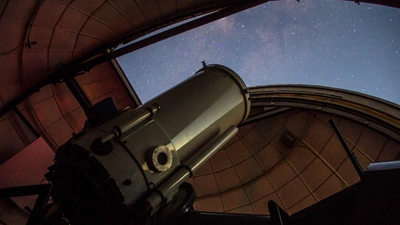
Swope Observing the Night Sky
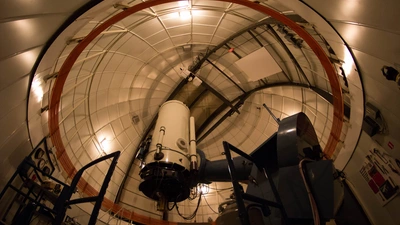
Swope Telescope Interior
What remains unchanged: the essence of observing
Despite technological advances, there are fundamental elements that remain intact.
“The desire not to miss a single minute of the night, the thrill of helping to answer questions humanity has always asked, the fascination with the beauty of the night sky—all of that remains the same,” Morell reflects. “Even the so-called ‘art of observing’ is still present. I think it has changed; but the essence has not been lost.”
The Swope Telescope has been instrumental in numerous high-impact scientific projects, particularly in the study of supernovae.
“Swope’s light curves have become a standard in the study of supernovae,” Morrell notes.
Furthermore, it has contributed to significant discoveries, such as new classes of stars and the detection of the optical counterpart to a gravitational wave event.
Its continued relevance stems from a combination of factors: “It’s an excellent instrument installed in a splendid location. It is constantly maintained and updated, ensuring that it can continue to produce top-tier data for a long time to come.”
More Than Just a Telescope
After more than two decades, Morrell’s connection to the telescope goes beyond the professional.
“It’s my home. I feel more at home here than in my apartment in La Serena.”
In a context where many observations are conducted remotely or automatically, Swope retains a unique educational value.
“It’s perhaps one of the last opportunities for young people to experience firsthand the life of an observer,” she concludes.

The Swope telescope with its dome open and the stars of the Milky Way shining overhead. Las Campanas Observatories is known for its unprecedented views of the night sky. Credit: Yuri Beletsky, Carnegie Science.

Airglow is a phenomenon that results in colorful skies thanks to excited atoms and molecules in the upper atmosphere. This image shows the Swope telescope under a beautiful multi-hued sky. Credit: Yuri Beletsky, Carnegie Science.
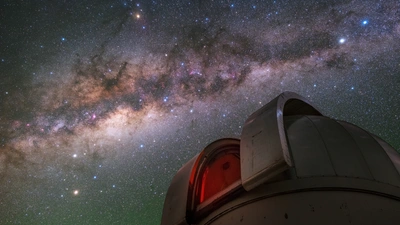
Swope Telescope Under the Milky Way
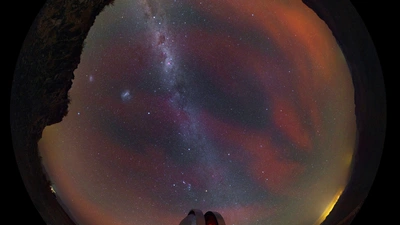
Swope Telescope With Airglow
Related Stories