A Life Among the Stars: The Science and Generosity of Henrietta Swope

In 1952, Henrietta Swope arrived at the Carnegie Observatories, carrying a reputation for extraordinary precision and a quiet determination to push the boundaries of what was known about the universe. Over the next three decades, she would prove to be both a scientist of the first rank and one of Carnegie astronomy's most quietly devoted and consequential benefactors.
Early Life and the Pull of the Stars
Henrietta Hill Swope was born in 1902, the first of five children of Mary Hill Swope, a graduate of Bryn Mawr College, and Gerard Swope, an industrialist who would go on to become president of General Electric and a millionaire.
As a child, Swope enjoyed stargazing in her backyard, recalling in a later interview, “when I was about 10 or 12…I used to go out and identify the constellations.” During summer trips to Nantucket, Swope was further exposed to astronomy through lectures hosted by family friend Margaret Harwood, the director of the Maria Mitchell Observatory. Swope recalled a lecture by Carnegie astronomer Harlow Shapley that “excited me very much, about the universe and about finding the globular clusters all in one place and their place around the Milky Way, the center of our galaxy.”
Inspired, Swope began her studies at Barnard College, where she earned a bachelor's degree in mathematics in 1925. After a brief stint at a Chicago business school, Swope, encouraged by Harwood, applied to the Harvard College Observatory to work with Shapley, who had by that time been appointed the facility's director.
Harvard College Observatory: Mapping the Milky Way
Swope earned a master’s degree in astronomy from Radcliffe College, the women’s coordinate institution of Harvard University, in 1928. For the next 14 years, she worked closely with Shapley as a research assistant at the Harvard College Observatory, focusing on variable star research that would help reshape our understanding of the structure of the Milky Way.
Astronomer Cecilia Payne-Gaposchkin, who had arrived at the Harvard Observatory two years earlier and with whom Swope would become good friends, later wrote in her autobiography: "A survey of variable stars as an approach to the structure of the Milky Way was one of Shapley's grand projects…The work was placed in the capable hands of Henrietta Swope, who…evinced an extraordinary flair for discovering variable stars."
This work built upon a foundation Shapley had laid during his earlier years at Carnegie's Mount Wilson Observatory, where he had mapped the globular cluster system of our Milky Way galaxy and identified its center, toppling the long-held belief that the Sun sat in this position. At the Harvard College Observatory, Swope and Shapley conducted extensive surveys and studies of variable stars—whose periodically changing brightnesses can be used to measure vast cosmic distances. This work enabled them to map the structure of the Milky Way. By 1934, Swope had been put in charge of the Harvard College Observatory’s variable star programs, which, as summarized by Payne-Gaposchkin, were “bearing fruit in enormous quantities.”
In 1942, with the world at war, Swope left the Harvard College Observatory to join projects supporting the U.S. military effort, first at the MIT Radiation Laboratory, and then at the Navy Hydrographic Office, where she helped to develop LORAN (Long Range Aid to Navigation), a system that allowed a ship or plane to determine its position based on radio signals. After the war, Swope went to work as an associate astronomer at her alma mater, Barnard College.

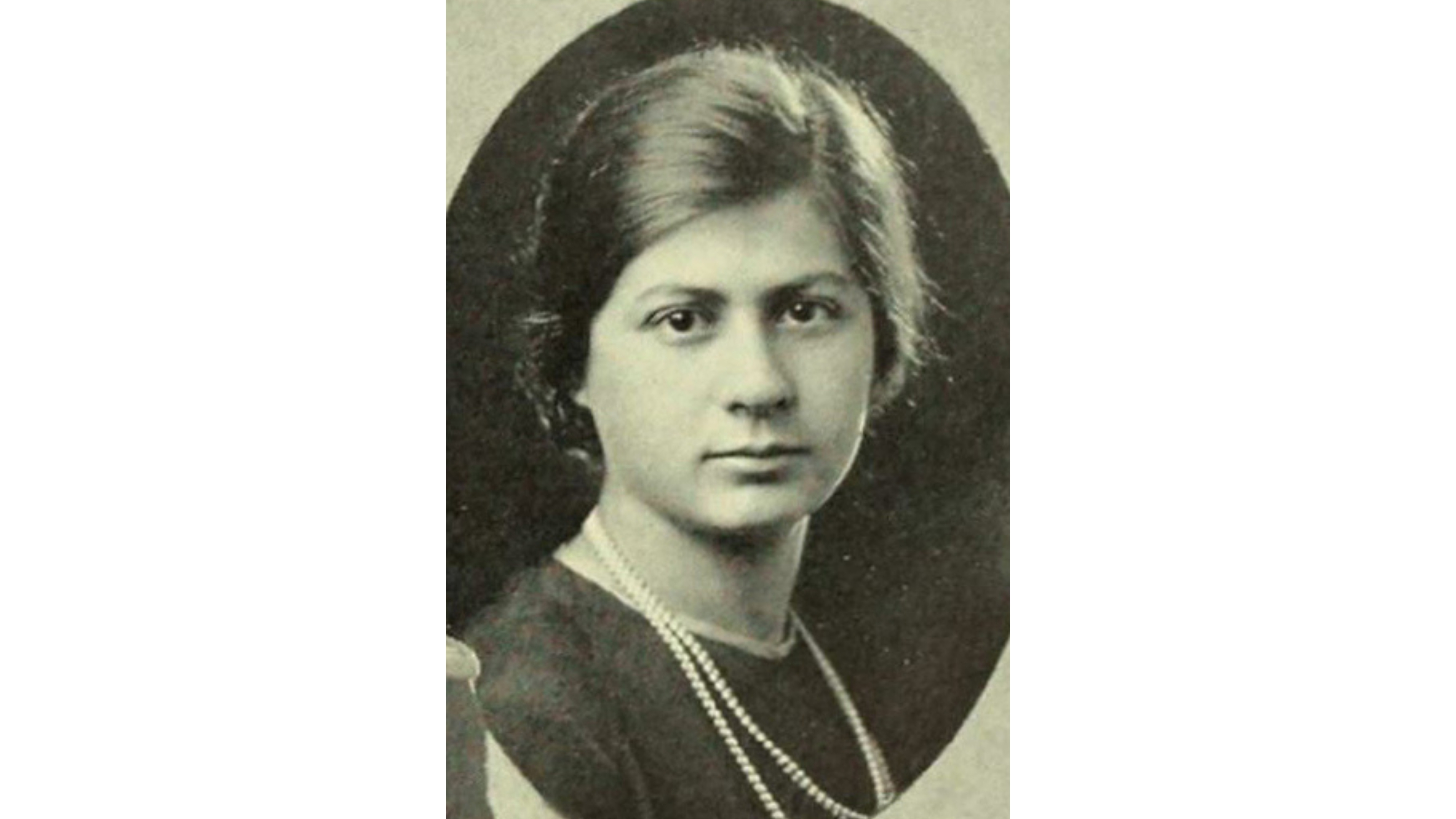
Henrietta Swope at work at the Harvard College Observatory, circa 1929. After earning a master’s degree in astronomy from Radcliffe College in 1928, Swope spent the next 14 years as a research assistant at the Harvard College Observatory. Credit: Schlesinger Library, Harvard Radcliffe Institute

Portrait of Harlow Shapley. Henrietta Swope worked closely with Shapley at the Harvard College Observatory, focusing on variable star research that would help reshape our understanding of the structure of the Milky Way. Credit: National Academy of Sciences

Henrietta Swope (third from the left) and others, including Cecilia Payne-Gaposchkin (second from the left), participate in the Harvard Observatory “Pinafore” before the American Astronomical Society, December 31, 1929. Credit: Schlesinger Library, Harvard Radcliffe Institute

Swope at Harvard College Observatory

Harlow Shapley

Harvard “Pinafore”
The Carnegie Observatories: Measuring the Universe
In 1951, Swope received a letter that would begin a significant new chapter of her career and life. Swope’s publications in the Harvard Annals and her excellent reputation for skill at estimating magnitudes of variable stars on photographic plates had caught the eye of Carnegie astronomer Walter Baade. She was asked to come to the Carnegie Observatories, then known as the Mount Wilson and Palomar Observatories, to assist Baade in assessing and interpreting variable stars on plates he’d taken with the 200-inch Hale telescope at Palomar.
Swope initially objected to the offered title of “computer”—a term that had long been used to classify women employed at observatories in roles that offered little recognition and limited autonomy, however significant their actual contributions. She wrote to Carnegie Observatories Director Ira Bowen, "I would like to enter my protest…I have always held an innocuous title, one which can mean much or little depending on one's own work… These titles [were] not imposing but neither need they be hidden from a slight sense of shame." Bowen reassured her “computer” was an outdated administrative designation used for all staff primarily engaged in plate assessment, and when she arrived at the Observatories in February 1952, she was introduced as a "research assistant."
At the Carnegie Observatories, Swope teamed up with Baade on a landmark effort to measure the distance to the Andromeda galaxy. She painstakingly analyzed hundreds of photographic plates, measuring the magnitudes, periods, and colors of countless variable stars. This work culminated in her most significant contribution: a revised distance to Andromeda of 2.2 million light-years, a finding that helped correct earlier underestimates of cosmic distances that dated back to legendary Carnegie astronomer Edwin Hubble's breakthrough work with Andromeda. This measurement became the “celestial yardstick” by which other distances in the universe were calculated.
The announcement of this discovery made headlines across the country, many of which—such as “Woman Develops Yardstick to Measure the Universe“ and “She Plots Waistline of the Universe”—captured the climate Swope navigated throughout her career, in which a woman astronomer was still regarded as a curiosity and areas of astronomy remained inaccessible to women. Swope didn’t observe at the telescope herself and once explained: “oh, a woman could use them if her husband was a scientist and reserved the time. But then I never had a husband.” In fact, women would not be officially permitted to observe at Palomar until Carnegie’s Vera Rubin was invited to observe in 1965.

Henrietta Swope at work at the Carnegie Observatories, circa 1960s. At the Observatories, Swope painstakingly analyzed hundreds of photographic plates, measuring the magnitudes, periods, and colors of countless variable stars.

Portrait of Walter Baade. Henrietta Swope collaborated with Baade at the Carnegie Observatories on a landmark effort to measure the distance to the Andromeda galaxy. Credit: Carnegie Science/Huntington Library

Henrietta Swope’s most significant contribution, a revised distance to Andromeda of 2.2 million light-years that helped correct earlier underestimates of cosmic distances, made headlines across the country. Credit: Schlesinger Library, Harvard Radcliffe Institute
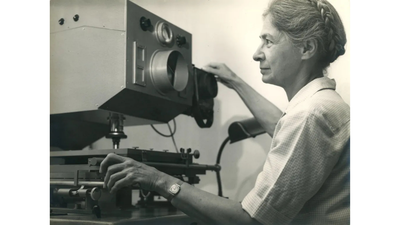
Swope at Carnegie Observatories

Walter Baade
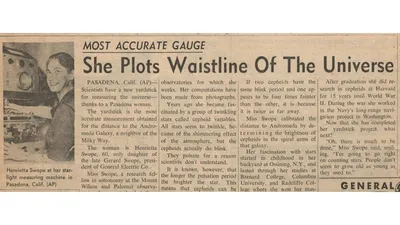
Headline
Swope and Baade’s collaboration continued until Baade’s retirement in 1958, extending to several other nearby dwarf galaxies. When Baade died two years later, Swope continued their research and prepared his unfinished results for publication, producing several of the more important “Baade and Swope” papers over the following years.
Swope officially retired in 1968, but continued her work at the Carnegie Observatories until shortly before her death in 1980. In 1962 she was finally given the title of “research fellow,” becoming the first woman to be so recognized at the Carnegie Observatories.
In 1968, Swope was honored for her accomplishments with the American Astronomical Society's Annie Jump Cannon Award, which commemorates another pioneering woman astronomer who was herself a renowned investigator of variable stars at the Harvard College Observatory. Swope was also awarded an honorary degree by the University of Basel, Switzerland in 1975, and the Barnard College Distinguished Alumna Award in 1975 and Medal of Distinction in 1980.
In a letter regarding Swope’s selection for the Barnard College Alumna Award, Carnegie Observatories Director Horace Babcock wrote, “Such an award is a highly appropriate recognition of Miss Swope’s professional career.” He praised her “quiet and effective dedication to research in astronomy” concluding, “such achievements are rare.”

Group photograph of the Carnegie Observatories research staff, including Henrietta Swope, in the Hale Library, Pasadena, 1966. Swope she was finally given the title of “research fellow” in 1962, becoming the first woman to be so recognized at the Carnegie Observatories. Credit: Carnegie Science/Huntington Library

Portrait of Henrietta Swope in 1968. Swope officially retired in 1968, but continued her work at the Carnegie Observatories until shortly before her death in 1980. Credit: Caltech Archives and Special Collections
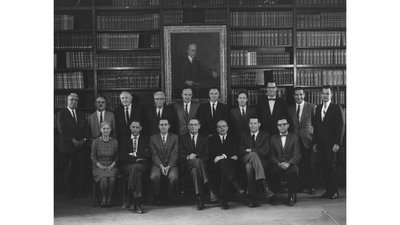
Carnegie Observatories staff

Henrietta Swope
A Gift That Opened the Southern Skies
Swope's dedication to Carnegie astronomy extended well beyond her own research. Throughout her career, she made a series of generous, largely anonymous gifts that helped shape the future of the institution and of astronomy itself.
When Caryl Haskins started as Carnegie president in January 1956, he was greeted with a letter from Swope stating that she would like to give an anonymous $2,000 donation to the Observatories for the director “to use as his own discretion for improving equipment or for special purposes such as travel funds for some of the younger astronomers.” Swope followed up with similar sums to the institution each year, given anonymously to the Astronomy fund.
In 1967, with the institution’s plans crystallizing for a new observatory in Chile to provide access to the southern skies, Swope made an extraordinarily generous anonymous gift of $650,000 to be used for site development at Las Campanas. This gift funded the construction of roads, water, and power systems, preliminary operating expenses, and the installation of a state-of-the-art 40-inch telescope. The telescope, which incorporated innovative optics designed by Carnegie astronomers Ira Bowen and Arthur Vaughan, saw first light in 1971 and continues to serve astronomers today.
Swope’s generosity as the donor who had made possible the establishment of Las Campanas Observatory was finally revealed—with her permission—in 1976 during the formal dedication of the 100-inch du Pont telescope when the older 40-inch telescope was officially named in her honor. The Swope telescope at Las Campanas has been an instrument of major scientific discoveries, including observations contributing to the study of supernovae and fast radio bursts, as well as the first ever observation of a neutron star merger.

Henrietta Swope attending 1976 du Pont Telescope dedication at Las Campanas Observatory, where it was finally revealed—with her permission—that she was the donor who had made possible the establishment of Las Campanas Observatory. Credit: Carnegie Science

Construction at Las Campanas Observatory, 1971. In 1967, with the institution’s plans crystallizing for a new observatory in Chile to provide access to the southern skies, Henrietta Swope made an extraordinarily generous anonymous gift of $650,000 to be used for site development at Las Campanas. Credit: Carnegie Science

Installation of Swope telescope at Mount Wilson Observatory, 1971. Henrietta Swope’s gift funded the construction of roads, water, and power systems, preliminary operating expenses, and the installation of a state-of-the-art 40-inch telescope, later named in her honor. Credit: William C. Miller/Carnegie Science

Swope at Las Campanas Observatory
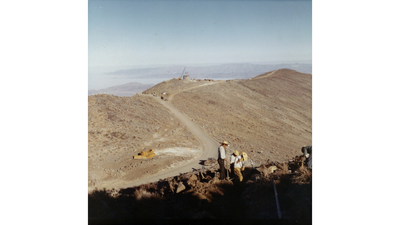
Construction at Las Campanas Observatory

Telescope installation
A new instrument, which also pays tribute to Swope and was designed for use on her namesake telescope, will be installed this spring. The Henrietta Infrared Spectroscope will help Carnegie astronomers study exoplanet atmospheres in unprecedented detail, transforming how we understand worlds beyond our solar system.
A longtime devoted friend of the Carnegie Observatories, Swope chose to bequeath the majority of her estate to the institution, to be used “in support of the Institution's program for planning, constructing, and operating optical astronomical observatory facilities and research in the Southern Hemisphere” or as recommended by the director of the Carnegie Observatories in support of astronomical research. Her letter of gift modesty concluded, “I myself have always been most interested in astronomical photometry, such as variable stars, color magnitude studies, and star clusters.” In total, Swope gave $1.45 million to Carnegie in support of the astronomy work she herself so loved.
A Lasting Legacy
As the Carnegie newsletter noted after her death in 1980: “Among scientists yet to come, Henrietta Swope will be known for her work with variable stars; she will also be remembered for her far-sighted generosity on behalf of the science that gave her life meaning.” Today we celebrate Swope for her astronomical contributions that helped redefine the scale of the universe and for her role as a visionary philanthropist whose quiet generosity built the infrastructure that enabled generations of astronomers to pursue their own discoveries.

The Swope telescope, which incorporated innovative optics designed by Carnegie astronomers Ira Bowen and Arthur Vaughan, saw first light in 1971 and continues to serve astronomers today. Credit: Consuelo González Ávila/Carnegie Science

The Swope telescope at Las Campanas has been an instrument of major scientific discoveries, including observations contributing to the study of supernovae and fast radio bursts, as well as the first ever observation of a neutron star merger. Credit: Yuri Beletsky/Carnegie Science

A new instrument, which also pays tribute to Swope and was designed for use on her namesake telescope, will be installed this spring. Jason Williams, a Carnegie postdoctoral fellow and the scientific and technical lead of the Henrietta project, stands with the Henrietta Infrared Spectrograph in the clean room at the Carnegie Science Observatories, where the instrument was designed, built, and is being tested before its installation at Las Campanas Observatory.

The Swope telescope

Swope telescope discoveries
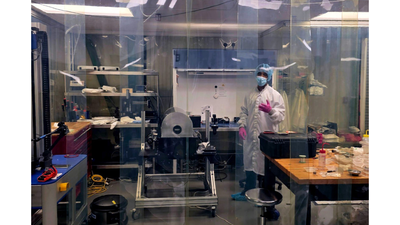
Henrietta Infrared Spectrograph
Bibliography
Carnegie Institution of Washington. “Carnegie Loses Henrietta Swope.” Carnegie Institution Newsletter, April 1981.
Carnegie Institution of Washington. “Legacy of a Life: Henrietta Swope.” Carnegie Institution Newsletter, June 1983.
Carnegie Institution of Washington. Year Book 51. Washington, DC: Carnegie Institution of Washington, 1952.
Carnegie Institution of Washington. Year Book 60. Washington, DC: Carnegie Institution of Washington, 1961.
Clark, Alfred E. “Henrietta H. Swope, 78, Is Dead; Helped to Measure Variable Stars; Helped to Develop Loran.” The New York Times, November 29, 1980.
Henrietta Hill Swope. Oral History Interview. Interview by David DeVorkin, August 3, 1977. Niels Bohr Library & Archives, American Institute of Physics.
Henrietta Hill Swope Papers, 1917–1982. 82-M146–85-M7. Schlesinger Library, Radcliffe Institute for Advanced Study, Harvard University, Cambridge, Massachusetts.
“Henrietta Hill Swope.” Physics Today 34 (March 1981).
“Henrietta Hill Swope.” The Harvard Plate Stacks: Women at the Harvard College Observatory. Center for Astrophysics, Harvard & Smithsonian. Accessed March 9, 2026. https://platestacks.cfa.harvard.edu/women-at-hco/henrietta-hill-swope.
Payne-Gaposchkin, Cecilia. Cecilia Payne-Gaposchkin: An Autobiography and Other Recollections. Edited by Katherine Haramundanis. 2nd ed. Cambridge: Cambridge University Press, 1996.
Sandage, Allan. Centennial History of the Carnegie Institution of Washington: The Mount Wilson Observatory. New York: Cambridge University Press, 2004.
Shearer, Benjamin F. and Barbara S. Shearer, eds. Notable Women in the Physical Sciences: A Biographical Dictionary. Westport, CT: Greenwood Press, 1997.
Welther, Barbara L. “Henrietta Hill Swope: Variable Stars in the Milky Way and Andromeda.” In Women in Astronomy, special issue of Mercury 21 (January–February 1992). San Francisco: Astronomical Society of the Pacific.