Object 8 | Carnegie Science Seal


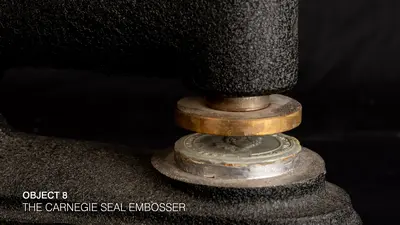
This heavy cast-iron embosser, made in the early 1900s, once gave Carnegie Science’s identity weight (literally, it's very heavy). Press its handle down, and the metal die stamps an impression of the Carnegie seal into paper, turning any plain sheet into an official document.
The seal’s story began almost as soon as Carnegie Science itself did. Within weeks of the institution’s founding in January 1902, the Board of Trustees had already resolved to obtain designs for a permanent seal. By the following year, they had settled on a concept: a likeness of Andrew Carnegie encircled by the institution’s name and founding year, Carnegie Institution of Washington, 1902.
The hard part was done; now they just had to decide which version of Andrew Carnegie's face they wanted to adorn official documents. An early version was reportedly rejected because it made Carnegie appear too severe. The final design, engraved by New York artist E. D. French and formally adopted in early 1904, struck a philanthropic tone. Notably, French had previously engraved the plate for the New York Public Library.
The seal was a printed emblem and a tool of authorization, something that could move between scholarship and administration. In one form, it appeared on all of the institution’s publications. In another, it left a raised mark on important papers.

This heavy cast-iron embosser created a raised impression of the Carnegie seal on official documents.

Left: An embossed impression of the historic Carnegie seal. Right: The seal as it appeared in print on the cover of the 1905 Carnegie Institution of Washington Year Book, showing how the mark served both as a formal seal and as a visual emblem on institutional publications.

Choosing a face was tricky. One early version was reportedly rejected because it made Carnegie appear too severe. The final design, engraved by New York artist E. D. French and formally adopted in early 1904, struck a more philanthropic tone. The seal was used for more than a century. When official logos were established, the seal became less useful, but it can still occasionally be found adorning documents.

The red "Carnegie Institution for Science" logo was used from 2005 to 2016.

The logo depicting stars, leaves, and a fossilized shell was used from 2016 to 2023.

The current logo was adopted in 2024 and is currently in use today.
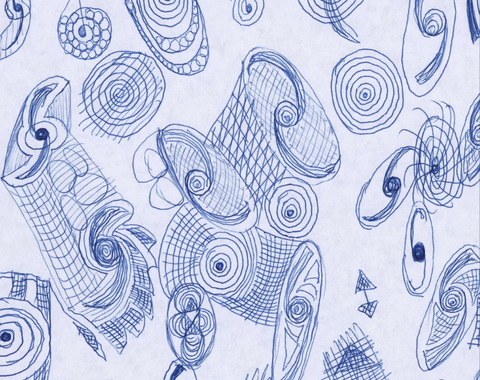
Can you spot the portrait?
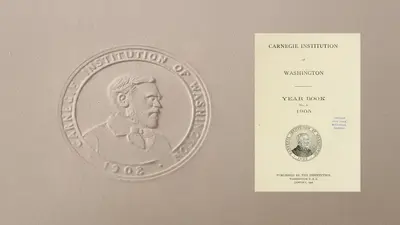
Dual purpose
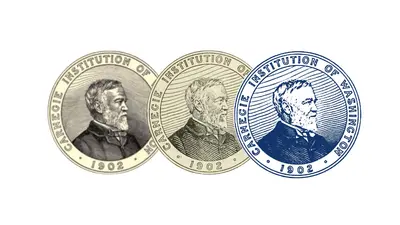
The Carnegie mark

2005 - 2016

2016 - 2023

2024 - Today

Carnegie Seal.mp4
Over time, the seal appeared across more than 600 volumes in the Carnegie Monograph Series and was used in the Year Book, on letterhead, and in other institutional materials. What began as a formal mark of authority gradually became one of the institution’s most recognizable visual symbols. By the 1980s, it had made its way off the page and onto Carnegie sweatshirts. In 1994, the seal was even imprinted on one of the ceramic cores used in casting a Magellan telescope mirror at the Steward Observatory Mirror Lab in Tucson, Arizona.
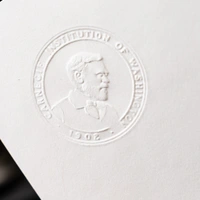
Though the physical press still works over a century later (Yes, we tested it.), our visual identity has evolved to put science more explicitly at the center, leaving the seal without its original purpose. But even though it's been relegated to the archives, the cast-iron press still carries the weight of an earlier era. You could even say it left its mark.
Explore More Objects