Object 7 | Jennie Lasby's 1912 Astronomical Glass Plate

On May 29, 1912, Carnegie’s Jennie Belle Lasby became the first female scientist to observe with the 60-inch reflector telescope at Carnegie’s Mount Wilson Observatory and the only known member of the Mount Wilson Computing Division to have taken data on the facility's telescopes. Over the next two years, the 60-inch's logbooks frequently list Lasby as part of an observing team. On more than 50 occasions, she and Walter Adams are listed as observer and assistant and Lasby’s observational work was also mentioned in the 1913 Carnegie Science Year Book alongside the names of several well-known male astronomers, including Adams, Arnold Kohlschütter, and Adriaan van Maanen.
Glass Plates: The Original Photographic Method
Although the process for analog photography remained largely the same over the decades, the medium on which the resulting images are printed changed. Before photographs were captured on rolls of plastic film, images were taken using thin pieces of glass that had been coated on one side with a clear, light-sensitive chemical emulsion. Silver halides in the emulsion underwent a chemical reaction when exposed to light, turning the parts of the image that were bright black, therefore creating a "negative." The light sensitivity of these halides were great enough that glass plates remained the primary method for astrophotography, in which capturing even very faint light sources is critically important, all the way through the mid 1990s.

The first known glass plate taken with assistance from a woman at Carnegie’s Mount Wilson Observatory; a solar spectroscopy plate taken by Jennie Lasby and Walter Adams on May 29, 1912. Credit: Carnegie Science

Librarian and Archivist Kit Whitten holds the Lasby plate over the light box. Whitten manages the vast plate archive at the Carnegie Science Observatories and nominated the Lasby plate for inclusion in our #Carnegie125 celebration. Credit: Carnegie Science

The 1912 solar spectroscopy plate taken with assistance by Jennie Lasby. Spectra of the Sun were studied in order to understand how and why the Sun rotates, as well as the speed at which this occurs. Credit: Kit Whitten, Carnegie Science Observatories.

The logbook for the 60-inch telescope on Mount Wilson Observatory in May 1912, when Jennie Lasby became the first known woman to make a spectrographic plate at the facility. Credit: Carnegie Science Observatories

The sleeve for the 1912 solar spectra taken by Jennie Lasby. The original has been replaced due to damage. Credit: Carnegie Science Observatories
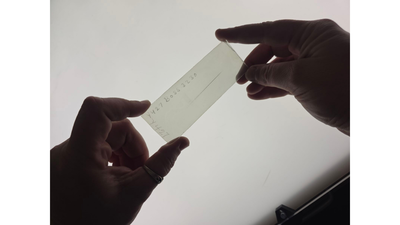
Lasby Plate over Lightbox
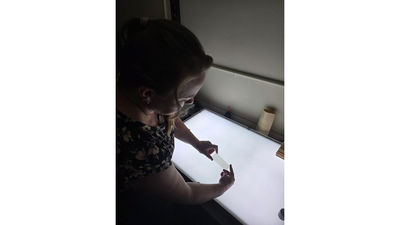
Kit Whitten with Plate
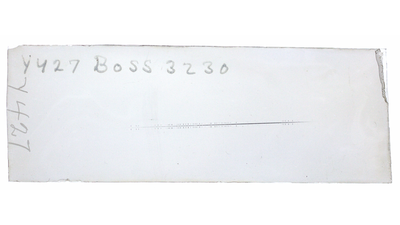
Lasby Plate
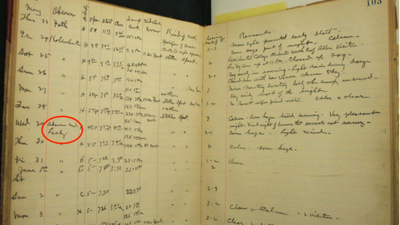
Lasby Logbook
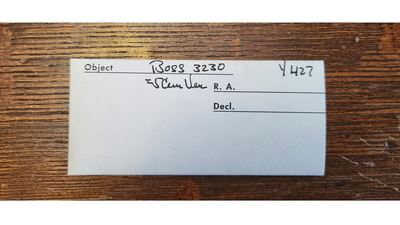
Lasby Plate Sleeve
Spectra and the Study of the Sun
Spectrophotography is a special kind of astrophotography that was critical for 20th century astronomers. It involves splitting the light up into its component wavelengths in order to reveal the composition of its source. Since each element emits a unique color of light, a spectrographic plate, called a spectra, shows the chemical makeup of the object being studied.
In 1912, when the Lasby plate was made, Adams was focused on taking spectra of the Sun in order to understand how and why it rotates, as well as the speed at which this occurrs. He accomplished this thanks to a phenomenon called the Doppler effect, which enables scientists to understand whether an object is moving toward or away from the observer. When an object is approaching, its light is shifted slightly to the blue and when an object is retreating, its light is shifted slightly to the red. This is the same reason a police siren sounds are higher-pitched when the vehicle is coming toward you and lower-pitched when it's moving away from you.
Using this understanding of blue- and red-shifts, Adams took several spectra of the Sun at different longitudes, knowing that the lines on the side of the Sun rotating away from us will be red-shifted relative to the center longitude and likewise, the side rotating toward us will be blue-shifted. Since the amount of shift is directly proportional to the speed of motion, Adams and his collaborators were able to calculate the Sun’s rotational velocity. At the time, this was a brand new field of study in solar astrophysics.
Although several dozen glass plate solar spectra were taken for Adams’ study, the May 29, 1912, plate is special among them, because it is the first known plate taken on Mount Wilson with assistance from a woman. It is the seventh object in our 125th-anniversary series.

Carnegie astronomer Walter Adams. On more than 50 occasions, Jennie Lasby and Walter Adams are listed as observer and assistant in the log book for the Mount Wilson Observatory 60-inch telescope. In 1923, Adams was named Director of the Observatories, succeeding founder George Ellery Hale. Credit: Carnegie Science

The 60-inch telescope at Carnegie’s Mount Wilson Observatory. On May 29, 1912, Jennie Lasby became the first female scientist to observe with the 60-inch. Credit: Courtesy of the Observatories of the Carnegie Institution for Science Collection at the Huntington Library, San Marino, California.
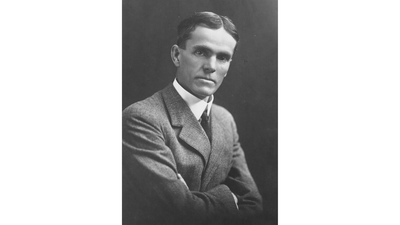
Walter Adams
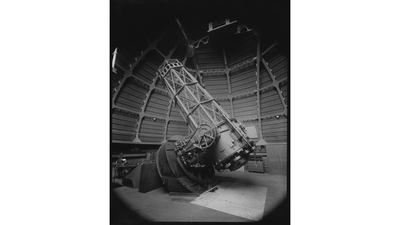
60-inch Telescope
Jennie Belle Lasby: Computer, Observer, Astronomer
In the early 1900s, professional roles in astronomy were largely gendered, and women were relegated to lower-paying, lower-status positions that provided little opportunity for promotion or freedom to pursue independent research.
Women employed at observatories were generally excluded from observing with telescopes, a skill deemed physically taxing and requiring stamina, and therefore considered suitable only for male astronomers. Observing at Carnegie's Mount Wilson Observatory often required sitting in the large metal domes at the top of Mount Wilson for hours overnight and—since the best observing conditions are in winter, when the average low temperature is 49 degrees Farenheit—this often meant the scientists needed to stay bundled in large fur coats to keep warm while performing the necessary mechanical adjustments to keep their desired celestial objects in view.
Conversely, women were thought to have the patience needed to perform the exacting and repetitive work of measuring the data on glass plates and performing complex calculations. The women who were tasked with precisely quantifying and reducing data were called "Computers," literally, “ones who compute.”
Jennie Lasby joined Mount Wilson Observatory's Computing Division in October of 1906 at the age of 24, after completing her master’s degree in astronomy at Mount Holyoke College. From the very beginning of her time at Carnegie, through her departure in 1914, Lasby assisted with Walter Adams’ investigation of solar rotation. Her efficiency improved steadily over the course of her eight years in Pasadena and it was noted in the 1913 institutional Year Book that she was able to measure and reduce over 1,000 spectrograms for radial velocity in just 12 months.
It is possible that Adams’ confidence in Lasby’s work led to his willingness to have her accompany him when he went to observe on Mount Wilson. Another contributing factor may have been that Adams’ solar observations were conducted in spring daylight hours, when conditions were more amenable than those on the mountain overnight.
However, Adams reliance on Lasby's skills did not extend to making her a co-author on his papers about solar rotations, which he published as sole author in The Astrophysical Journal. She went on to publish her own account of their work in Popular Astronomy.
Jennie Lasby left Mount Wilson Observatory in 1914 to work on a spectroscopy project in Germany. However, with the start of World War I, she returned to the U.S. the following year. After a short time in Minnesota, Lasby returned to Southern California, teaching history and astronomy at Santa Ana Junior College from 1919 to 1946. She died in 1959 at the age of 77.

Jennie Lasby (far right) with three other women “computers” attending the 1910 International Union for Co-operation in Solar Research conference held at Carnegie’s Mount Wilson Observatory. Credit: Phoebe Waterman Haas Photo Album [Digital Scans], NASM.2015.0045, National Air and Space Museum, Smithsonian Institution.

A group of women, likely members of the Computing Division of Carnegie’s Mount Wilson Observatory, circa 1910-1911. Jennie Lasby is pictured on the far left of the back row. Credit: Phoebe Waterman Haas Photo Album [Digital Scans], NASM.2015.0045, National Air and Space Museum, Smithsonian Institution.

A portrait of Jennie Lasby with a dog. Credit: Phoebe Waterman Haas Photo Album [Digital Scans], NASM.2015.0045, National Air and Space Museum, Smithsonian Institution.
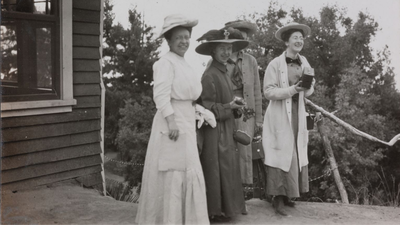
At Solar Research Conference
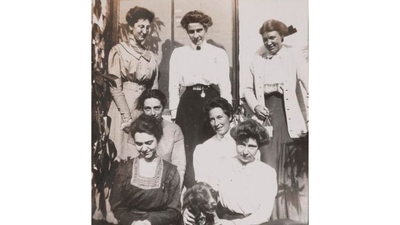
Lasby with "Computers"
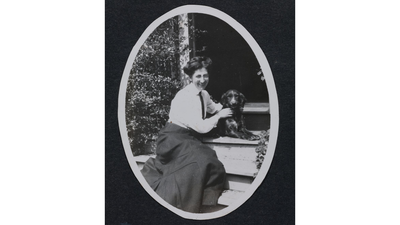
Lasby Portrait
![Vera Rubin at Lowell Observatory, 69-inch [i.e., 72-inch] Telescope (Kent Ford in white helmet)](/sites/default/files/styles/banner_max/public/2024-09/DTM_VR-B-011_19650000.jpg.webp?itok=-i2aV9UF)