Object 10: Lunch Club Notebook and Geolunching

In the fall of 1947, a handful of biophysicists got tired of driving off campus for lunch. Their solution was simple: they'd cook for each other.
Each week, one scientist would buy the groceries, set the table, and prepare the food. Then they'd hand their duties off to the next person the following week and so on. To support the endeavor, then-Director Merle Tuve had a kitchen installed in the old Standardizing Magnetic Observatory. Voila! Lunch Club was born!
Over the ensuing years—almost 80 of them—Lunch Club managed to acquire three ironclad rules for operation:
- No complaints about the food. (Compliments are fine).
- No seconds before 12:45 p.m.
- No hot dogs more than once a week. (The origin of this rule has been lost to time.)
Over time, the cuisine has drifted with the cooks, as each new member and every new generation brings a fresh culinary perspective. Fresh milk and, apparently, wine graced the table in the early decades; Creole fish and chicken Basquaise were popular in the 1980s; and today each meal tends to come with a vegan or vegetarian option.


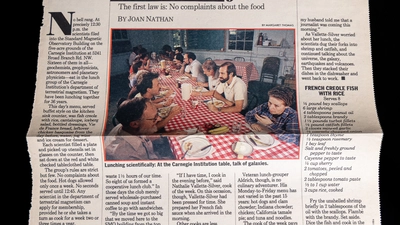
Full Washington Post Article
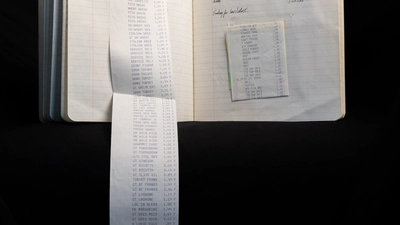
A receipt unfurls from the Lunch Club notebook.
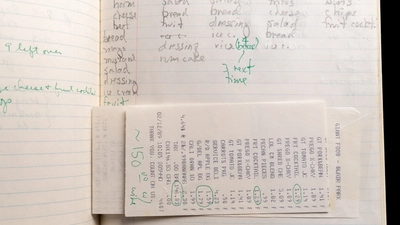
Wine on the Menu for Valentine's Week
Inner Cover
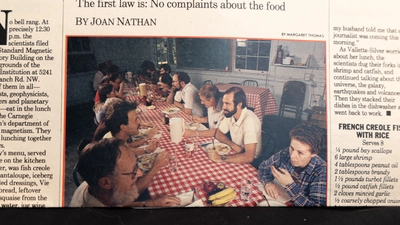
Geolunching Snippet
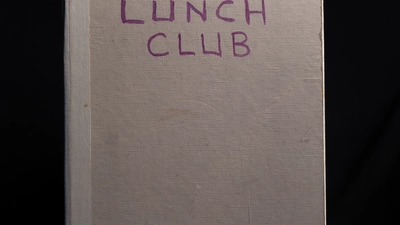
Lunch Club Notebook
But maybe the coolest thing about Lunch Club is what happens around the food.
Geochemists end up learning some astronomy. Astronomers pick up some geology. According to campus lore, at least two isotope geochemistry breakthroughs occurred over lunchtime conversation, one in the 1940s and another decades later.
When Tuve once asked a young astronomer named Vera Rubin to share what she'd been working on over lunch, she didn't realize until after the fact that the conversation had actually been a job interview. She got the job and went on to revolutionize how we understand the cosmos.
Louis Brown, who began his Carnegie career as a nuclear physicist and later shifted into instrumentation and isotope geology, credited Lunch Club with the rarity of campus infighting in the department's centennial history.
“Surprisingly enough, the Lunch Club has endured to the present day. The 25th, 40th, and 50th anniversaries of its founding were festively celebrated—at real restaurants. The extreme rarity of academic bickering ... owes its absence in great measure to the relaxed atmosphere that it has created, perhaps a consequence of the psychological effect of cooking for the others and eating their food.”


L to R around the table: Xinhua Zhou, Rick Carlson, Typhoon Lee, Alan Linde, Thomas Aldrich, Kent Ford, [unidentified man; unidentified young girl], Linda Schweizer, Norbert Thonnard, Francois Schweizer, Vera Rubin, David James, Fouad Tera, and Selwyn Sacks.

Myriam Telus, Emma Bullock, Gary Bors

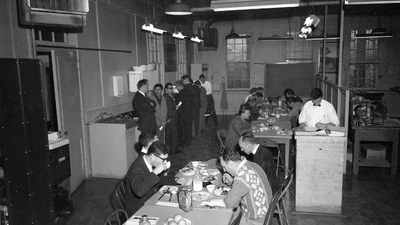
Lunch Club - 1963
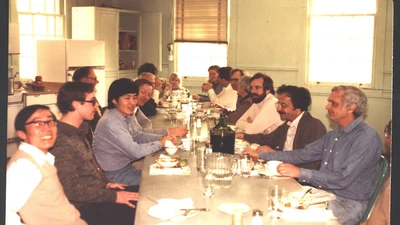
Lunch Club - 1981
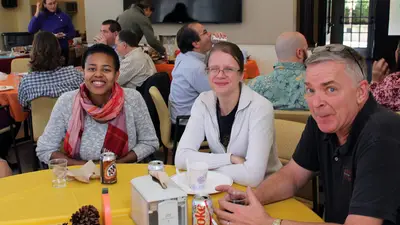
Lunch Club - 2015
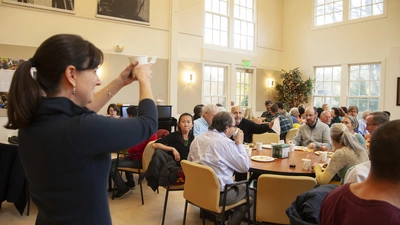
Thanksgiving 2019, Lunch Club Style
In 2027, as Carnegie Science itself turns 125, Lunch Club will turn 80. This makes it the oldest surviving tradition at our Broad Branch Road campus and, as far as anyone can tell, the only club of its kind to be found at any academic institution around the globe. After leaving Carnegie in 1979, Geochemist Albrecht Hofmann repeatedly tried to start a version of the club at the Max Planck Institute in Mainz. He apparently failed every time.
This collection of artifacts, presented together as Object 10 in our #Carnegie125 series, provide small windows into the heart of our Lunch Club. The news clipping is from October 1984, when The Washington Post sent food writer Joan Nathan to Broad Branch Road to report on the place. Her piece ran under the headline "Geolunching: The First Law Is No Complaints About the Food." The notebook is from the same era—a battered grey composition book that cooks passed hand-to-hand to plan their meals.
Today, the physical notebook has been retired in favor of a Google spreadsheet, and the five-day schedule has been reduced to Thursdays and Fridays after COVID almost knocked it out permanently. But as of today, Lunch Club still welcomes everyone on the Broad Branch Road campus to take a seat at the table and enjoy some "home" cooking by colleagues.