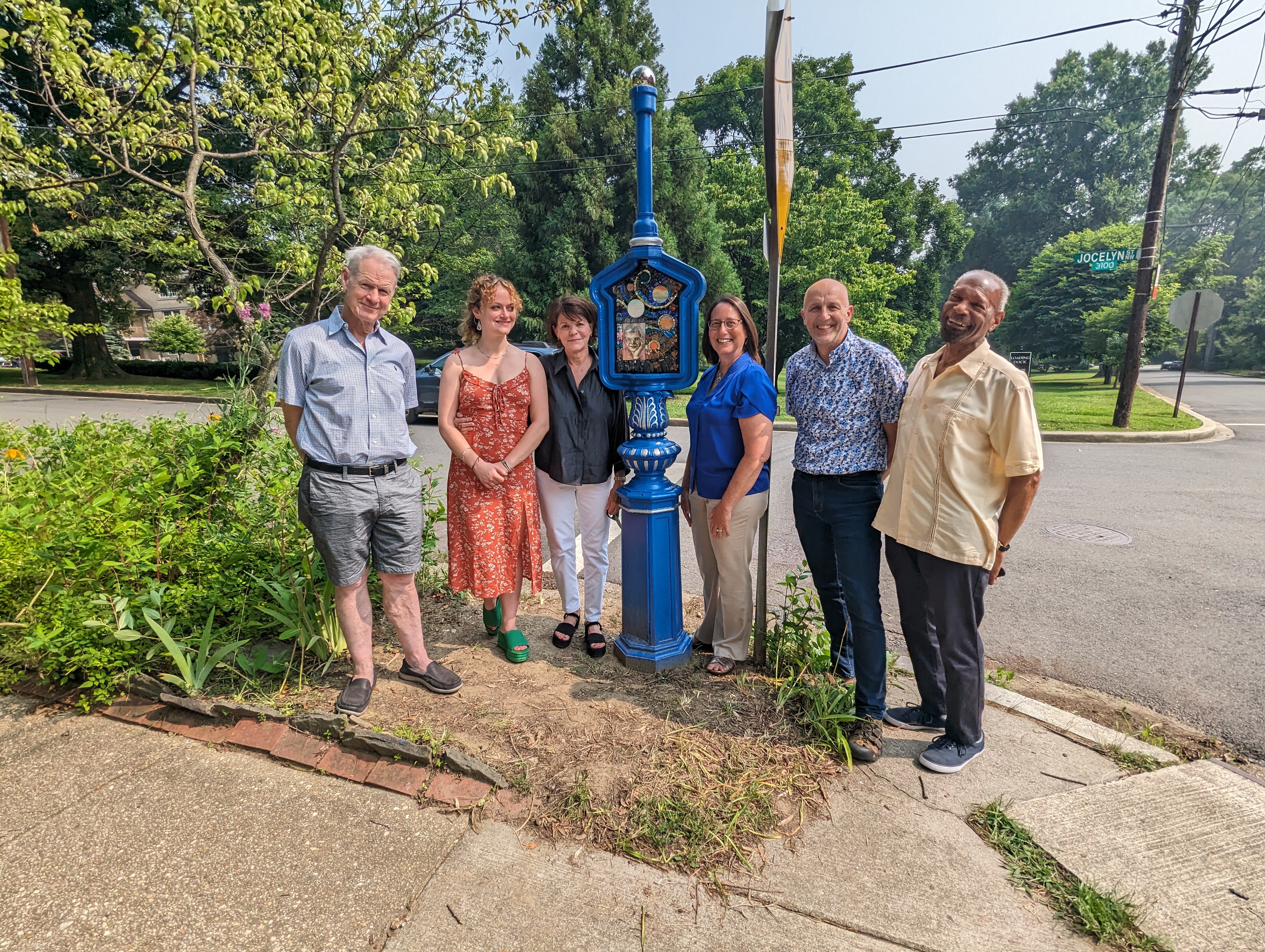
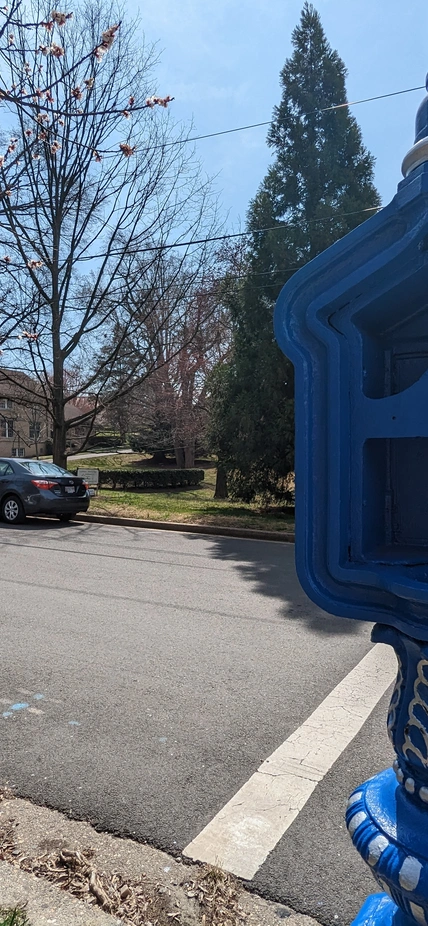
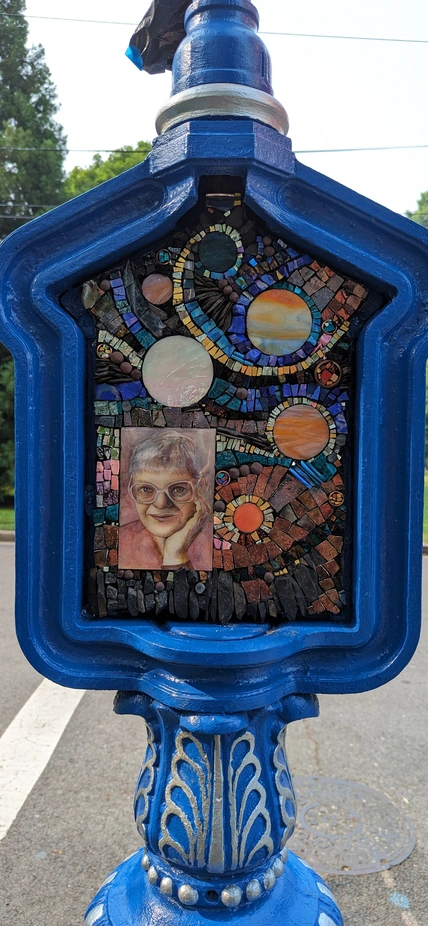
At the corner of Jocelyn and 32nd Streets in Northwest Washington, D.C., a call-box-turned-art-installation invites passersby to contemplate the hidden forces that shape our universe.
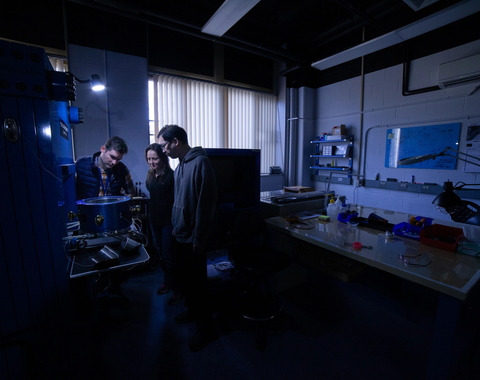
Featuring a hand-painted portrait of Vera Rubin, the Carnegie Science astronomer whose groundbreaking work provided the first hard evidence of dark matter, the newly minted mosaic stands just a stone’s throw from where Rubin conducted some of her most groundbreaking research at the institution’s Earth and Planets Laboratory (EPL).
To celebrate the new community landmark, EPL opened its doors to nearly 100 neighbors, scientists, community leaders, and artists for a summer soiree complete with space-themed snacks and cosmic lemonade. After brief remarks from Rubin’s friends and colleagues, the crowd gathered for the grand reveal of the artwork, which had been covered in fabric for dramatic effect.
“This call box expresses the beauty and wonder of the cosmos in a way that I think Vera would have appreciated,” said EPL Director Michael Walter to the crowd, emphasizing how art can help a wider community appreciate even the most intricate scientific concepts.
A Legacy That Redefined Our Universe
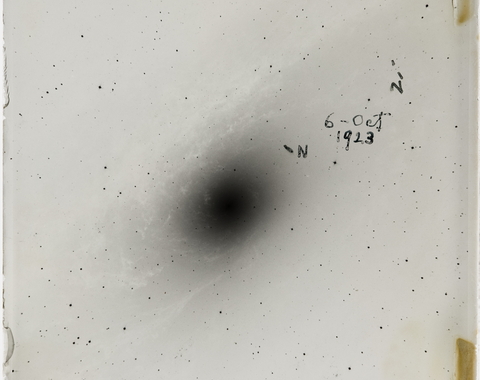
Vera Rubin’s research at Carnegie Science unearthed insights that revolutionized our understanding of galaxy dynamics. In the late 1970s, she and longtime colleague Kent Ford, an expert in instrument development, examined the rotation curves of spiral galaxies and found something wholly unexpected: stars on the outer edges were moving just as fast as those nearer the center, defying the expectations of classic Newtonian physics.
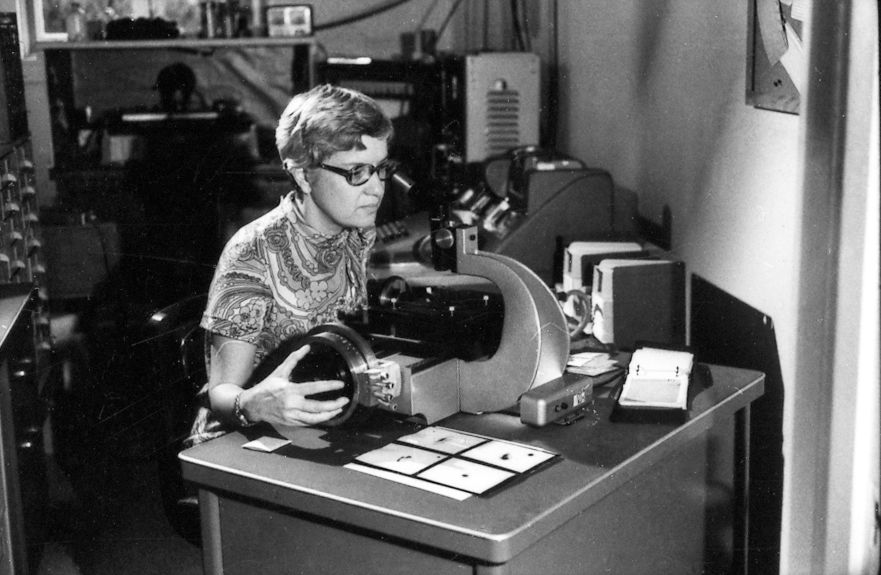
The most plausible explanation was an invisible, yet powerful, mass—which we now call dark matter—providing the gravitational glue that holds galaxies together. Though others had hypothesized its existence, Rubin’s data offered the first concrete evidence, forever altering the course of modern astrophysics. While dark matter remains one of science’s great unsolved puzzles, her discovery still underpins current research.
In addition to scientific breakthroughs, Rubin was also a fierce advocate for women in science—pushing for the same observing privileges as male colleagues and mentoring rising astronomers. Rubin devoted her life in equal parts to scientific discovery and dismantling barriers in STEM.
Alycia Weinberger, an EPL astronomer who worked alongside Rubin, recalled: “She was a trailblazer for women in science. She was also a wonderful colleague, a friend, and an inspiration.”
She was a trailblazer for women in science. She was also a wonderful colleague, a friend, and an inspiration.
Bringing Science Into the Community
Local creators Danielle Feuillan, Sarah Joyce-McCarron, and Laura McCarron saw the Rubin call box project as a chance to highlight this local legend. “We often strolled by Rubin’s house and said, ‘That’s where Vera Rubin lived—she discovered dark matter,’” Joyce-McCarron recalled. “Of course, we didn’t really know what that meant at the time.”
As they learned more about Rubin and dark matter, the creative team became determined to capture the scientific depth and impact of her career in a multi-hued mosaic of swirling celestial motifs, hinting at the invisible structures Rubin spent her life illuminating.
The call box restoration is part of a broader campaign led by the Chevy Chase Community Association to repurpose D.C. 's aging emergency call boxes as neighborhood landmarks, both preserving local heritage and celebrating those who shaped it.
A true community effort, the installation was made possible by a coalition of local organizations, including District Bridges, Chevy Chase Main Street, Ch/Art, and Historic Chevy Chase DC. It was sponsored by Advisory Neighborhood Commission 3/4 G, Little Beast, and Carnegie Science. Carnegie Science also provided scientific guidance on Rubin’s discovery and hosted the celebratory event that drew the neighborhood together.
A Lasting Tribute to Curiosity and Exploration
The Vera Rubin Call Box is more than just another street-corner ornament—it’s an invitation to wonder.
For those new to Rubin’s legacy, the artwork provides a window into one of the 20th century’s most pivotal astronomical breakthroughs. For those already inspired by her life, it offers a well-earned homage to a scientist whose work still resonates in classrooms, observatories, and research papers worldwide.
This installation provides a bridge that connects Carnegie’s neighbors to the past, present, and future of discovery that has occurred right in their backyards. Thanks to the combined efforts of our community, Rubin’s story is woven into the fabric of the neighborhood she called home. Now, anyone who strolls past the Earth and Planets Laboratory can pause and recall the scientist who helped us see the invisible framework of our universe—and imagine what spectacular breakthroughs might lie just beyond the horizon.