What Star Trek Got Right, and Wrong, About Strange New Worlds

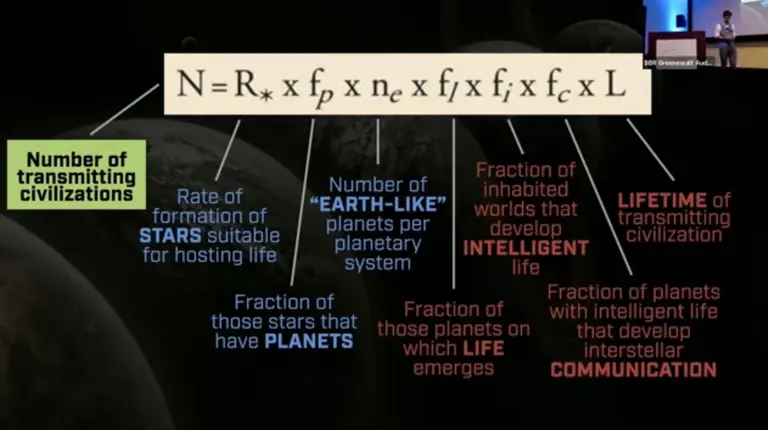
In 1964, the concept underpinning the Drake Equation—a formula for estimating how many civilizations might exist in our galaxy—figured prominently in Gene Roddenberry's pitch to NBC for Star Trek. Unfortunately, he didn't know what it looked like, so he scribbled something plausible and sent it in. The network didn't know either, and the show was approved. Later, as Carnegie astrobiologist Michael Wong tells it, Frank Drake himself saw the fake equation that substituted for his namesake and burst out laughing.
Sixty years later, Carnegie scientists can fill in part of the real equation. On Sept. 9, the Earth and Planets Laboratory hosted a special Neighborhood Lecture in Washington, D.C., to check Star Trek's science against today's research.
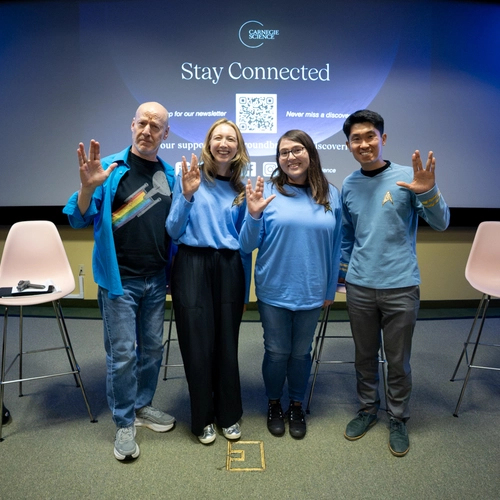
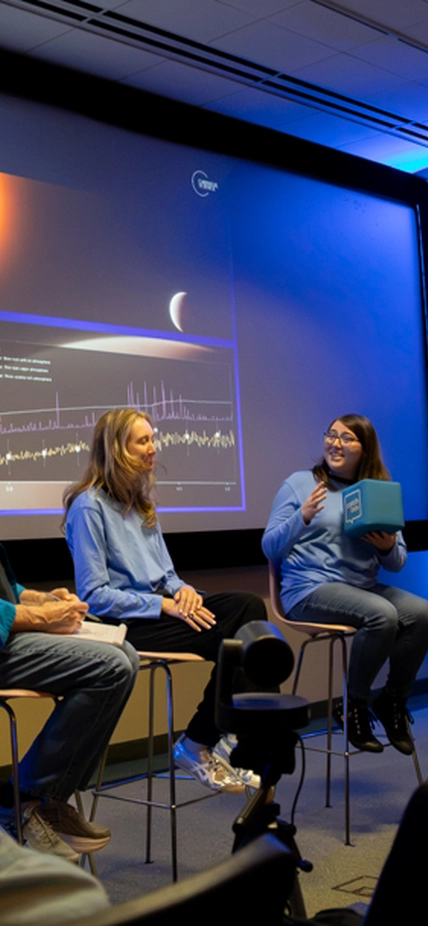
The room was full of Star Trek-loving scientists and neighbors, including the evening's panelists. Wong, the featured speaker, was dressing up as Captain Kirk at age six. Panelist Postdoc Maggie Thompson crawled toward the TV as a baby whenever The Next Generation theme played. Postdoc Nicole Wallack ignored advice to watch the original series as a kid, then found herself watching the J.J. Abrams’ 2009 reboot in theaters eight times.
EPL Director Michael Walter, who hosted the event as "captain" of the "USS Carnegie," and "The Bad Astronomer” Phil Plait, who moderated the panel discussion, guided the evening's discussions.
So how did Star Trek do?
What Star Trek got right
1. Lava planets are real
The original series episode "The Savage Curtain" featured a planet of molten rock, which Plait dismissed as impossible when he was a kid. Today, a Carnegie-led team including Postdoc Nicole Wallack has used JWST to find the strongest evidence yet of an atmosphere on a rocky planet beyond our Solar System. That planet is the lava world TOI-561 b, where a year lasts just 10.56 hours.
"I thought, well, that can't be. You can't have a planet like that. And it turns out, maybe you can."—Phil Plait
2. Planets really do start out molten
Star Trek's Genesis device melts a world down and rebuilds it. Thompson does something similar on a tiny scale, using a laser to turn milligrams of floating rock into glowing molten spheres. Nearly every rocky planet, including early Earth, likely began as a magma ocean, and her experiments show how those molten interiors form atmospheres.
"I would definitely be optimistic, because it turns out water is something that really likes to hang out and dissolve in at least Earth-like magmas."—Maggie Thompson
3. One star can host several Earth-sized worlds
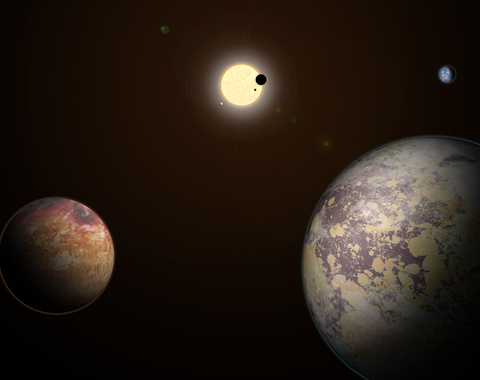
Plait assumed Star Trek's systems with multiple habitable planets were pure fiction. Then astronomers found the TRAPPIST-1 system, which has seven Earth-sized planets orbiting closer to their star than Mercury is to the Sun.
"Star Trek's problem was that it didn't think big enough sometimes." —Phil Plait
4. A planet's air says who lives there
In Star Trek: Discovery, Captain Burnham introduces humanity to aliens by sending the makeup of Earth's air. Wong says that's sound science: our atmosphere reflects billions of years of life shaping the planet. Measuring the air of distant worlds is at the heart of Staff Scientist Peter Gao's research.
"What Star Trek does and what we do here are not very different."—Peter Gao
5. Alien life may first appear as an anomaly
In "The Devil in the Dark," the silicon-based Horta go undetected by scans built for carbon-based life. Wong expects real discoveries to start the same way: as puzzles. His team trains machine learning models to recognize the molecular patterns of life. The approach recently found chemical evidence of life in 3.3-billion-year-old rocks.
"I believe that confusion is the gateway to discovery." —Michael Wong
What Star Trek got wrong
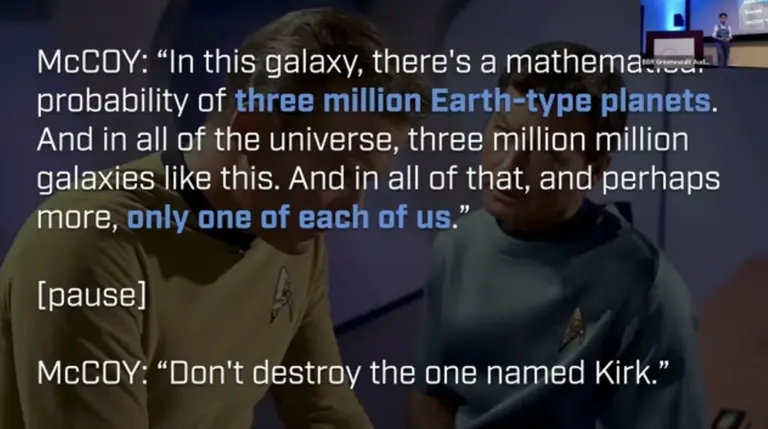
1. There are far more Earth-like planets than McCoy thought
In "Balance of Terror," Dr. McCoy estimates that there are 3 million Earth-type planets in the Milky Way. Using modern data, Wong gets roughly 40 billion. That puts McCoy off by more than a factor of 10,000.
"Damn it, Jim, I'm a doctor, not an astrophysicist."—Michael Wong, channeling Bones
2. Aliens almost certainly aren't humanoid
Star Trek explains its many human-looking aliens with an ancient species that seeded the galaxy with its genes. Evolutionary biologist Mohamed Noor, a Star Trek science consultant, has shown that billions of years of mutation would scramble any such blueprint.
"I think that life out there will utterly baffle us and surprise us." —Michael Wong
3. Real planets don't give up their secrets at a glance
Spock reads a planet's atmosphere in seconds. Wallack spent 50 hours with JWST to get seven data points on TOI-561 b. Thompson compared it to spotting a bug in front of a New York City streetlamp from San Francisco.
"I don't think the story stops at those seven points. I think it just kind of starts."—Nicole Wallack
Carnegie Science goes where no one has gone before
"If Star Trek's going to become real, then places like Carnegie are going to be the places where it's going to happen."—Phil Plait
Neighborhood Lectures are free thanks to supporters who believe discovery should be shared. Sign up for our newsletter and follow us on social media to hear about future events or donate to help us keep bringing programs like this to our community.