Object 27 | Album: The Human Side of Geophysics

A white-hot crucible plunges into a pot of water. The chemist gripping the tongs is visible from the shoulders down, his head cropped out of the frame. Beside the photograph, a hand-lettered caption explains: “Where Allen lost his head completely.”
The joke belongs to Ernest S. Shepherd, a physical chemist who joined Carnegie Science's Geophysical Laboratory in its first months. In 1906, he began a photograph album that he would add to for several years, titling it The Human Side of Geo-Physics at Washington DC and inscribing it, with a wink, as a holiday present to his “own sweet self.” Now held in the Geophysical Laboratory Photograph Collection in the Carnegie Science Archives, the album is Object 27 in our #Carnegie125 series. It is nearly the only visual record of the laboratory's earliest days, and an equally rare glimpse of the personalities who built it.

Chemist E.T. Allen (with his head out of frame) quenching a white-hot sample crucible in a pot of water at the Geophysical Laboratory. The photograph was jokingly captioned “Where Allen lost his head completely” in the photo album featured as Object 27 in our #Carnegie125 series.

Physical chemist Ernest S. Shepherd at work at the Geophysical Laboratory. Shepherd joined the laboratory in its first months. In 1906, he began a photograph album that he would add to for several years.

Shepherd titled the album The Human Side of Geo-Physics at Washington DC and inscribed it, with a wink, as a holiday present to his “own sweet self.”
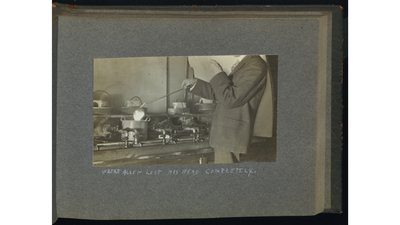
Where Allen Lost His Head Completely
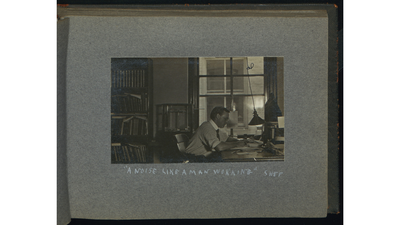
Ernest S. Shepherd
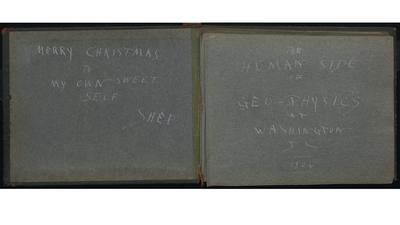
The Human Side of Geo-Physics
The idea for the laboratory began to take shape almost as soon as the institution did. Shortly after Andrew Carnegie's December 1901 announcement of a $10 million gift for scientific research, Charles D. Walcott, director of the U.S. Geological Survey (USGS), who would soon become secretary of the new institution's Board of Trustees, began lobbying for a laboratory that would bring the methods of physics and chemistry to bear on geology. In 1903, an advisory committee of earth scientists published a detailed plan covering staff, budget, and even the building. At its core were questions geologists could not settle in the field: At what temperatures do rocks melt? How does molten rock crystallize as it cools, and how does pressure change the result? The Carnegie Trustees formally established the Geophysical Laboratory on December 12, 1905.
Under its first director, Arthur L. Day, the new lab built its program around controlled experiments. Its scientists developed furnaces and pressure apparatus to mimic conditions deep inside the Earth, then heated simplified rock compositions to carefully controlled temperatures to learn which minerals and melts were stable under which conditions. That approach would soon make the laboratory a world center of experimental petrology.
The work began in borrowed space. Day and chemist E. T. Allen had been running high-temperature experiments at the USGS since 1900, and most of the founding staff came from the Survey too. Until they had a building of their own, the laboratory's employees worked on the fourth floor of the USGS headquarters at 1330 F Street NW in downtown Washington.
Shepherd's album introduces them. A group portrait, likely taken by Shepherd in 1906, shows the first staff: Director Day alongside physicists, a chemist, a petrologist, mechanics, and technical and administrative staff. Shepherd labeled the photograph “The Bunch” and gave his colleagues nicknames. Physicist J. K. Clement became “Corporal,” mechanician W. Beck was “Professor Blow-torch,” and Allen was dubbed “In Charge of Precisions Garbage Cannery.” Shepherd saved one of the best for himself: “Quite Undismayed By Facts.”

This group portrait, likely taken by Shepherd in 1906, shows the Geophysical Laboratory’s first staff: Director Day alongside physicists, a chemist, a petrologist, mechanics, and technical and administrative staff. Shepherd labeled the photograph “The Bunch” and gave his colleagues nicknames.

Under its first director, Arthur L. Day, the Geophysical Laboratory built its program around controlled experiments.
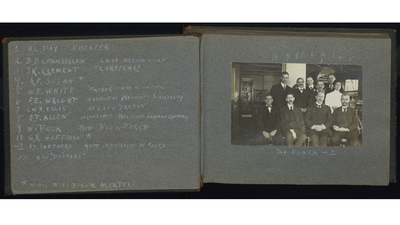
The Bunch
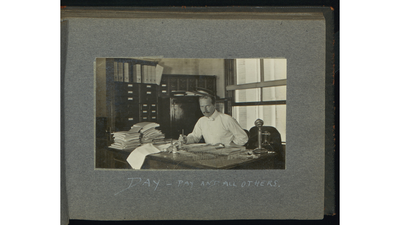
Arthur L. Day
Other pages record the tools of the new science: furnaces and calorimeters, a pyrometer for reading extreme temperatures, potentiometers for precise electrical measurements, gas furnaces, the machine shop, and Allen's chemistry lab. The album captures some of the laboratory’s early high-temperature apparatus.
Even here, Shepherd couldn’t resist a punchline. A photograph of Day and Shepherd beside a large carbon arc and resistance furnace is captioned “Pure bluff,” perhaps a nod to the staged pose and Day’s formal attire. Another shows Allen at work while Shepherd acts out a remark attributed to William F. Hillebrand, one of the leading chemists of the day, with the caption “Good Picture, Bad Chemistry.” A double exposure layering Allen's laboratory over technical assistant C. W. H. Ellis at work in the shop is labeled “Very Close Quarters,” perhaps a joke about the cramped F Street rooms.

A photograph of Day and Shepherd beside a large carbon arc and resistance furnace is captioned “Pure bluff,” perhaps a nod to the staged pose and Day’s formal attire.

A double exposure layering Allen's laboratory over technical assistant C. W. H. Ellis at work in the shop is labeled “Very Close Quarters,” perhaps a joke about the cramped F Street rooms.

Allen at work while Shepherd acts out a remark attributed to William F. Hillebrand, one of the leading chemists of the day. Shepherd captioned the photograph “Good Picture, Bad Chemistry.”
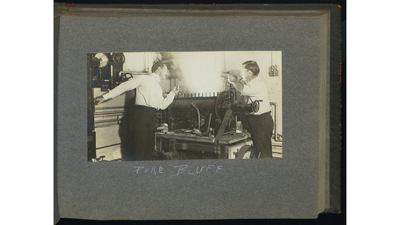
Pure Bluff
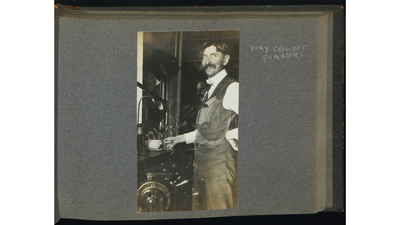
Very Crowded Quarters
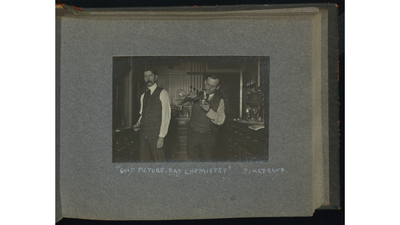
Good Picture, Bad Chemistry
The album follows the laboratory's move from temporary quarters to its long-term home. Two photographs from the F Street years carry Shepherd's titles. “Inspiring Outlook” looks east across downtown toward the Capitol, past the Willard Hotel. “More Inspiration” looks south over the District Building, then under construction, to the Smithsonian Castle peeking out between smokestacks.
Meanwhile, Day's plans were becoming reality at a plot of land on Upton Street in northwest Washington, D.C., the institution bought in March 1906. He had sketched a three-story building with a basement for heavy equipment and a machine shop, where new tools could be brought to fruition, plus a main floor of independent laboratories with offices and optical rooms above, as well as living quarters so researchers could tend to experiments around the clock. The architects, Wood, Donn & Deming, turned Day’s sketches into a Spanish Renaissance Revival design with tall ceilings and two-foot-thick walls.
The album records the groundbreaking in July 1906 and, later that year, the rising structure, which Shepherd dubbed “A House of Dreams Untold.” The staff moved in on June 7, 1907, and the building remained the laboratory’s home until 1990. That year, the Geophysical Laboratory moved to Carnegie’s Broad Branch Road campus, where it later merged with the Department of Terrestrial Magnetism to form today’s Earth and Planets Laboratory.

The album follows the Geophysical Laboratory's move from temporary quarters to its long-term home. This photograph from the F Street years, which Shepherd titled “Inspiring Outlook,” looks east across downtown toward the Capitol, past the Willard Hotel.

Day's plans for a new building were becoming reality on a plot of land on Upton Street in northwest Washington, D.C., that the institution bought in March 1906. The album records the groundbreaking in July 1906.

The rising structure on Upton Street, which Shepherd dubbed “A House of Dreams Untold.” The staff moved in on June 7, 1907, and the building remained the Geophysical Laboratory’s home until 1990.
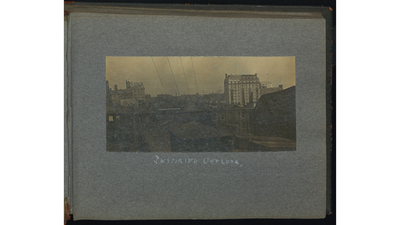
Inspiring Outlook
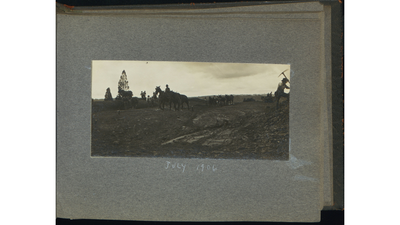
Upton Street
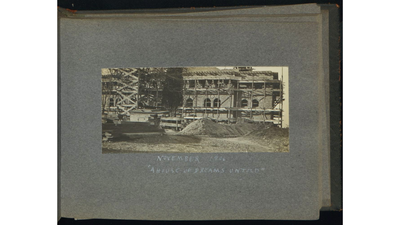
A House of Dreams Untold
Having photographed its beginnings, Shepherd went on to spend nearly four decades working and living in the Upton Street building until he retired in 1946. His contributions went well beyond the album. In 1909, he and colleague George A. Rankin developed the one-atmosphere quenching technique: by cooling a molten sample almost instantaneously, researchers could lock in the minerals and textures that had formed at high temperature and for study room temperature. The method has since been used in countless experiments in petrology, ceramics, and metallurgy, and it remains in use today. Later in his career, Shepherd turned to analyzing the gases released by volcanoes and trapped inside igneous rocks.
Today, Earth and Planets Laboratory scientists still study matter under extreme pressure and temperature conditions and still develop new tools and techniques to push the boundaries of investigation in novel directions. The questions have grown from understanding Earth’s rocks to probing the deep interiors of planets and the characteristics that make a world habitable, but the approach Shepherd and his colleagues pioneered endures, and so, we hope, does their sense of humor.
