Lori Willhite brings EPL's mass spec lab into the future

It’s no secret that technological advancements drive scientific discovery. So, when the opportunity for innovation knocks, it’s best to answer the door.
That’s certainly the case for Lori Willhite, who just completed her first year as Mass Spectrometry Lab Manager at Carnegie Science’s Earth and Planets Laboratory and a major upgrade of the campus’ geochemistry facilities.
“This was a once-in-a-career opportunity,” she says, explaining her decision to join Carnegie. “I feel very lucky to be on the verge of managing a new, elite research space that will help drive discovery in priority areas for EPL.”
Driven by the 2023 arrival of two new Staff Scientists—geochronologist Jennifer Kasbohm and isotope geochemist Andrea Guiliani—the lab renovation has more than doubled the research space, making room for new instruments.
The geochemistry team—which also includes Staff Scientists Steve Shirey, Anat Shahar, Conel Alexander, as well as Senior Research Scientist and Secondary Ion Mass Spectrometer (SIMS) Lab Manager, Jianhua Wang, and Geochemistry Laboratory Manager Michelle Jordan, have worked together to create a lab space with the capacity to redefine the cutting edge of analytical geochemistry. Their efforts were aided by Carnegie Science Facilities Director David Ashwood.
In collaboration with a team of specialized architects—and building off of planning work undertaken by her predecessor in the role, Timothy Mock, who retired at the end of 2024— Willhite helped ensure that the enhanced space will be able to meet all of the power, temperature, and stability needs of the lab’s instrument suite.
“Even at labs where world-class science is being done, it’s not uncommon to have to shut things down due to temperature concerns in the dead of summer,” she explains. “But that won’t be a problem here.”
Willhite discovered her passion for technical and instrumentation work while pursuing her M.S. at the University of California Santa Barbara, when she needed to figure out how to fix and operate a brand-new mass spectrometer. She later worked at NASA GSFC building and testing instrumentation for space missions and eventually completed her Ph.D. at the University of Maryland, where she had a taste for technological problem solving on big research questions.
“Sitting down and saying, ‘how can we try something in a new way’ is fundamental to the Carnegie approach,” she says. “I’m intrigued by the idea of developing new analytical methods and combining new techniques with tried-and-true ones in interesting ways and that is how Carnegie scientists like to work best.”
There are now three state-of-the art instruments in the facility. These will be enhanced by a new instrument arriving later in the year, and a custom, one-of-a-kind mass spectrometer arriving in approximately 2027.


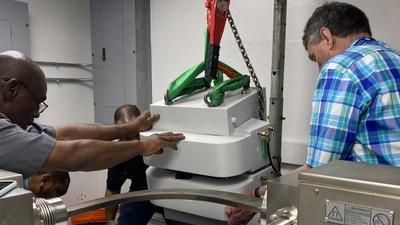
The renovation required the delicate relocation of several high-precision instruments. Credit: Lori Willhite/Carnegie Science
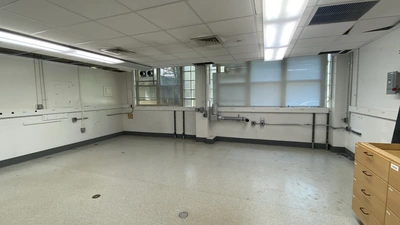
Construction began in late August 2025 to update the mass spectrometry lab in the Earth and Planets Laboratory's cyclotron building, increasing the size of the facility in order to bring in brand new instruments and expand analytical capabilities. Credit: Lori Willhite/Carnegie Science
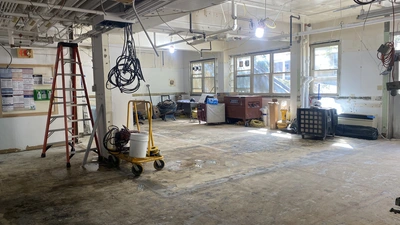
A complete overhaul of the Mass Spec Facility on Carnegie's Broad Branch Road campus ushers in a new era of geochemistry research at the Earth and Planets Laboratory. Credit: Lori Willhite/Carnegie Science
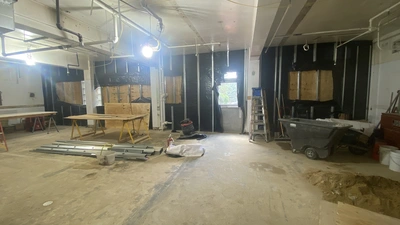
A complete renovation of the space was undertaken in order to bring fresh instrumentation capabilities for the geochemistry team at Carnegie's Earth and Planets laboratory. Credit: Lori Willhite/Carnegie Science
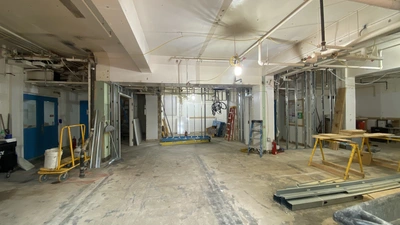
The Earth and Planets Laboratory's mass spec lab was expanded to make room for a more extensive instrument suite with even greater research capabilities. Credit: Lori Willhite/Carnegie Science
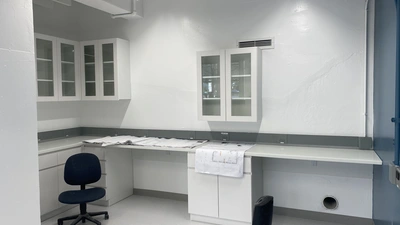
The newly remodled mass spec lab contains this area for loading samples that will be analyzed by the TIMS, a highly sensitive isotope mass spectrometer. Credit: Lori Willhite/Carnegie Science
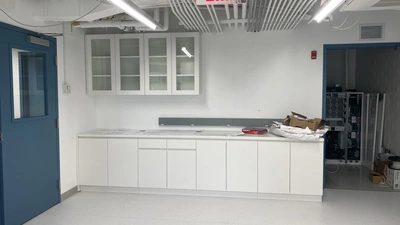
Look at all that working space! The beautifully remodeled new lab contains this space for loading samples to be analyzed by the Inductively Coupled Plasma Mass Spectrometer. Credit: Lori Willhite/Carnegie Science
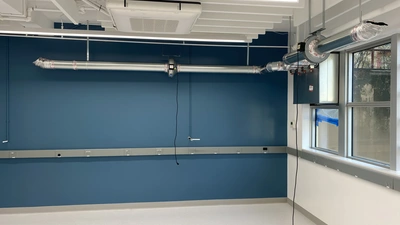
Duct work undertaken as part of this remodel ensures the optimal functionality of the high-precision instruments. Credit: Lori Willhite/Carnegie Science
