Object 6 | Vera Rubin's Spiral Doodles

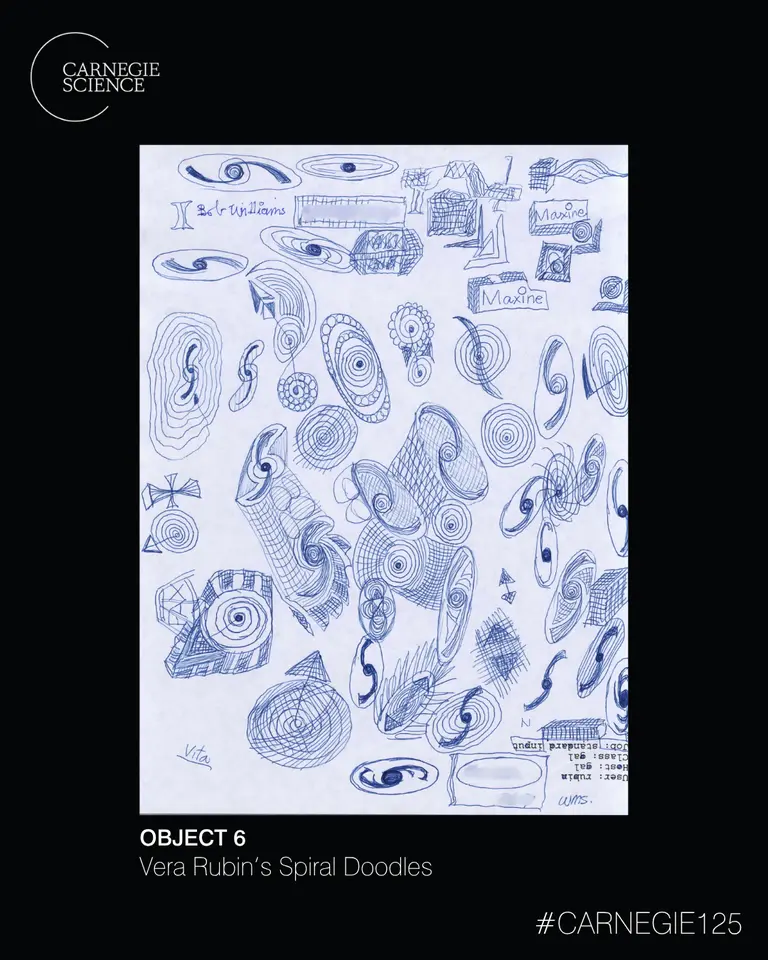
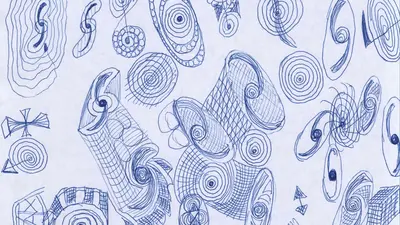
This single sheet of paper—the back of a computer printout, flipped upside down— is completely covered, edge to edge, with blue spirals. Some spirals are small, others sprawl. Some have cross-hatched shading and trellised networks. Others have beams shooting from the center like the jets of a quasar. This is what happened when Carnegie astronomer and "Mother of Dark Matter" Vera Rubin picked up the phone.
Many of us draw cubes, daisies, stars, or that one heavily stylized super "S" when our minds wander, but Rubin's comfort doodle was, unsurprisingly, galaxies.
Rubin spent her career studying how galaxies rotate. With Carnegie colleague Kent Ford, she discovered that stars at the outer edges of spiral galaxies move just as fast as those near the center, even though physics predicted they should slow down. The visible matter wasn't enough to hold these galaxies together. Something unseen had to be there, lending its mass. After studying more than 60 galaxies, Rubin and Ford built an overwhelming case for dark matter, the mysterious, invisible substance that we now know makes up more than 80 percent of all mass in the universe.
Take a Closer Look

What can doodles reveal about the doodler?

Carnegie astronomer Vera Rubin spent decades studying how spiral galaxies rotate. Rubin and Carnegie colleague Kent Ford discovered that stars at the outer edges of spiral galaxies move just as fast as those near the center, evidence of an enormous amount of unseen dark matter holding it all together. It’s no wonder spirals were her go-to doodle!

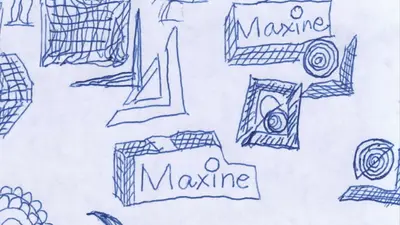
The name 'Maxine' appears twice on the page. That's Maxine Singer, Carnegie Science's president from 1988 to 2002, the first woman in the role. Both Singer and Rubin were committed to opening doors for the next generation of women in science. And based on the number of spirals on this page, it looks like their phone calls weren't short!

"Bob Williams" and a Baltimore-area phone number are penned in the upper left corner, likely astronomer Robert Williams, who directed the Space Telescope Science Institute and launched the famous Hubble Deep Field project. Just another name in Vera Rubin's Rolodex.
A Closer Look
Spirals on Her Mind
Who's Maxine?
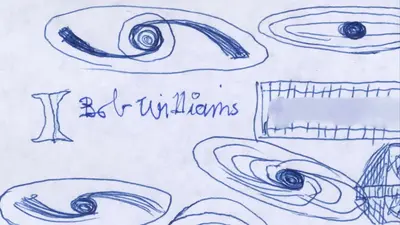
Galaxy-Sized Rolodex
Now take a closer look at the clues scattered across the page. "Bob Williams" and a Baltimore phone number (blocked out for privacy) appear in the corner, likely the astronomer who directed the Space Telescope Science Institute and launched the Hubble Deep Field project. The name "Maxine" appears twice; that's got to be Maxine Singer, the molecular biologist who served as Carnegie's president from 1988 to 2002, the first woman in the role. Both Singer and Rubin were committed to opening doors for the next generation of women in science.
So, while we don't know exactly when or why Rubin was doodling this page, she may have been chatting with her boss and fellow trailblazer while absentmindedly drawing the objects she used to show the world that most of the universe is invisible.
That's why we love this doodle. It captures something her formal honors don't; give Vera Rubin a pen and a piece of scrap paper, and she'd draw you the universe.
Keep Exploring

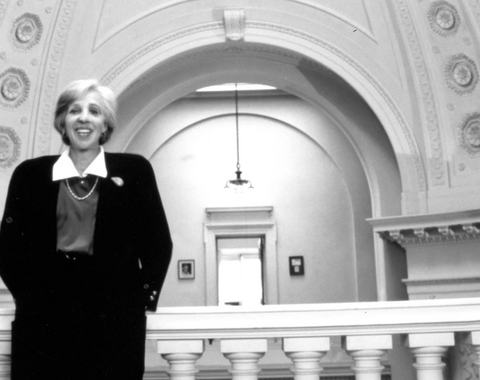
Join us in honoring Maxine Singer, President Emerita of Carnegie Science, whose pioneering research and advocacy transformed the scientific community.
Join the Conversation | #Carnegie125
