Object 21 | Ruling Engines and Diffraction Gratings

Beneath the original 1912 office building of the Carnegie Observatories on Santa Barbara Street in Pasadena sits a diffraction grating laboratory, frozen in time. A selection of diffraction gratings rest on a table, next to two small rooms each housing remarkable machines known as ruling engines. A calendar on the wall is still turned to March 1964 and a vintage bottle of red nail polish used by scientists to mark their work sits on a shelf. Comprising Object 21 in our #Carnegie125 series, the ruling engines and diffraction gratings represent an important chapter in the history of 20th-century astrophysics. Join astronomer and Carnegie Observatories Outreach Coordinator Jeff Rich in the sub-basement for a firsthand look.
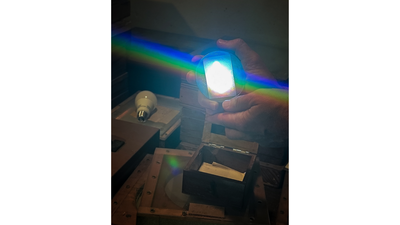
Diffraction gratings are essential tools for astronomers. When light from a star, galaxy, or planet, passes through a grating, it is split into a spectrum, a rainbow of data that can reveal the object’s physical properties including composition, temperature, motion, and distance.
Research-quality diffraction gratings were, and remain, difficult to produce. These precision instruments are made by etching thousands of straight, parallel, equally spaced grooves, so fine and closely packed they're invisible to the naked eye, into a highly reflective surface of metal or glass.

Diffraction gratings are essential tools for astronomers. When light from a star, galaxy, or planet, passes through a grating, it is split into a spectrum, a rainbow of data that can reveal the object’s physical properties including composition, temperature, motion, and distance.

These precision instruments are made by etching thousands of straight, parallel, equally spaced grooves, so fine and closely packed they're invisible to the naked eye, into a highly reflective surface of metal or glass.

Carnegie Observatories Outreach Coordinator Jeff Rich stands next to a historical ruling engine in the sub-basement of the Carnegie Observatories building.

Ruling engines were the specialized machines used to manufacture diffraction gratings, etching thousands of thin, parallel, equally spaced lines with extreme precision.

Today, the diffraction grating laboratory appears frozen in time. A calendar on the wall is still turned to March 1964 and a vintage bottle of red nail polish used by scientists to mark their work sits on a shelf.
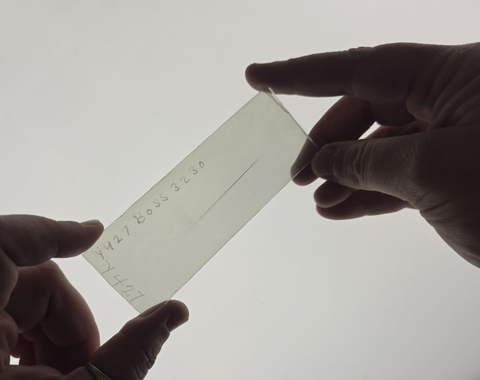
Diffraction Grating
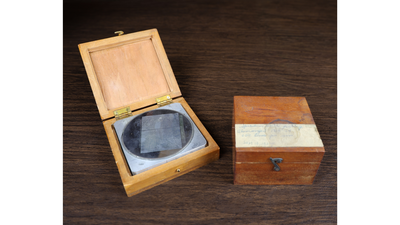
Diffraction Grating
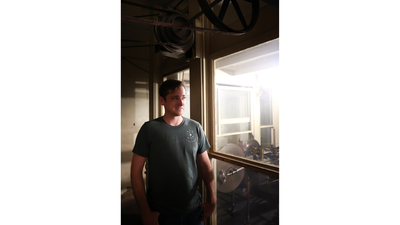
Jeff Rich and Ruling Engine
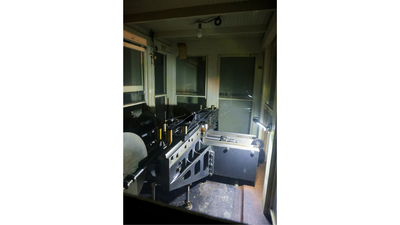
Ruling Engine
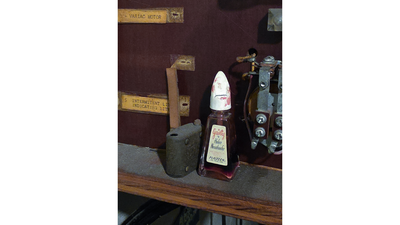
Nail Polish
Ruling engines were the specialized machines used to manufacture diffraction gratings, etching those lines with extreme precision. Even tiny variations in temperature, pressure, or vibration could affect the process, which is why the ruling engines were housed underground behind a heavy door.
When the Carnegie Observatories building was constructed in 1912, Director George Ellery Hale determined that if adequate diffraction gratings were to be available for research with the new Mount Wilson telescopes, they would need to be produced in house. The sub-basement was purpose-built, and design and construction began that year on the first ruling engine, known as the “A” machine. In 1929, work began on a second, smaller, and even more precise “B” ruling engine.

When the Carnegie Observatories building was constructed in 1912, Director George Ellery Hale determined that if adequate diffraction gratings were to be available for research with the new Mount Wilson telescopes, they would need to be produced in house. Credit: Carnegie Science/Huntington Library

The sub-basement was purpose-built to house a ruling engine laboratory. Credit: Carnegie Science/Huntington Library

Design and construction began in 1912 on the first ruling engine, known as the “A” machine, shown here. In 1929, work began on a second, smaller, and even more precise “B” ruling engine. Credit: Carnegie Science/Huntington Library
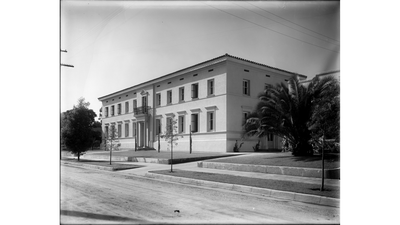
Observatories Building
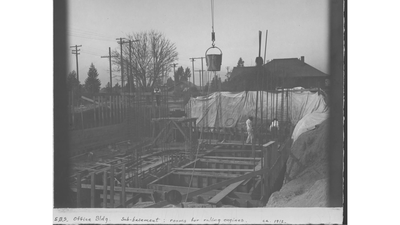
Sub-basement Construction
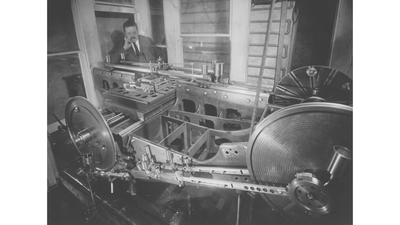
Ruling Engine
For half a century, the sub-basement laboratory turned out research-quality diffraction gratings for the spectrographs used at Carnegie's Mount Wilson and Palomar Observatories, as well as by observatories and laboratories around the world. The gratings made here enabled tens of thousands of spectra to be captured, supporting decades of research into the physics and chemistry of objects across the universe.
The laboratory shut down in 1963, as newer methods and sources of gratings took over. But the ruling engines and samples of the gratings they produced remain in the sub-basement to this day, a reminder of the precision engineering that helped make 20th-century astrophysics possible.