Object 16 | Science: The Endless Frontier

On July 5, 1945, a report landed on President Harry Truman's desk conveying an outsized ambition: to chart the course of American science for the next half-century. Titled Science: The Endless Frontier, it is Object 16 in our #Carnegie125 series, and it remains one of the most consequential documents in the history of U.S. research policy.
Its author was Vannevar Bush, who had arrived at Carnegie Science's Washington, D.C. headquarters in 1939 to take up the presidency of the institution. He was already a committed champion for science and would remain a life-long advocate for the importance of basic research. Within a year, the deepening crisis in Europe pulled him toward a much larger task.
Bush persuaded President Franklin Roosevelt that the country's scientific talent needed to be mobilized for the coming war, and Roosevelt put him in charge of the effort. Throughout the conflict, Bush ran the Office of Scientific Research and Development out of Carnegie's historic headquarters building in downtown Washington, D.C., while continuing to lead the institution. Essentially a “General of Physics,” Bush coordinated a wartime research enterprise that touched everything from radar to penicillin to the early stages of the Manhattan Project.
Before the fighting even ended, Bush was already looking ahead. In 1944, Roosevelt wrote to him with a question: how could the country carry the spirit and machinery of wartime science into peacetime? The president asked Bush to consider four things:
- how to share the scientific knowledge gained during the war
- how to turn science against disease
- how to encourage research in the public and private sectors
- how to cultivate scientific talent in the next generation of Americans.
Bush organized a set of committees to study each question, then wove their findings into a single report. Science: The Endless Frontier argued that a strong, secure, and prosperous nation depended on sustained investment in basic research— the open-ended, curiosity-driven work whose payoffs are unpredictable but, over time, indispensable.

The model that Carnegie Science president Vannevar Bush laid out in Science: The Endless Frontier—public funding, independent execution, merit-based review—became the template for U.S. science policy for the rest of the century.

Bush's conviction that basic research driven by curiosity and discovery deserved support was, in many ways, an extension of Carnegie Science's own founding mission, "to advance investigation, research, and discovery."
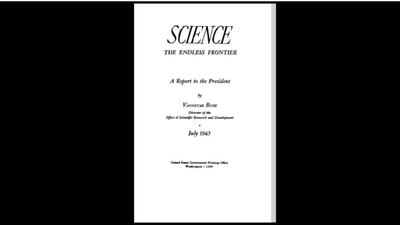
Science: The Endless Frontier
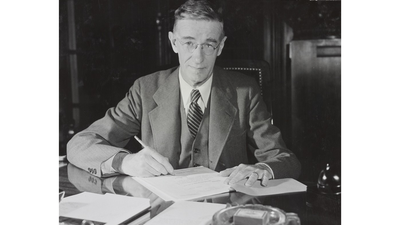
Vannevar Bush
Bush proposed a new federal body, which he called the National Research Foundation, to direct that investment. Crucially, he argued the money should flow to universities and private laboratories, rather than government facilities, and be awarded strictly on the merit of the science, rather than politics or geography, as well as shielded from interference by military or political authorities.
Bush's proposal touched off years of debate in Congress and in the new Truman administration before a bill finally created the National Science Foundation in 1950. The model Bush laid out in Science: The Endless Frontier—public funding, independent execution, merit-based review—became the template for U.S. science policy for the rest of the century.
In the introduction to the commemorative 2020 reprint of the report, then-NSF Director France A. Córdova wrote: “Science—the Endless Frontier was a remarkably prescient treatise. It retains much of its original vision and relevance today.”
Even as he was revolutionizing American investment in research, Bush had never set aside his Carnegie leadership, continuing as the institution's president until 1955 and remaining a Trustee for years afterward. His conviction that basic research driven by curiosity and discovery deserved support was, in many ways, an extension of the institution's own founding mission, "to advance investigation, research, and discovery."
