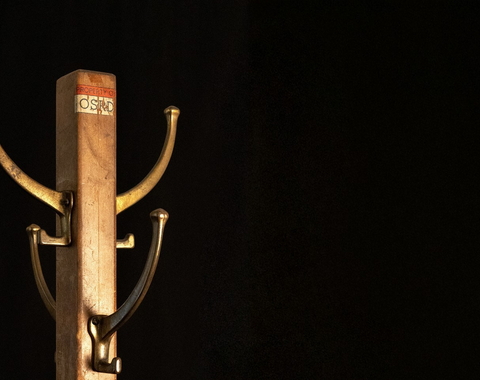
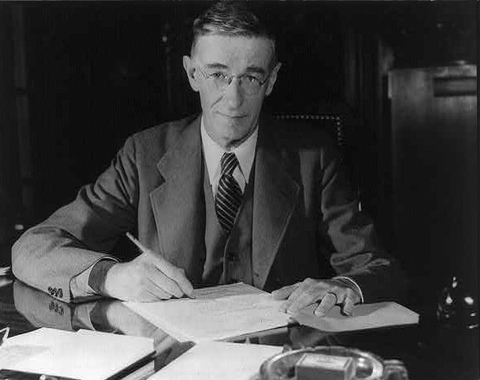
Object 15 | The "General of Physics"

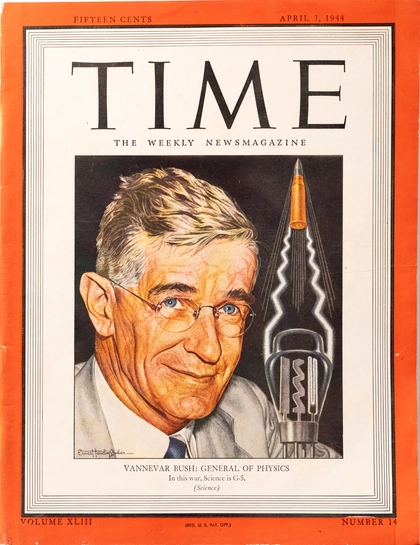
By the spring of 1944, Vannevar Bush had become something for which the United States did not yet have vocabulary. He was a scientist, but he did not spend his days conducting experiments. He was an administrator, but the term hardly captured what he oversaw. As president of Carnegie Science and director of the Office of Scientific Research and Development, he presided over the laboratories responsible for radar, the proximity fuze, and the early work on the Manhattan Project—much of it secret, all of it consequential. When TIME put him on its cover on April 3, 1944, it reached for the nearest available shorthand. It called him the "General of Physics."
A New Kind of Scientist
The title was an exaggeration, but it had an aura of accuracy. Bush held no rank. However, some expert estimates indicate that at the height of the war effort more than two-thirds of the nation's physicists were working, directly or indirectly, under his supervision. The war was being fought in the laboratory as much as it was on the battlefield, and the laboratory answered to Bush.
The cover portrait itself was the work of Ernest Hamlin Baker, one of the magazine's most prolific cover artists, with more than 300 TIME covers to his name. The article inside ran under the headline "Yankee Scientist." The story profiled Vannevar Bush and broke down OSRD and the Allies' contributions to the war effort, including:
- Radar — sharpened from a crude locator tool into the military's "eyes" on the skies, able to find aircraft through cloud or darkness and to aim anti-aircraft guns
- Supersonic submarine detection — a sound-beam locator that became the fleet's "ears" beneath the ocean's surface
- Self-steering torpedoes — capable of traveling up to five miles at speeds faster than 50 mph
- Rockets and jet propulsion — including the shoulder-fired bazooka
- The amphibious "Duck" — a 2.5-ton truck that could push through heavy surf onto a beachhead
- Faster penicillin production — keeping the troops healthy and ready to fight
- A freon "mosquito bomb" — capable of clearing a tent of insects in mere minutes
- An unquenchable magnesium fire bomb — and a bomb fuse that armed itself mid-fall
- Quieter fixes — mothproof, washable uniforms; fireproofed flight gear; night-vision phosphors; a wing putty that cut enough drag to recover 180 horsepower
That a scientist appeared on the cover at all was not all that unusual. Einstein had been there more than once by 1944, and Nikola Tesla made the cover in 1931 in honor of his 75th birthday. What was new was the framing. Bush stood for something worldly: science as an organized force, marshaled in the service of a nation's survival. The cover marked a change in what Americans understood science's purpose to be.
Highlights from "Yankee Scientist"

Beyond the War
As the country was fixing Bush in its imagination as a scientific commander, he was turning toward the ideas that would outlast wartime devices. In July 1945, he published "As We May Think" in The Atlantic, imagining a desk-sized machine—he called it the "memex"—that could hold the whole of human knowledge and let a reader move through it along associative "trails." Historians of computing now read it as an uncanny premonition of hypertext, and of the internet.
That summer, still serving as Carnegie's president, Bush sent the White House a report titled Science, The Endless Frontier. Its point was clear: that a nation that leaves discovery to others will fall behind in health, in wealth, and in security and that it behooved federal government to underwrite basic research in peacetime at a never-before-seen level. Five years later, that argument became an institution—the National Science Foundation—and it has shaped how America does science ever since.
Each of Bush's post-war achievements is large enough to deserve its own story. Yet, this TIME cover captures a moment before all of that. In 1944, when people across the country looked at newsstands and saw the face of a new kind of wartime leader, they didn't yet know that they were actually looking at the architect of a powerful new idea—the theory that a nation's strength depends on how seriously it invests in scientific discovery.
This is Object No. 14 in our #Carnegie125 series, marking 125 years of Carnegie Science through 125 objects from our history.

Vannevar Bush, president of Carnegie Science and director of the wartime Office of Scientific Research and Development, on the cover of TIME, April 3, 1944. The cover cast him as the "General of Physics"; a second line read, "In this war, Science is a G-5." Cover art by Ernest Hamlin Baker.

The profile introduced Vannevar Bush and the OSRD—the roughly 6,000 scientists mobilized across some 300 laboratories—then broke their wartime work down device by device: radar as the military's new eyes, submarine-detecting supersonics as its ears, and a stream of other inventions from the amphibious "Duck" to faster penicillin production.

From left: Alfred Newton Richards (medical research), Jerome C. Hunsaker (aviation), OSRD director Vannevar Bush, War Department liaison Harvey Bundy, and James B. Conant (weapons research) constituted the civilian leadership of the Office of Scientific Research and Development, which by 1944 directed some 6,000 scientists across roughly 300 laboratories.
TIME Magazine Cover
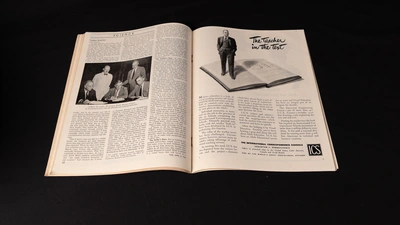
Interior Spread
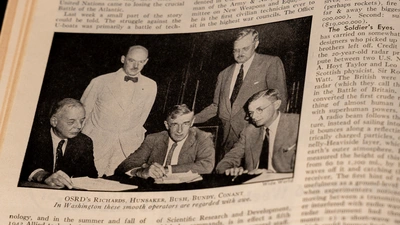
OSRD Group Photo
Keep Exploring
- Read the original article, "Science: Yankee Scientist," in the April 3, 1944 edition of TIME.
- View this cover art in the TIME cover archive, April 3, 1944.
- Learn about the artist, Ernest Hamlin Baker, who illustrated more than 300 TIME covers.
- Explore Bush's 1945 report that led to the establishment of the National Science Foundation.
- Discover the report's legacy 75 years after the National Science Foundation's founding.
- Object No. 13 | OSRD Coat Rack — A surviving witness to when Carnegie's headquarters became the command center of American science.
- Object No. 11 | Bermuda Cahiers — Field notebooks from the Department of Terrestrial Magnetism's World Magnetic Survey.
- Object No. 10 | Lunch Club Notebook — The oldest surviving tradition at our Broad Branch Road campus.