Neighborhood Lecture Recap: The Geological Mystery of Bermuda

At our most recent Neighborhood Lecture, Carnegie Postdoctoral Fellow William Frazer walked a packed room through one of the strangest puzzles in modern geology: how to explain the existence of Bermuda.
To most of us, Bermuda is a pink-sand vacation destination. To a seismologist, it's a geological problem that doesn't add up. Frazer, who earned his Ph.D. at Yale in 2024 and joined Carnegie's Earth and Planets Laboratory (EPL) shortly after, has spent years trying to figure out why this little island sits where it does, and what's holding it up.
The Bermuda Puzzle
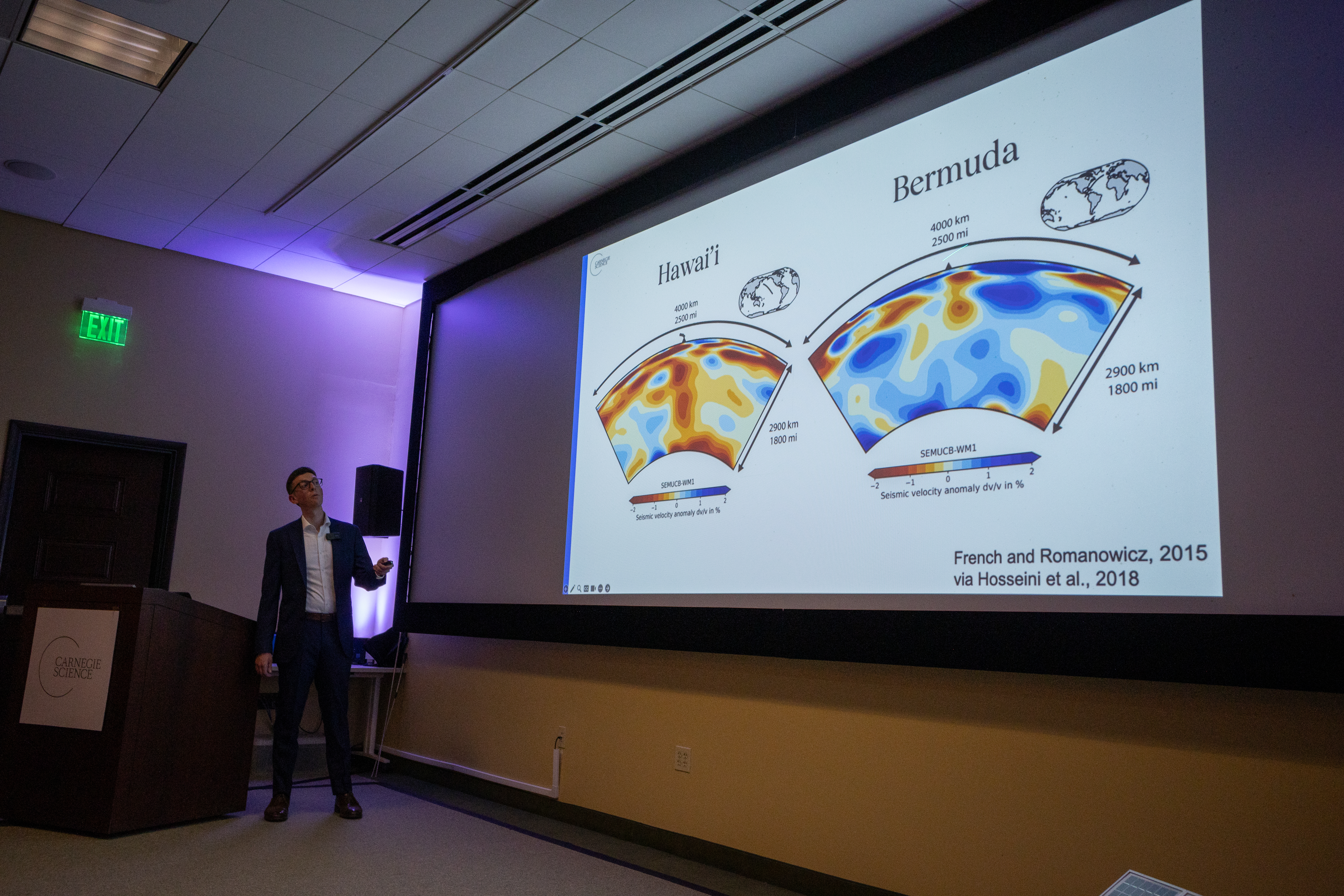
Bermuda is a tiny dot of land in the middle of the North American tectonic plate. But beneath the waves, it sits atop a massive underwater bulge, what geologists call a bathymetric swell, roughly 560 miles across and a third of a mile tall. For comparison, that's about the driving distance from Washington, D.C., to Boston.
Swells like this typically form above mantle plumes: hot columns of rock that rise from the boundary between Earth's core and mantle, nearly 1,800 miles deep. Hawaii is the textbook example of this phenomenon. Its swell; its chain of age-progressive volcanoes; and the activity occurring beneath its surface, as revealed by seismic imaging, all clearly point to a plume below.
Bermuda has the swell. And it has volcanic origins. (It last erupted about 31 million years ago.) But when seismologists look for a plume below it, they find nothing.
As Frazer put it: "Bermuda with this mantle plume model probably shouldn't exist."
The Hypothesis
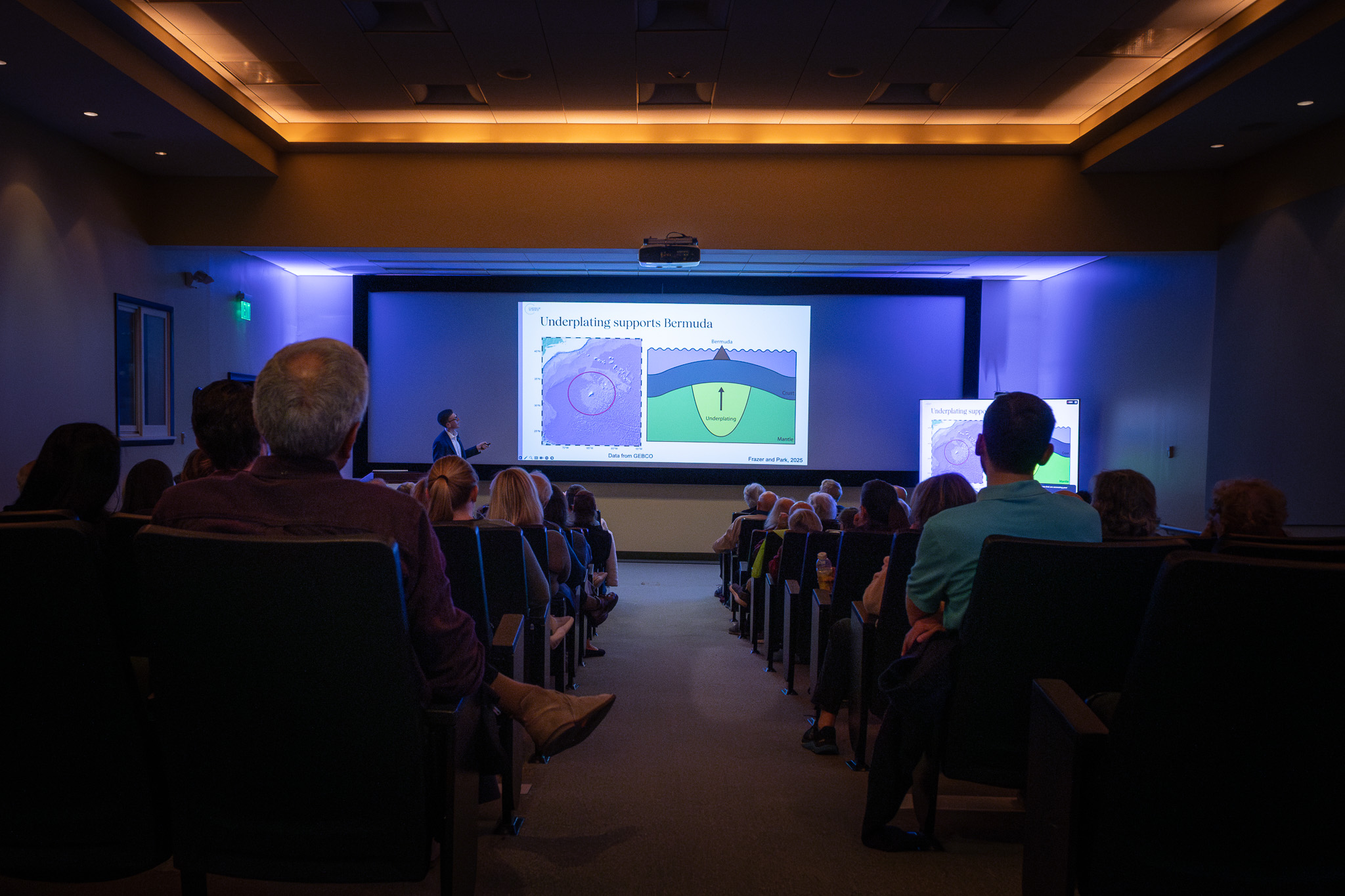
Frazer's leading explanation involves a process called magmatic underplating. When Bermuda's volcanism occurred 30 million years ago, much of the magma never made it to the surface. Instead, it pooled and froze beneath the crust, forming a thick, buoyant layer of rock. That frozen layer, not an active mantle plume, may be what's holding the entire swell up today.
By using earthquake waves like an ultrasound to image shallow structures under a single seismometer, Frazer identified a deep interface beneath Bermuda that doesn't exist below Hawaii. It's solid evidence that Bermuda is underplated. This means that there’s an unusually buoyant base layer of rock sitting below the oceanic crust, pushing upward.
The Earthquakes
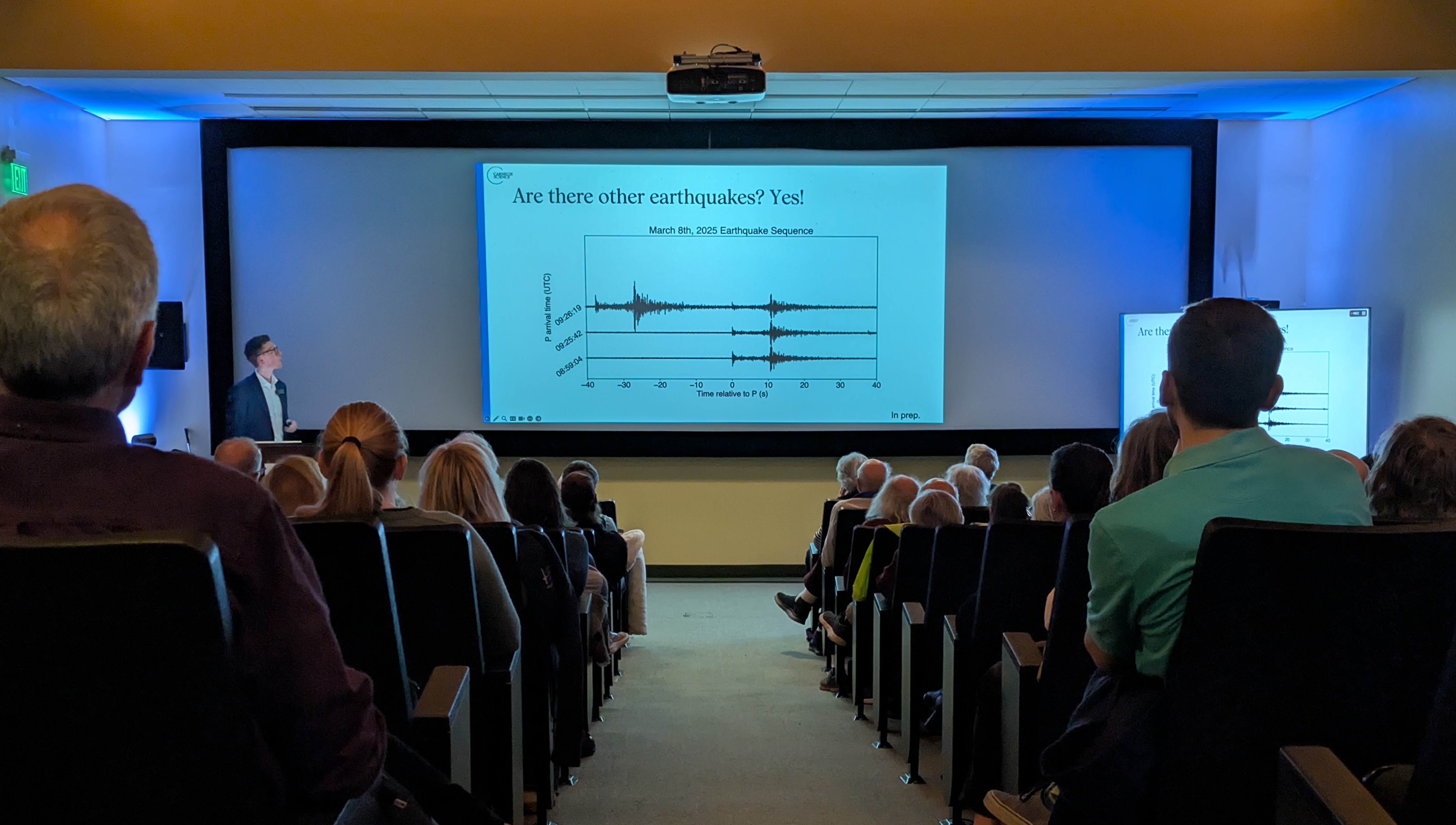
If the underplated layer is real, it should be putting stress on the overlying oceanic crust, and that stress should produce small earthquakes. So Frazer went looking, using data from Bermuda's single permanent seismic station. He found something striking: clusters of nearly identical "repeating" earthquakes, multiple events in a single hour with matching waveforms, indicating the same fault being activated again and again.
"These indicate that we have the same exact stress being activated repeatedly," explained Frazer.
The Fieldwork
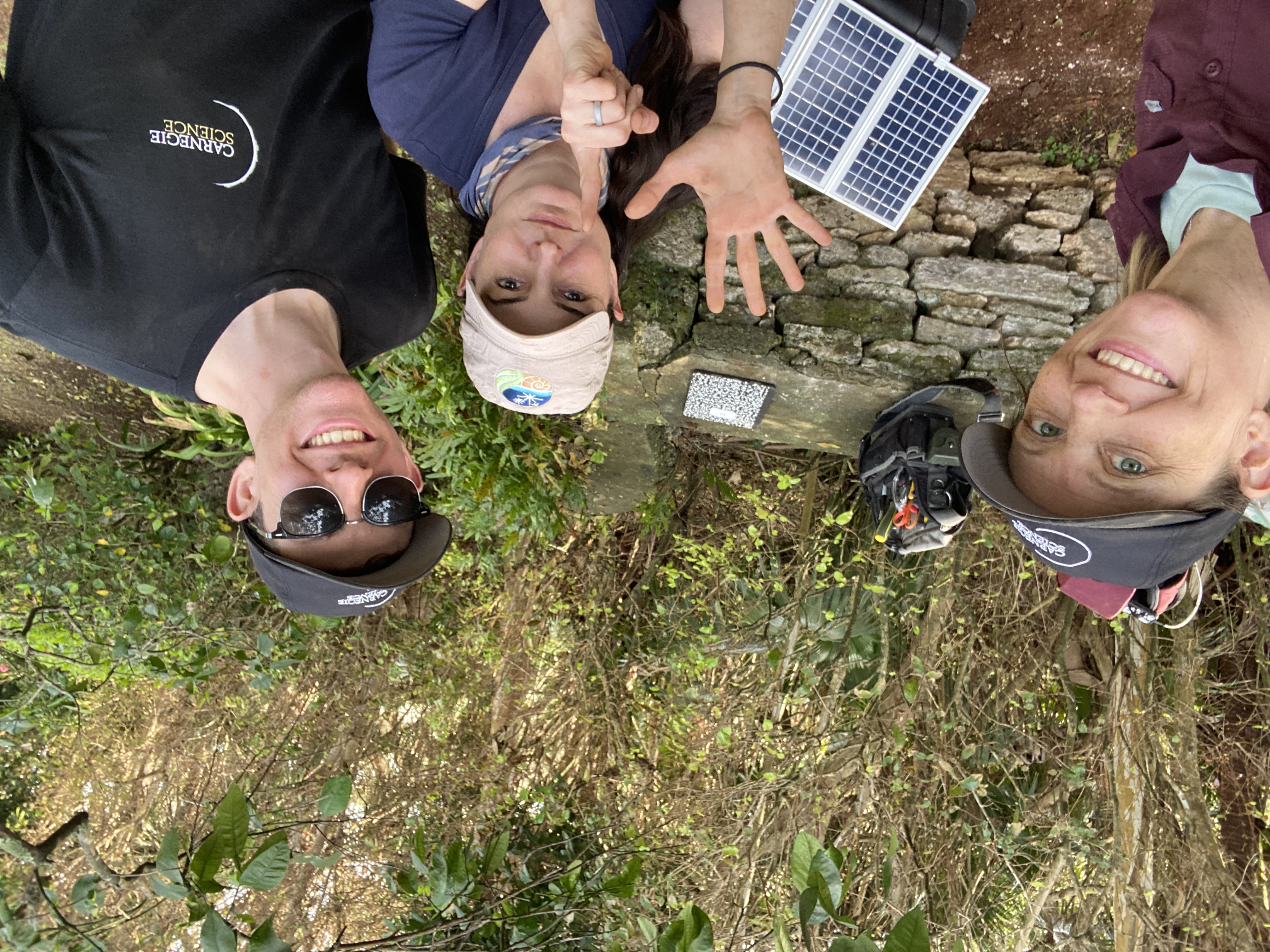
To locate these earthquakes precisely, Frazer and his colleagues, Carnegie staff scientists Diana Roman and Lara Wagner, in partnership with the Government of Bermuda, BIOS, and the Bermuda Aquarium, Museum and Zoo, deployed a network of 10 portable seismometers across the island in February 2026. They'll return in May to collect the first major data set.
Beyond Bermuda
Bermuda isn't unique. Roughly 50 oceanic swells dot Earth's seafloor, and many, like the Canary Islands and St. Helena off the coast of Anfola, defy the clean Hawaii-style mantle plume model. Understanding Bermuda may reshape how we think about volcanic islands worldwide.
A few fun facts that came up during the talk:
- The Bermuda Triangle has a real magnetic anomaly. A handheld compass can change direction depending on where you're standing on the island. The team had to build a solar compass to orient their seismometers.
- Carnegie has a historical connection to Bermuda's magnetic field. A non-magnetic research vessel called the Carnegie visited the island in 1909 and 1922 to measure it.
- One seismometer was installed inside an actual fort, on a concrete pier built by the U.S. government in the 1950s for nuclear test-ban monitoring. Frazer called it the coolest thing he's ever ever found during fieldwork.
- A seismologist's biggest enemy? Weed whackers. They cut right through the sensor cables of seismometers.
Speedy set up wins the day. Being able to quickly deploy a seismic array is a product of the Carnegie-developed Quick Deploy Box, or QDB, which allows scientists to spend less time digging and more time analyzing.
Related Content