Joe Gall’s Personal Papers and One-of-a-Kind Library Find a Home at American Philosophical Society

When the legendary Carnegie Science biologist Joseph Gall died in September 2024, the days and weeks that followed saw an outpouring of tributes that extolled his mentorship of generations of emerging scientists, his advocacy for creating opportunities for women in research, and, of course, his indelible scientific contributions as the “father of modern cell biology.” But when Gall’s friends and colleagues gathered last February for a memorial symposium and celebration of life, the American Philosophical Society’s David Gary offered yet another side of Gall: visionary curator, collector, and preserver of science history, both contemporary and antiquarian.
Gall’s scientific reputation was forged on the cutting edge of biological discovery, revolutionizing our understanding of how chromosomes are organized by showing that most chromosomes contain a single DNA molecule stretching from end to end. As the co-developer of in situ hybridization, he pioneered one of the first techniques to connect individual nucleic acid sequences with the genome as a whole and helped usher in today's genomic era.
That work is far cry from the then-groundbreaking science contained in the 17th-, 18th- and 19th century volumes that form the basis of Gall’s collection, but his research was nevertheless rooted in those early advancements, and Gall knew it. In the years preceding his death, he donated nearly 700 volumes to the APS alongside 105 linear feet of personal papers and scientific manuscripts. One of those volumes was an early edition of Robert Hooke’s Micrographia, which Gary found while perusing the collection after joining the society as its associate director of collections in 2017. Accustomed to looking at books that had been donated decades, or even centuries earlier, he was surprised to see this particular volume had been donated by Gall as recently as 2011. With a colleague’s help, he connected with Gall, initiating a series of visits in which they quickly developed an easy friendship over their shared passion for scientific texts. It didn’t take long for Gary—an expert in the role of the book in the early history of the United States—to recognize the collection as one-of-a-kind.
“Joe understood the cultural importance of these books inside and out,” said Gary. “What got Joe started on his collection were images. In the 1950s, he got his first job after graduating from Yale at the University of Minnesota, and he didn’t realize you could actually buy rare books yourself. He met a colleague, Dr. [Dwight] Minnich, who had a collection of prints and would have people over to look at them. It blew Joe’s mind.”
Following Minnich’s example, Gall began to acquire prints himself, then volumes that contained prints of interest, purchasing up to 40 volumes per year from a variety of trusted dealers and keeping meticulous records on their origin. Gall’s collecting preferences centered on volumes that were intended for day-to-day use and offered a practical purpose—such as catalogs and handbooks—or that related to his own work. They often related to the history of the microscope or to species on which his research centered, accordingly.
“Joe cared deeply about the history of science and the history of fields he studied, and he seriously collected everything he could get that related to them,” said Gary. “Science is a field where people are thinking forward. Joe was someone who did that, but also looked back.”
His collecting habits may be regarded similarly, encompassing texts that were groundbreaking among their contemporaries. Highlights of the collection include a 1718 edition of Louis Joblot’s French handbook on microscopy, Descriptions et usages de plusieurs nouveaux microscopes; a 1695 edition of an Antonie van Leeuwenhoek’s Arcana Naturae Detecta, which marked a major advancement in microscopy by offering detailed plate engravings of natural specimens; French chemist Pierre Borel’s De vero telescopii inventore, the first full account of the invention of the telescope and microscope; and August Johann Rösel’s illustrated folio, Historia naturalis ranarum nostratium, or A Natural History of Frogs. The latter volume is Gary’s favorite of the collection.
Gary says that amassing a comparable library today would not only be technically challenging, but cost-prohibitive to institutions, even those with the reputation and stature of the APS. He credits Gall with identifying this budding area of collecting long before it became popular. The consequences of Gall’s visionary collection will be felt by generations of researchers to come.
Gall’s scientific inclinations were obvious from childhood. Encouraged by his parents, he relished exploring the natural world around the family’s home. The creatures he encountered in those days, such as frogs and salamanders, would prove formative and recur in his research activities. The personal papers contained in the collection show the natural evolution of a person destined for a career in science; the actualization of passion and learning into a prolific research career. They also illustrate a person concerned with the tools of the trade, as Gall’s lifelong interest in microscopy—which led him to study and build his own prototypes—are reflected in both his papers and his books. The manuscripts, correspondence, and lab notebooks show discovery, and the scientific community’s reaction, in real time.
“Joe’s papers have really immense correspondence with different collaborators and competitors. Joe was very friendly with his competitors,” Gary said. Among the materials in the collection are documents from Gall’s early childhood and immediate family members and other memorabilia. Gary says the collection is, “both personal and scientific. We want to study the life of the whole person, not just the science.”
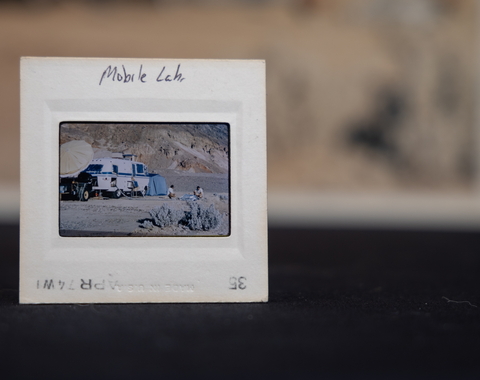
Gary credits Gall’s wife Diane Dwyer with essential help in organizing and transferring a lifetime of material—including the very best of Gall’s thousands of slides—to the APS.
As the nation's first learned society, the APS remains open to researchers. Gary and his team are in the process of cataloging Gall’s books and will do the same for the manuscripts and personal papers in the future. Because of the large amount of material in the Gall collection, it will be some time before they become available online, but researchers (including prospective biographers) can request access to the books and papers with advance notice in the meantime. Once cataloged, Gall’s papers and volumes will become part of the 14 million pages of manuscripts (across approximately 3 miles of shelf space) and 325,000 books that are held within the Society's collection.
News