Help Us Choose Our 2026 Holiday Card!

As each year draws to a close, we show our Carnegie pride with a holiday card featuring original artwork from a member of our staff that represents our mission and our deep curiosity about the natural world.
The process starts with a contest that welcomes submissions from every cohort of our community—scientists, technical staff, administrative employees, and other support roles. Our collective creativity showcases the breadth of Carnegie research from seismic wave measurments to microscopy and exoplanet illustrations to astrophotography.
Once we've narrowed the field down to three finalists, we open the process up to the public and let you choose the winner. The polls are only open for a week, so don't dilly dally. Make your voice heard now!
2026 Holiday Card Finalists

Description: This illustration represents an artistic depiction of dark matter as the invisible force that quietly shapes and holds the universe together, influencing galaxies, clusters, and the vast structure of the cosmos through its gravitational pull. In much the same way, according to the artist, the spirit of the holiday season is an unseen force that draws humanity together.

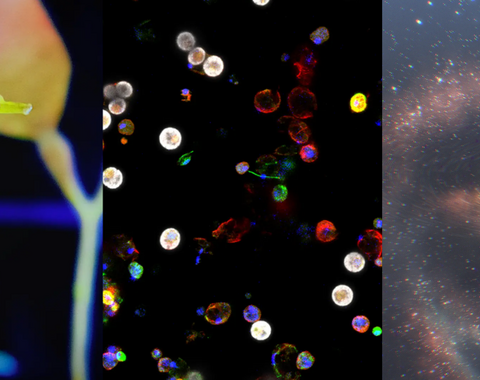
This image shows immunofluorescence imaging of Xenia soft coral cells. Cell nuclei are shown in blue, actin filaments in red, microtubules in green, and symbiotic algae in gray through autofluorescence.

A close-up photograph of a seahorse anchored by its prehensile tail to the stalk of aquatic vegetation, showcasing its natural camouflage and delicate morphology.
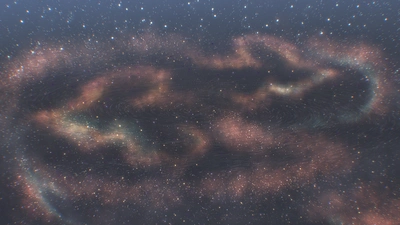
"Dark Matter: The Greatest Holiday Light Is Not Always the One We See"
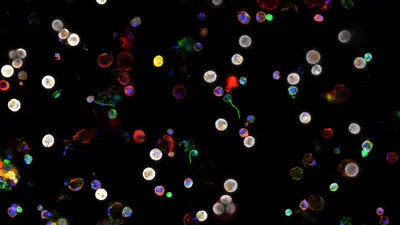
"Little Lights in the Night"
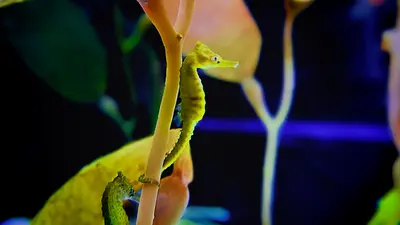
"Floating in the Ocean's (Winter) Wonderland"
The winning artist will remain anonymous until the design is unveiled later this year in Carnegie Science’s official digital holiday card.
Thank you to everyone who submitted artwork, and good luck to our finalists!
Spotlight on Past Winners
Past winning designs have featured everything from dazzling astronomical imagery to intricate cellular artwork. These pieces reflect both the scientific spirit and artistic talent across Carnegie Science.

This image shows the blue nuclei of a cluster of cells called a germline cyst in the ovary of an African clawed frog (Xenopus laevis).
One or more of these sister cells will develop into eggs, while the others will serve as nurse cells. Extended and branched scaffolds, called microtubules, connect the cells and are visible here in green. Centrioles—the organizing centers from which microtubules grow—are marked in magenta. This image illustrates how sister cells within a cyst interact, sharing molecules through microtubule networks that resemble a spider’s web.
IMAGE CREDIT: ASYA DAVIDIAN, POSTDOCTORAL ASSOCIATE | SPRADLING LAB | BIOSPHERE SCIENCES & ENGINEERING

This image shows two chromosomes labeled with cyan (chromosome 1) and magenta (chromosome 4) fluorescent tags in heart muscle cells that are lacking the protein Lamin-B1. This important nucleoskeletal protein plays a crucial role in organization of the nuclear envelope. Without it, chromosomes are stretched and distorted, creating a galaxy-like appearance.
Artist: Katherine Bossone, Graduate Student, Zheng Lab Biosphere Sciences and Engineering

This artwork features a rainbow-colored moon as a metaphor for Earth and climate change. The stars around the moon symbolize endless possibilities in the universe, emphasizing our duty to protect our planet while exploring the cosmos. It was created by blending vibrant colors into a moon-shaped canvas, with the intent to underscore the interconnectedness and responsibilities of all humankind to safeguard our planet as we venture further into the galaxies beyond our own.
Image by Frances George, Assistant Business Manager, Carnegie Observatories

This is an image of lamin proteins, a component of the cytoskeleton, found in trophoblast cells during the blastocyst stage of a mouse embryo. The image was captured during an experiment at the Department of Embryology which was studying whether a particular lamin gene is preferentially expressed in cells destined to become the placenta.
Sara Debic, Graduate Student, Carnegie Science Biosphere Sciences & Engineering | Department of Embryology
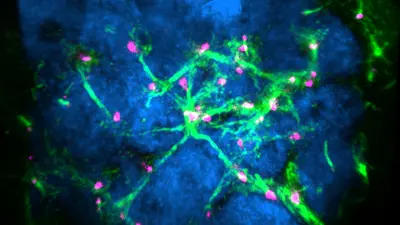
2025: Sister cell interactions in a frog ovary cyst
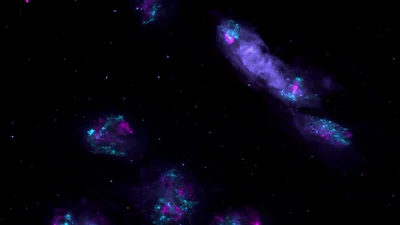
2024 | Galactic Echoes in the Heart of Cells
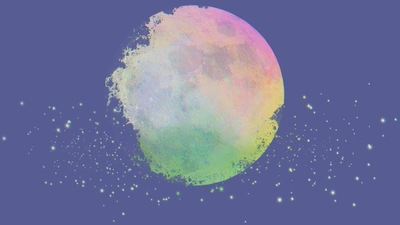
2023: Rainbow Moon
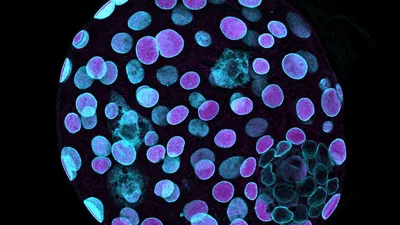
2022 | Embryonic Light
News