“Extragalactic archeology” reveals nearby galaxy’s evolution

Pasadena, CA—A team of astronomers, including Carnegie Science’s Jeff Rich and other former Carnegie Observatories astronomers, have for the first time traced the history of a galaxy outside our own Milky way by studying chemical fingerprints in deep space, a new approach they are calling “extragalactic archeology.” Their findings are published in Nature Astronomy.
“This is the first time that a chemical archaeology method has been used with such fine detail outside our own galaxy,” said lead author Lisa Kewley of the Center for Astrophysics | Harvard and Smithsonian.
The breakthrough was made possible using data from the Carnegie-led TYPHOON survey of 44 nearby galaxies taken by the du Pont telescope at our Las Campanas Observatory in Chile.
Called “data cubes,” the TYPHOON observations include an incredible level of detail, including both two-dimensional spatial information and spectral information. The extraordinarily sharp resolution of these observations enabled the researchers to separate and study individual star-forming clouds in the spiral galaxy NGC 1365, also known as the “Great Barred Spiral Galaxy.”
“We essentially made a really big 3D photocopy of the galaxy in which every pixel is rich in both spatial information and chemical composition,” said Rich. “This unique set of data was collected by Carnegie astronomers over several years and allows scientists around the world who access our data cubes to study the makeup of galaxies in great detail.”
Other co-authors on the paper include retired Carnegie astronomer Barry Madore, TYPHOON’s principal investigator and creator of the “step-and-stare” method used in the construction of these data cubes, and Mark Seibert, former Observatories senior research associate and a member of the TYPHOON team.

The first three panels highlight different aspects of the galaxy’s chemical composition: hydrogen, nitrogen, and sulfur gas. These three gas signatures are composited in the next image, enabling a more comprehensive identification of star formation hotspots and the active galactic nucleus at the galaxy’s center. Credit: Mark Seibert, Carnegie Science Observatories.

Using a new “space archaeology” technique that reads the chemical fingerprints in the galaxy’s gas, astronomers have reconstructed how NGC 1365 grew over 12 billion years. Credit: Melissa Weiss/CfA.

The observations for the TYPHOON data cubes were taken by the du Pont telescope at Carnegie's Las Campanas Observatory in Chile. Credit: Charlie Hull, Carnegie Science Observatories.
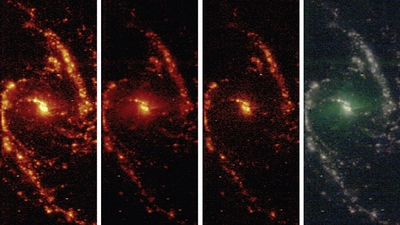
Four views of the spiral galaxy NGC 1365, as extracted from the TYPHOON survey, showing somoe of the richness of the information available in the data cubes.
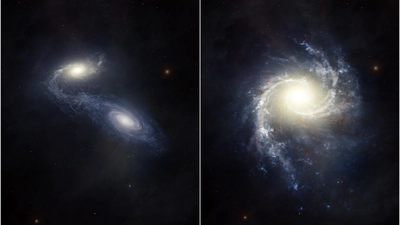
An artist’s impression shows the giant spiral galaxy NGC 1365 as it collides and merges with a smaller companion galaxy, stirring up star formation and redistributing gas and heavy elements.
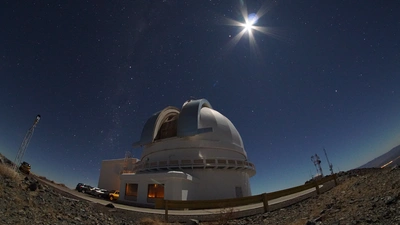
The Irénée du Pont telescope at Carnegie Science’s Las Campanas Observatory in Chile.
Tracing Oxygen
Hot, young stars shine brightly in the ultraviolet wavelengths, and their intensity can excite nearby gases, each element of which can be detected by telescopes as distinct light patterns. By homing in on oxygen signatures in particular, the research team was able to elucidate NGC 1365’s past.
Galactic centers have more heavy elements, including oxygen, while the outer reaches of galaxies have lower concentrations of these materials. Oxygen’s distribution within a galaxy like NGC 1365 is shaped by several factors, including where and when stars formed and exploded as supernovae, how gas has flowed in or out of the galaxy, and past mergers with other galaxies.
The research team used TYPHOON data to reveal oxygen distribution patterns across NGC 1365 and then compared this data with state-of-the-art galaxy simulations from the Illustris Project—which models the motion of gas, star formation, black holes, and chemical evolution in galaxies from shortly after the Big Bang to the present day.
Taken together, the team was able to see how the galaxy grew and merged with other structures over 12 billion years of cosmic time.
“Lisa and her colleagues combed through simulations of about 20,000 galaxies to find one that closely matched the properties of NGC 1365 from our TYPHOON data, which allowed us to infer periods of growth and mergers that likely comprised its past,” Rich explained. “It’s amazing to see the kind of science that can be accomplished with our dataset, which we constructed meticulously over many years and is now bearing all sorts of exciting fruit, like this study.”
Added Seibert: “We hope this technique is adopted as a template for galaxy evolution studies as this type of observation method becomes more widely available to the astronomical community."
History Revealed
Overall, the study shows NGC 1365 began as a small galaxy and slowly grew into a giant spiral via multiple mergers with smaller dwarf galaxies.
The astronomers found that NGC 1365’s central region formed early in the galaxy’s history and developed a large amount of oxygen. The gas further out built up over 12 billion years through collisions with smaller dwarf galaxies. The gas in the outer spiral arms of the galaxy probably formed relatively late, over the last few billion years, and was also fed by gas and stars from merging dwarf galaxies.
By studying galaxies like NGC 1365, which bears similarities to the Milky Way, experts can gain insight into the various evolutionary pathways that shape a galaxy’s life story.

We made the cover!
The team’s research is featured on the June 2026 cover of Nature Astronomy. The cover image of NGC 1365 was created by study co-author Alex Garcia of the University of Virginia.
View on nature.com