Does Time Have a Second Arrow? Two Carnegie Scientists Probe the Evolution of Everything

Nature is defined by laws. Based on meticulously observed phenomena, these fundamental rules help us understand how our universe works and enable us to predict the outcomes of different scenarios.
Newton’s laws govern force and motion. Boyle’s law connects pressure and volume. The laws of thermodynamics reveal the relationships between energy and heat. These are just a few of the physical laws that explain how everything around us works.
But have scientists already documented every natural law?
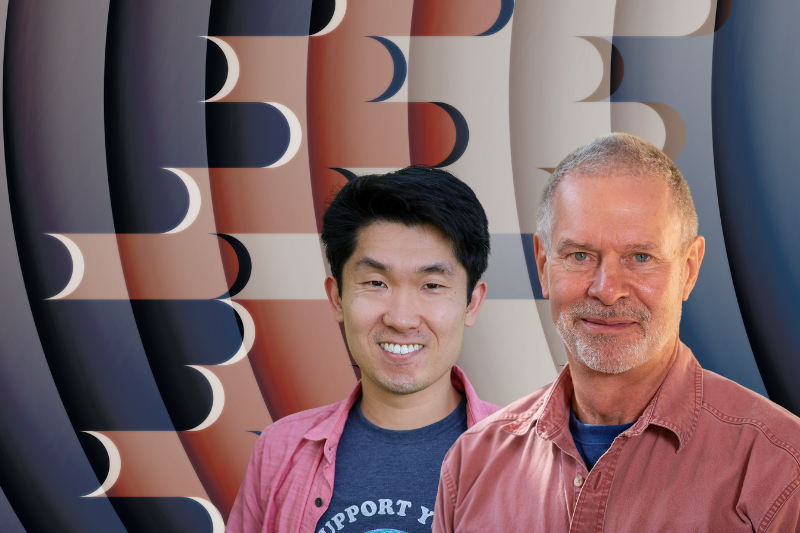
Carnegie scientists Robert Hazen—a senior mineralogist—and Michael Wong—an early career astrobiologist—say they’ve uncovered a new one and it has to do with information and complexity. Their bold idea has its critics, but its interdisciplinary genesis is helping it gain traction across a variety of experts.
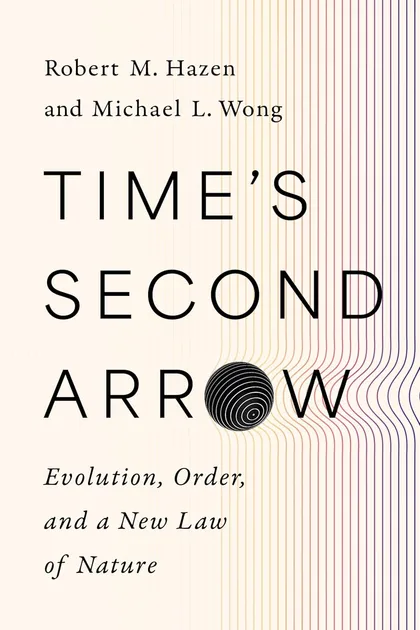
Later this month, they’ll make the case to the public in a new popular science book Time’s Second Arrow: Evolution, Order, and a New Law of Nature.
Out just in time to make the perfect Valentine’s Day gift for science-minded nerds who like to ponder life’s big questions, Kirkus Reviews described it as a “paradigm-shifting work of scientific daring that inspires us to reconsider the emergence of life in the cosmos.”
But how does one go about proposing the existence of an until-now “missing” scientific law? Let’s take this story back to its beginning.
Hazen is a senior scientist with long-standing expertise in mineralogy and a penchant for advancing new approaches to thinking about our planet and its place in the universe. He spent most of the last decade leading the Deep Carbon Observatory, a 10-year effort that brought together geologists, mineralogists, geophysicists, chemists, biochemists, and microbiologists to develop a holistic understand of carbon’s distribution, movement, and interactions beneath our planet’s surface.
During this period, Hazen pioneered the concept of mineral evolution—linking an explosion in mineral diversity to the rise of life on Earth—and developed the idea of mineral ecology—which analyzes the spatial distribution of the planet’s minerals to predict those that remain undiscovered and to assert Earth’s mineralogical distinctiveness in the cosmos.
As this work progressed, Hazen and collaborators adopted new tools such as machine learning and connected with new disciplines, including philosophy.


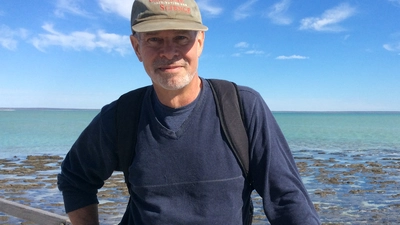
Bob Hazen in Australia on a fieldwork trip in 2014.
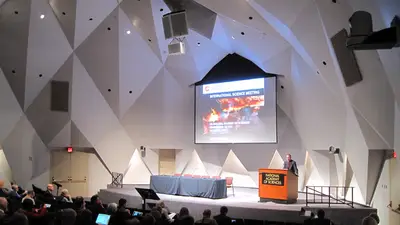
Bob Hazen presents at the National Academy of Sciences' Kavli Auditorium for the final meeting of the Deep Carbon Observatory research network.
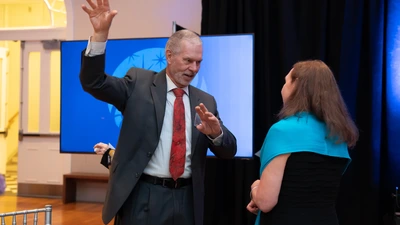
Bob Hazen talks to an event attendee after giving a presentation at a Carnegie Board of Trustees meeting.
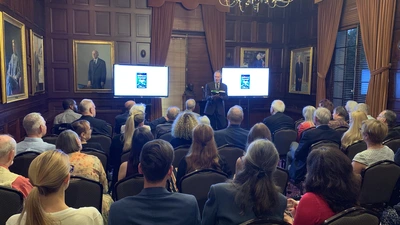
Bob Hazen reads from his book "Symphony in C: Carbon and the Evolution of (Almost) Everything"
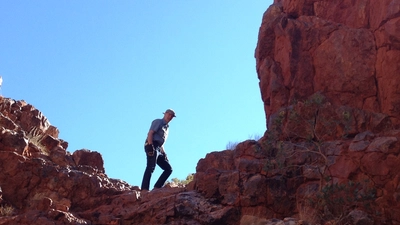
Bob Hazen hiking in the field.
In 2020, as pandemic life rocked communities around the globe, Hazen and his team upended conventional wisdom in the mineralogical community, developing an additive mineral categorization system that accounts for a mineral’s origin story.
“We built connections between the very different fields of philosophy and geoscience to explore ways to bring the dimension of time into discussions about the solid materials that compose Earth,” Hazen explained.
Speaking to reporters in December at the annual meeting of the American Geophysical Union, Hazen credited Wong’s arrival on his team as the spark that pushed his ideas about the origin and evolution of minerals on Earth and other planets to something much bigger.
Wong, then a postdoc with a growing catalog of work on searching for biosignatures in planetary atmospheres returned to the campus where he’d been an undergraduate intern 11 years earlier and dived into applying network science to exoplanet research and the search for life elsewhere.
“I love astrobiology because it pushes us to build connections between fields and pursue big questions about what’s out there” Wong said. “At the same time, it asks us to reflect on our own planet, like how we got here and where we’re going.”
In 2023, Hazen and Wong led an interdisciplinary nine-member team—scientists from Carnegie, Caltech, and Cornell University, and philosophers from the University of Colorado—to introduce their proposed new law to the scientific community in a paper published by Proceedings of the National Academy of Sciences.
They put forward that complex natural systems evolve to states of greater patterning, diversity, and complexity. According to Hazen and Wong, this means that evolution is not limited to life on Earth, it also occurs throughout the cosmos.


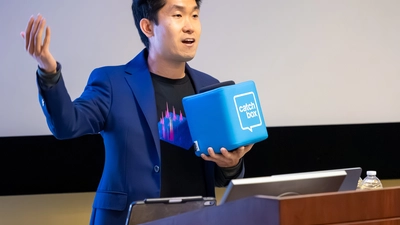
Mike Wong moderates Q&A at Neighborhood Lecture featuring NASA’s Caleb Scharf. In 2025, Wong and Scharf received a $5 million, five-year grant to develop A.I. tools for enhancing the search for signs of life on other planets.
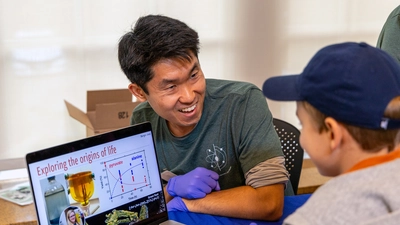
Mike Wong engages with a neighborhood child during the inaugural EPL Open House in the fall of 2025.
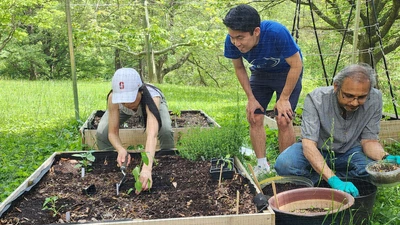
Mike Wong is part of the EPL gardening team, which grows vegetables on campus during the warmer months.
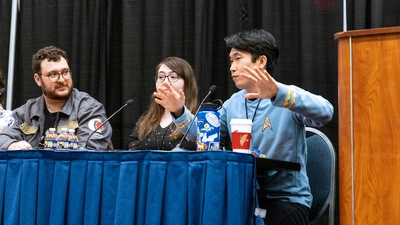
Mike Wong is part of a Carnegie panel on fictional exoplanets during the 2025 D.C. Awesome Con.
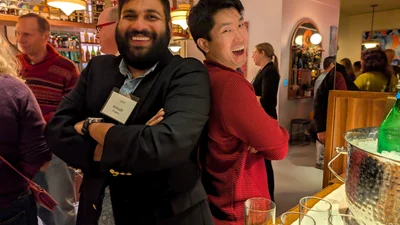
Mike Wong and frequent collaborator Anirudh Prabhu at Carnegie's annual alumni reception durign the American Geophysical Union's Fall Meeting.
In Time’s Second Arrow Hazen and Wong expanded this approach in order to further probe the balance between the tendency for disorder governed by the second law of thermodynamics and the development of complexity predicted by their law of increasing functional information.
“We contend that evolution is a universal phenomenon, in play since the Big Bang 13.8 billion years ago and continuing today in many systems at many scales,” they wrote. “Atoms evolve in stars. Molecules evolve in atmospheres. Minerals evolve on and within planets, as does life in all its varied splendor. What’s more, nature’s evolving systems often interact with each other: Atmospheres, minerals, and life coevolve in complex, interdependent, and unexpected ways.”
During the AGU press briefing on his and Hazen’s work, Wong was asked how they would break down an idea as sophisticated as increasing functional information while meeting up with friends for happy hour.
“I’d ask the bartender to make me their favorite cocktail. Then I’d ask about the recipe of that cocktail and how it came to be,” Wong answered. “Think about all the different ingredients, the way it’s shaken or stirred, the kinds of garnishes that are used. And then think about all the different combinations that were tried during the development of this recipe but just didn’t taste as good. So out of all the possibilities for drinks that could exist, we only have a subset being served in bars today. Our new law of nature suggests that the functional information describing drink recipes has increased over time as many possibilities have been tried and winnowed down to the ones that taste delicious.”
The arrow mentioned in the new book’s title refers to the temporal directionality of increasing complexity, echoing the way that the second law of thermodynamics requires a temporal directionality for increasing entropy. Hazen and Wong say these two concepts can happily live side-by-side.
“Life illustrates this point. Every chemical reaction in a cell obeys the laws of thermodynamics. They must. Nevertheless, the laws of thermodynamics do not describe and explain, much less predict, why life emerged from the primordial soup,” they wrote. “The transition from nonliving molecules to a living cell is where selection for novelty must come into play.”


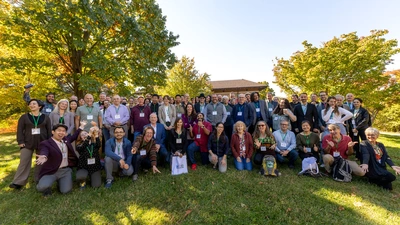
Group photograph at the Workshop on Information, Selection, and Evolution (WISE).
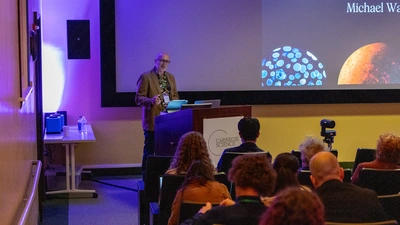
Earth and Planets Laboratory Director gives remarks at the first day of Workshop on Information, Selection, and Evolution (WISE).
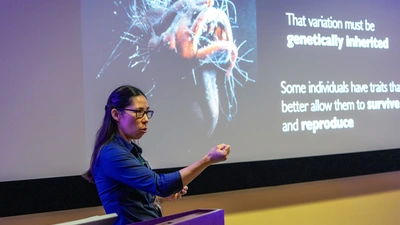
Rika Anderson gives a plenary talk at the Workshop on Information, Selection, and Evolution (WISE).
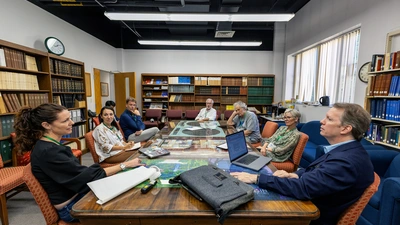
Breakout session during the Workshop on Information, Selection, and Evolution (WISE)
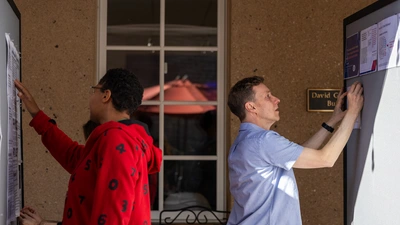
Poster session preparations during the Workshop on Information, Selection, and Evolution (WISE).
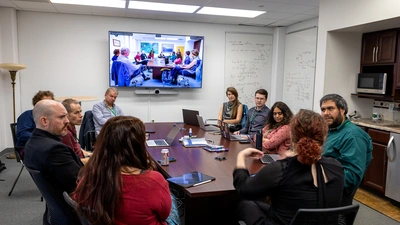
In-person and virtual attendees join a breakout session during the Workshop on Information, Selection, and Evolution (WISE).
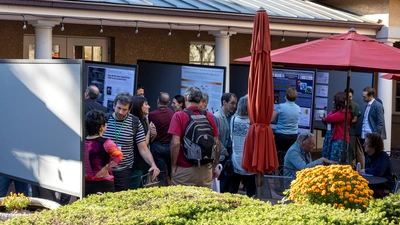
Poster session during the Workshop on Information, Selection, and Evolution (WISE).
According to Hazen and Wong, their proposed law can inform research on the emergence of life on Earth search for life elsewhere. Taking this one step further, they concluded that humanity is at an inflection point in our understanding of complexity, prompting questions about meaning and purpose that exist at the nexus of science and philosophy.
But the book isn’t an endpoint on the path to better understanding our existence in the world. It is a milestone in the ongoing journey, and Hazen and Wong continue to grow their community of like-minded intellectual travelers.
In late 2024, they brought together more than 90 experts in biology, AI, planetary science, and philosophy for the multi-day a multi-day Workshop on Information, Selection, and Evolution (WISE). The assembled attendees engaged in wide-ranging, sometimes intense, discussions on topics ranging from what is time to how to predict how systems from societies to supercomputers will evolve.
“We are in the perfect place to lead these kinds of boundary-pushing, field-defining pursuits and we are going to keep at it,” Hazen said. “After all, as our President John Mulchaey recently told me, at Carnegie Science we study the evolution of everything.”
