Carnegie Science Celebrates Second Annual Carnegie Science Day

Today, Carnegie Science celebrates its second annual Carnegie Science Day, a commemoration of the institution’s inaugural Board of Trustees meeting on January 29, 1902 and a celebration of its continuing history of scientific excellence. In honor of this special day, Carnegie Science has released a suite of articles and videos that offer a glimpse into our Blueprint for Discovery, which is guiding our quest to answer some of the biggest questions facing humanity today. Carnegie scientists explain how they’re jumping across vast scales from “star stuff” to planets, from planets to life, and from life on Earth to life elsewhere in the universe, to advance the boundaries of knowledge.
“The world and ways we pursue transformational discovery may be vastly different than they were 124 years ago, but this much is clear: the tenets of our mission and model have not changed,” said Carnegie Science President John Mulchaey. “We are still innovating basic science in ways that reach far beyond our labs, telescopes, campuses, and divisions. We are increasingly embracing multidisciplinary approaches to unravel complex phenomena. And we will always ask and answer the biggest scientific questions facing humankind in our commitment to its betterment.”
Until the founding of Carnegie Science, universities and private industry were the primary hubs of research and innovation. In Carnegie Science, Andrew Carnegie established and endowed a new kind of organization that would empower brilliant researchers to follow their curiosity in an environment free of academic or business commitments. In more recent years, our research has coalesced around three core specialties: biology, Earth and planetary sciences, and astronomy.
When industrialist Andrew Carnegie founded the institution, he advised his hand-picked Board of Trustees of their mission: “Your work now begins, your aims are high, you seek to expand known forces, to discover and utilize unknown forces for the benefit of man. Than this there can scarcely be a greater work. I wish you abundant success…”
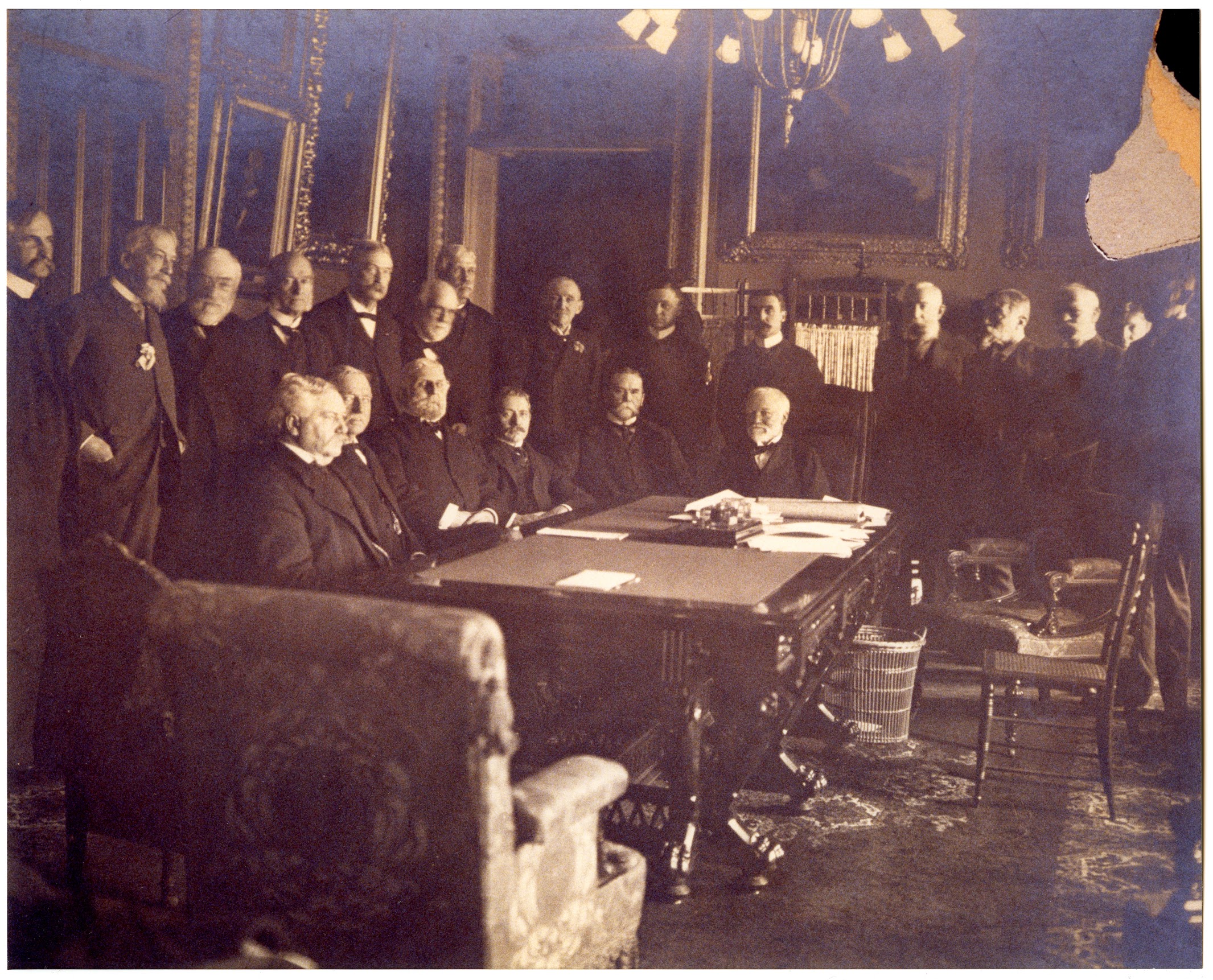
That charge has shaped Carnegie’s legacy ever since, and in the intervening years the institution has become a home to such pioneers as Vera Rubin, Edwin Hubble, Barbara McClintock, and Joe Gall, as well as dozens of the world’s foremost scientific innovators working today. Such a legacy is cause for celebration, and scientific, administrative, technical, and support staff from across Carnegie’s campuses—from Washington’s Earth & Planets Laboratory, to our Las Campanas Observatory in Chile’s Atacama Desert—will gather today to wish Carnegie Science a “happy birthday” with a variety of local treats.
This Carnegie Science Day is unique in that it also kicks off the countdown to our quasquicentennial, or 125th anniversary, next year. As we gear up to celebrate that milestone, Carnegie Science will unveil 125 objects, items, and specimens that tell our story. Today, we begin with a photo from the very first meeting of the Board of Trustees. In the coming weeks and months, we will unveil the remaining 124 items on our social media channels, from the Carnegie—a research vessel that sailed around the world to map its magnetic field—to Hubble’s famed “VAR!” plate, which captured a pulsating Cepheid variable and which helped the Carnegie astronomer confirm the existence of Andromeda.
Carnegie Science invites you to follow along as we share our story and dive into today’s groundbreaking research that our descendants will look back on to celebrate 124 years from now.
