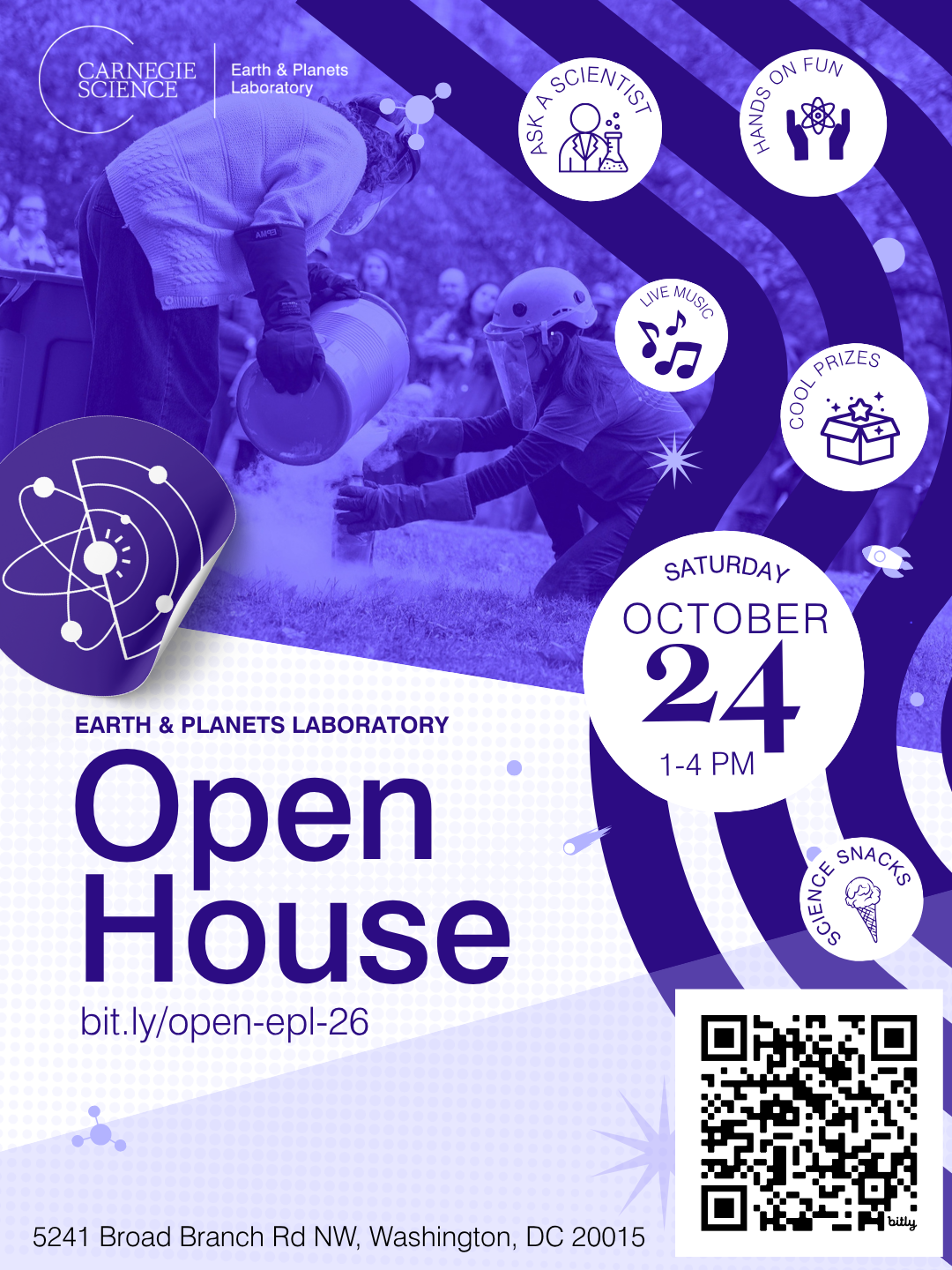
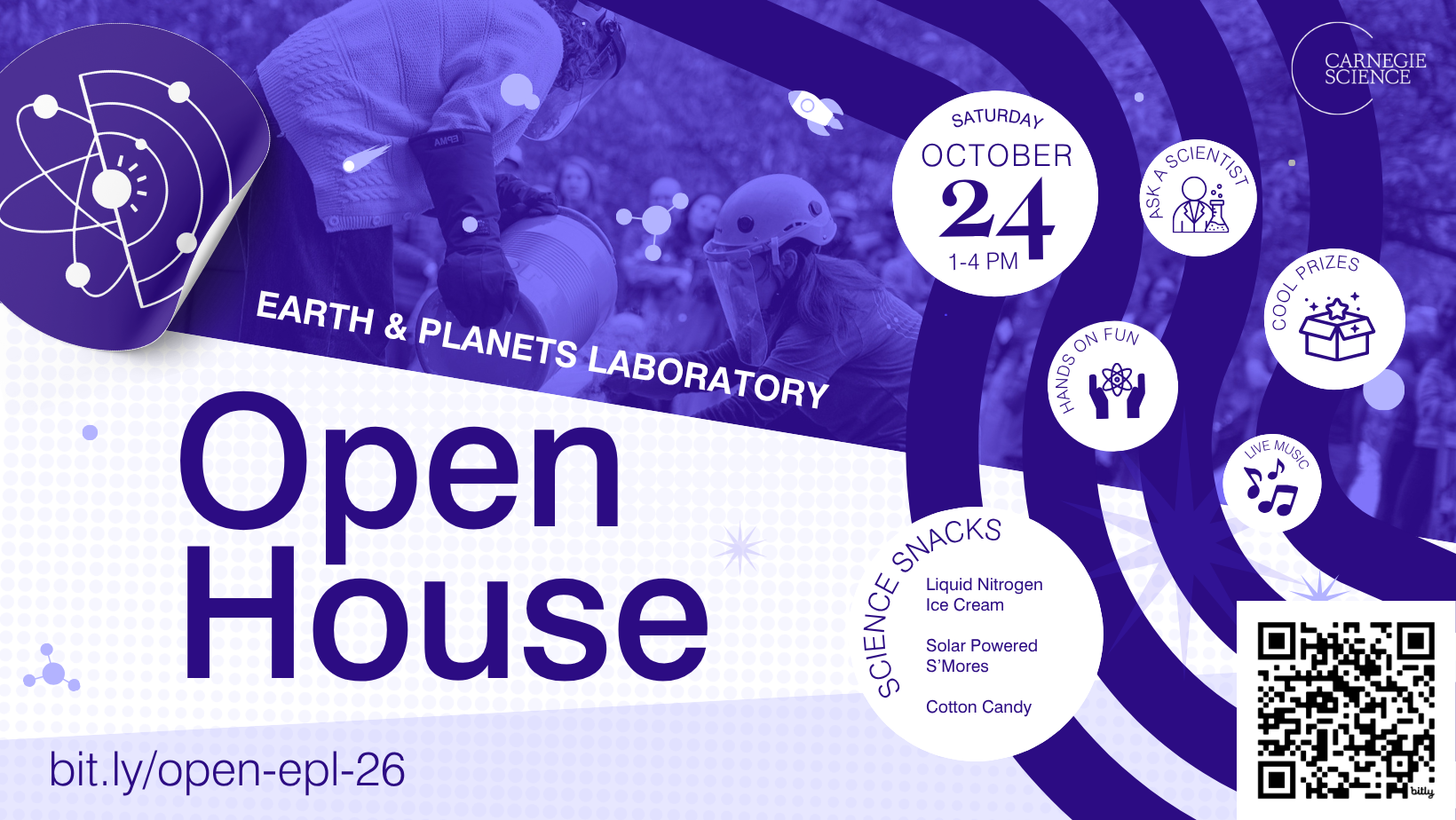
Earth & Planets Laboratory Open House


Your Lineup
Explore the Solar System, collect stamps, win prizes! (See below for station details.)
Stop by our Ask a Scientist table to chat with real Carnegie researchers who study Earth’s deep interior, far-off exoplanets, and everything in between.
No question is too big, too small, or too weird—curiosity is always welcome!
Head to the back of the Research Building to take a sneak peek at the Large Press Lab, where scientists recreate the intense heat and pressure found deep within planets! Using piston-cylinder presses, our researchers can squeeze and heat samples to 3 gigapascals of pressure and 1,700°C—conditions similar to those hundreds of kilometers below Earth’s surface.
Here, scientists make new materials, explore how rocks melt and change, and study how elements behave inside planetary interiors. Thanks to the lab’s precise and powerful equipment, they can run experiments for long periods, heat and cool samples quickly, and study materials large enough to reveal exciting details about how our world (and others) are built.
1:30 PM | From Nebula to Atoms: What We Investigate at EPL | Dr. Michael Walter, Director
Greenewalt Lecture Hall
2:30 PM | Science Time Travelers | Shaun Hardy, Librarian Emeritus
Atom Smasher
3:30 PM | An Astrobiologist Goes to the Movies | Dr. Mike Wong, Astrobiologist
Greenewalt Lecture Hall
Liquid Nitrogen Ice Cream (Opens 2PM)
This demo is super cool! Watch as we use liquid nitrogen at a chilly –320°F to freeze ice cream in mere seconds.
Cotton Candy Creations
Watch chemistry and physics in action as sugar crystals transform into wispy candy threads.
Sun S'mores
Let’s toast some marshmallows using solar power—direct from the source.
Move to the groove with astrobiologist Andrew Steele.
Ask a Scientist Booth



2026 Science Stations
Discover how researchers recreate the extreme conditions of Earth’s interior with a device small enough to fit in your hand.
Using a diamond anvil cell, scientists squeeze tiny samples between two diamonds to reach pressures up to 400 gigapascals—that’s roughly 4 million times the atmospheric pressure at sea level. These pressures match what materials experience deep inside our planet.
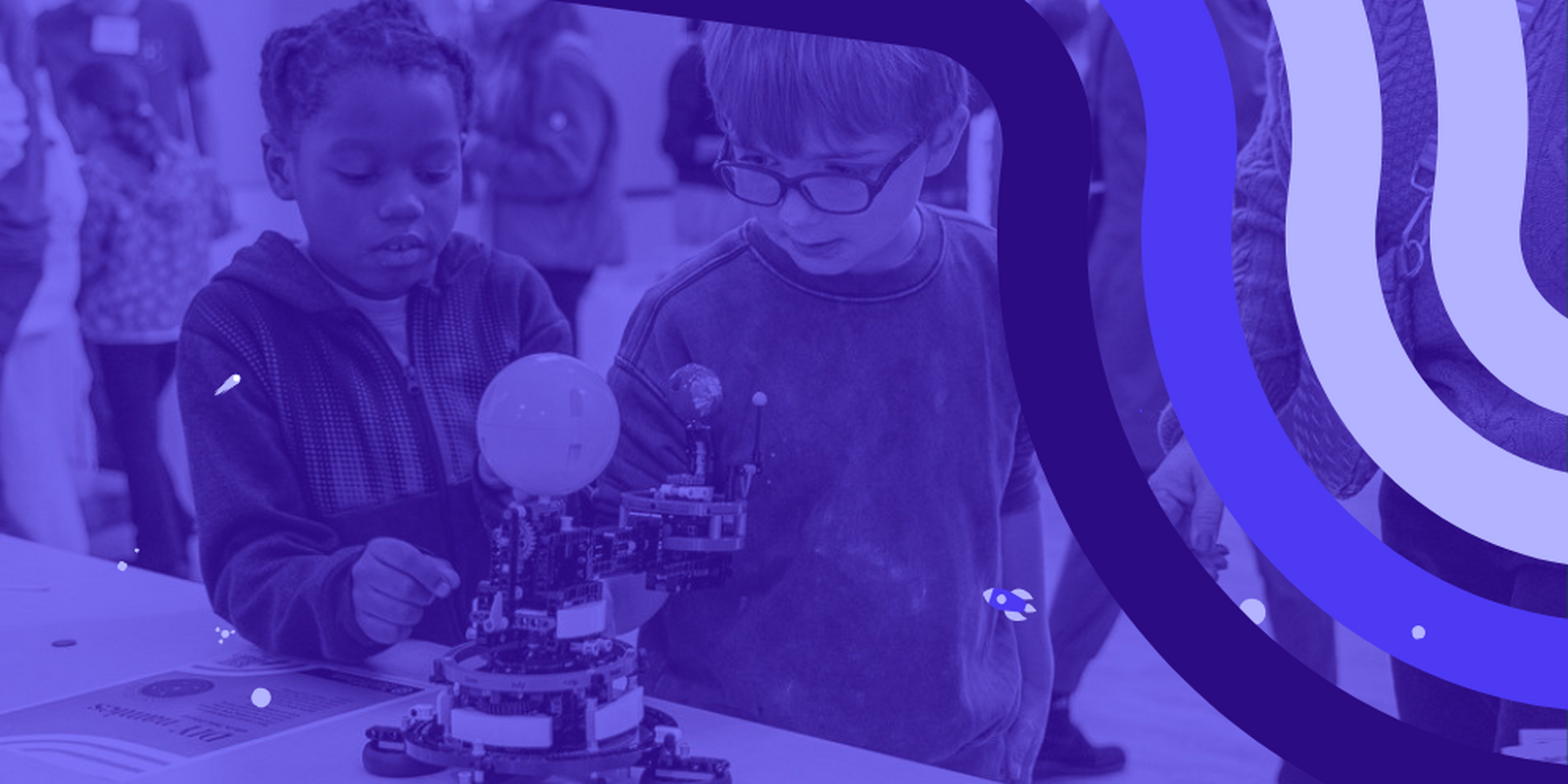
Watch colorful currents swirl in a LEGO-built rotating tank! This model shows how heat and motion inside planets and oceans create looping flows and shifting patterns.
Did you know? Experiments with rotating tanks like this one help scientists test and improve the computer models they use to study weather, oceans, and planetary interiors.
Discover how scientists visualize Earth’s surface using an augmented-reality sandbox.
Shape the sand to build mountains, volcanos, and islands, then watch the map change in real time. You can even “make it rain” and see virtual water flow across your landscape. This hands-on model helps researchers and students understand how elevation, gravity, and water interact to shape our planet and others.
Get up close with a real meteorite from Mars—a rock so special that a twin sample rides aboard NASA’s Perseverance rover!
Look through the microscope to see its surface in detail and discover what Martian rocks can reveal about the search for life.
How do scientists tell time when there are no calendars for the early Earth? They read the rocks!
Discover how geochemists use isotopes—tiny atomic variations—as natural clocks to measure the age of minerals and trace the story of our planet. Learn how these “rock clocks” reveal when mountains formed, volcanos erupted, and even when the first oceans appeared.
Stand back and get ready for a blast! Watch as liquid nitrogen meets water in a dramatic eruption that launches Ping-Pong balls sky-high. This mini “volcano” shows how pressure builds inside real volcanos until—BOOM!—they erupt.
When liquid nitrogen warms up, it expands into a gas about 700 times its liquid volume—just like magma turning into steam and gas deep inside a volcano. That rapid expansion drives the explosion!
Step right up and sink your hands into oobleck—a gooey mixture that acts like a liquid when you move slowly and a solid when you move fast. Watch how speed changes everything in this lesson on material science.
Oobleck is a non-Newtonian fluid. Its behavior depends on how quickly you deform it. Rocks that are solid on short timescales, but flow over long periods of time, show the same kind of behavior deep inside our planet!
Deep inside Earth, heat and pressure melt rock into magma, which fuels volcanoes. At this station, Carnegie scientist Lara Wagner melts rock using just sunlight. A large lens concentrates the Sun’s light onto one small spot, raising its temperature above 1,200°C (about 2,200°F). Stop by to watch solid rock begin to melt, and ask Lara how scientists at the Earth and Planets Laboratory study what happens to rocks deep below our feet.
Let’s toast some marshmallows using solar power—direct from the source.
Watch plant-like towers grow before your eyes as simple salts and “water glass” spark a reaction that builds its own shimmering crystal garden.
These delicate mineral structures mimic the volcanic vents you can find at the bottom of the ocean. They demonstrate how simple chemistry can build complex structures—whether on Earth, Mars, or icy moons. Some people think the chemistry of life started in a crystal garden similar to the one you’ll build today!
The ground beneath us is moving a few centimeters a year, about as fast as your fingernails grow. Over millions of years, that motion builds mountains, opens oceans, and sends plates sliding back down into Earth’s interior. Peter van Keken builds computer models that recreate these processes, simulating how heat from deep inside a planet churns its interior and shapes its surface. Stop by to see these models in action and ask how scientists use them to understand Earth and other worlds.
Hold stardust in your hands! Examine meteorites up close with a hand lens and discover how these ancient space rocks reveal the story of our Solar System’s birth.
Did you know? Some meteorites contain tiny grains of stardust that are older than the Solar System itself—real pieces of stars that existed before the Sun was born.
Explore treasures from the Carnegie Science Archives that tell the story of our nearly 125 years of curiosity-driven discovery.
Learn how astronomers use light to learn about faraway planets, stars, and galaxies.
Build a pocket-sized Solar System to explore our cosmic neighborhood, make your own spectrometer to break light into its rainbow of colors, and see how infrared light reveals what our eyes can’t see.
Did you know? These same techniques help scientists find distant exoplanets and study their atmospheres from millions of miles away.
Resources
How to Build a Spectrograph: https://weinberger.dtm.carnegiescience.edu/for-the-public/make-a-spectrograph
Pocket Solar System: https://www.nisenet.org/sites/default/files/catalog/uploads/ExSci_Space_PocketSolarSystem_folding.pdf
About Infrared: https://weinberger.dtm.carnegiescience.edu/infrared, https://coolcosmos.ipac.caltech.edu/
Examine real prehistoric shark teeth and learn how fossils tell the story of ancient oceans. While you’re here, grab a sticker, chat with our team, and sign up to hear about upcoming Carnegie Science events and news.
Did you know? Sharks shed thousands of teeth in a lifetime—that’s why they’re some of the most common fossils on Earth!
Let’s shake things up!
Discover how scientists “see” inside Earth by studying the vibrations that travel through our planet. Jump, stomp, or tap and watch a real seismometer record your every move.
Did you know? Seismometers are so sensitive that they can detect earthquakes on the other side of the world!
This demo is super cool! Watch as we use liquid nitrogen at a chilly –320°F to freeze ice cream in mere seconds.

Learn how astronomers use light to learn about faraway planets, stars, and galaxies.

Watch plant-like towers grow before your eyes as simple salts and “water glass” spark a reaction that builds its own shimmering crystal garden.

How do scientists tell time when there are no calendars for the early Earth? They read the rocks!

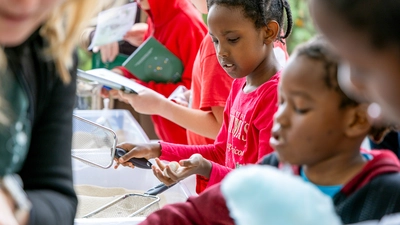
Watch chemistry and physics in action as sugar crystals transform into wispy candy threads.

EPL Librarian Emeritus shares the history of the Atom Smasher during

Stop by our Ask a Scientist table to chat with real Carnegie researchers who study Earth’s deep interior, far-off exoplanets, and everything in between.
No question is too big, too small, or too weird—curiosity is always welcome!

Watch colorful currents swirl in a LEGO-built rotating tank! This model shows how heat and motion inside planets and oceans create looping flows and shifting patterns.

This demo is super cool! Watch as we use liquid nitrogen at a chilly –320°F to freeze ice cream in mere seconds.

Get up close with a real meteorite from Mars—a rock so special that a twin sample rides aboard NASA’s Perseverance rover!

Step right up and sink your hands into oobleck—a gooey mixture that acts like a liquid when you move slowly and a solid when you move fast.

Discover how scientists visualize Earth’s surface using an augmented-reality sandbox.

Learn about Vera Rubin, the Carnegie astronomer who discovered the first solid evidence of dark matter.

Cosmochemist Dr. Conel Alexander talks about rocks from space (i.e., meteorites).

Examine real prehistoric shark teeth and learn how fossils tell the story of ancient oceans.

Discover how scientists “see” inside Earth by studying the vibrations that travel through our planet.

Visit all the stations, travel the Solar System, collect stickers, and win a prize.

Toast marshmallows using solar power—direct from the source!
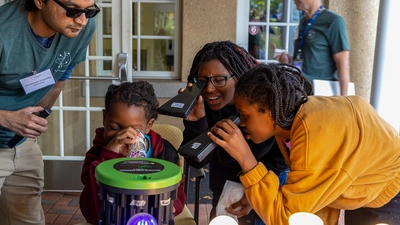
Learning about Light
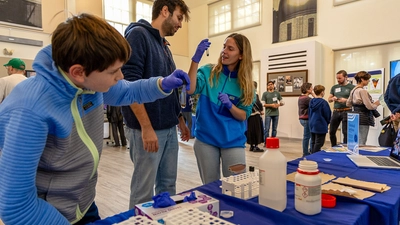
Chemical Gardens
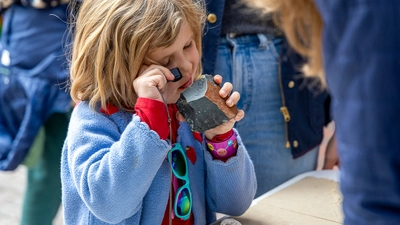
Rock Clocks
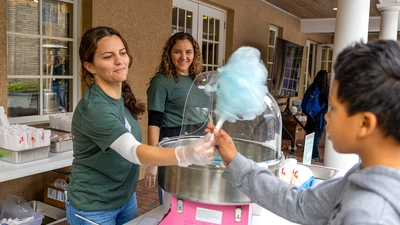
Cotton Candy Creations
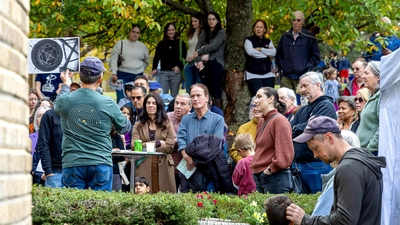
Science History Tour
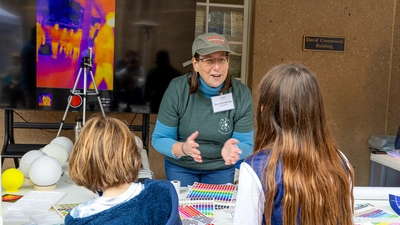
Ask Scientists
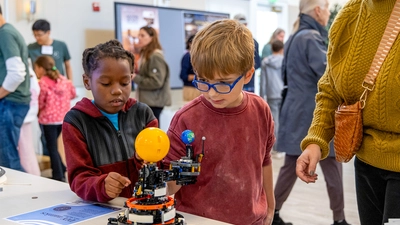
Lego DIYnamics
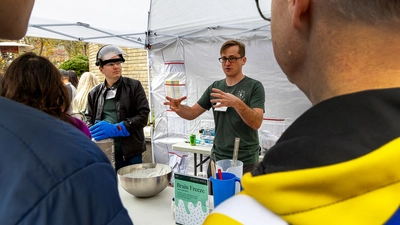
Liquid Nitrogen Ice Cream
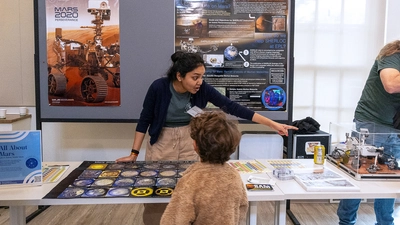
Martian Meteorites
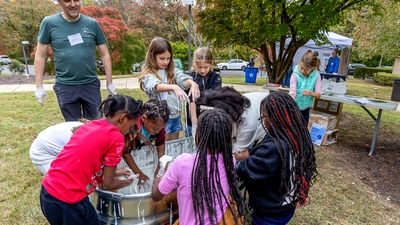
Bathtub Bounce
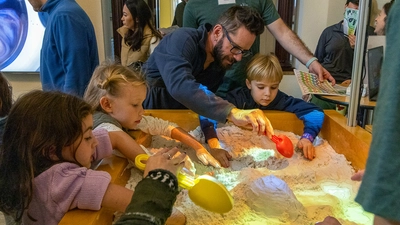
Sandbox Simulations
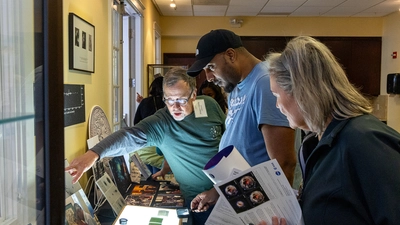
Mother of Dark Matter
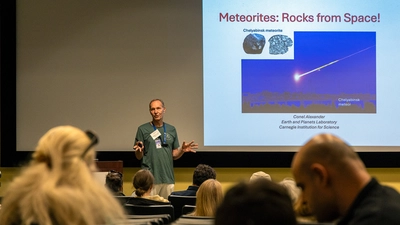
Science Talks
Shark Attack!
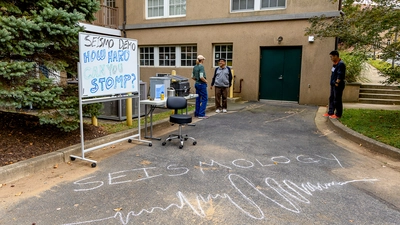
Seismology Demo
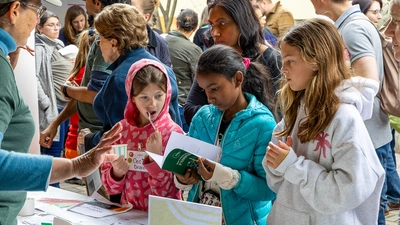
Stamp the Passport
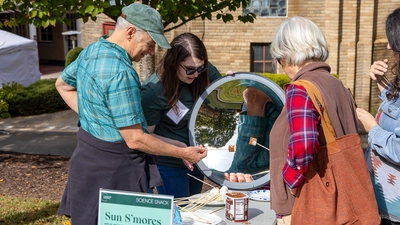
Sun S'mores