What a Place Remembers

There is a bridge at Jasper Ridge Biological Preserve where, not long ago, you could stand and look out at water in both directions. Today, if you stand on that same bridge, you see nothing but trees.
"You're just standing in a forest, basically," says Jeffrey Dukes, a Staff Scientist in Carnegie's Biosphere Sciences and Engineering division (BSE). "If you look down, there's still water underneath you, but it's just a big forest of willows."
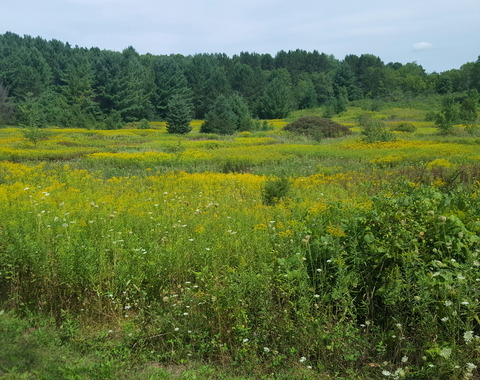
Dukes has been coming to Jasper Ridge—a roughly 1,000-acre preserve tucked into the foothills of the Santa Cruz Mountains on the outskirts of the Stanford University campus—for more than 30 years. He knows the willow forest used to be open water. He knows the serpentine grasslands on the ridge where native wildflowers bloom each spring in carpets of yellow and purple. He knows the trails that wind through bay laurel and redwood down to San Francisquito Creek, where steelhead still run upstream each year.
That depth of knowledge is not incidental to his science. It is, in many ways, the point.
Dukes grew up about three miles from the preserve in Los Altos Hills. His mother kept telling him he should visit. He wasn't interested.
"I was a high school student who thought plants were really boring," he says. "Joke's on me."
He first walked into Jasper Ridge in 1994 as a Stanford graduate student. For his Ph.D., he studied yellow starthistle, an aggressive invasive species, working from a hilltop on the preserve. From his vantage point, he had a front-row seat to something else taking shape—just below him, crews were building what would become the long-running Jasper Ridge Global Change Experiment, a nearly two-decade study that would subject grassland plots to simulated future conditions.
"I was watching that project get built and installed, literally in front of me," he says, "as I was doing my work."
He didn't know it then, but in a few years, he would be running it.
After a postdoc at the University of Utah, Dukes returned to the Bay Area, where Chris Field, then at Carnegie, offered him a position coordinating the very experiment he had watched come together at the bottom of his hill.
He led the project for two years, from 2002 to 2003. One of its clearest findings was a surprise: the grassland didn't respond to elevated carbon dioxide the way researchers expected. Adding more resources—carbon dioxide, water—didn't make the plants grow faster. Instead, they preferred the environmental conditions they had adapted to over generations. It was a finding that could only have emerged from patient, sustained observation.
"You only get that by having many, many years of data," Dukes says.
Dukes himself wouldn’t return to the ridge until 2022, this time as a Staff Scientist at Carnegie Science’s new Biosphere Sciences and Engineering division. Jasper Ridge, it turns out, is the perfect place for his own long-term data collection project.
Across the preserve, Dukes is installing sensors designed to last up to 14 years, which will study microclimates—the differences in temperature and moisture that can exist between, for example, a shaded redwood grove and a sun-baked hilltop just a hundred meters apart. While those two spots would get the same treatment in a weather forecast (or a climate model), the reality is they are vastly different.
Dukes wants to know what that simplification costs us. Are the organisms in each microclimate adapted to their local conditions? Does ignoring that variation bias our predictions about how ecosystems will respond to a warming planet? These are questions that require knowing what is actually happening on the ground, and that means getting your hands dirty and installing sensors in the soil. It means walking the same trails year after year. It means standing on a hilltop as a graduate student, watching an experiment get built below you, and coming back years later to run it.
Now, with BSE’s recent move to Pasadena, the preserve isn’t a five-minute drive anymore.
"Right now, I could just jump in a vehicle and go up there anytime," he says. "It's gonna be more complicated."
But the sensors will keep measuring. The willows will keep growing over the water. The wildflowers will keep blooming on the serpentine ridge. And Dukes? He’ll keep coming back to see what's changed.


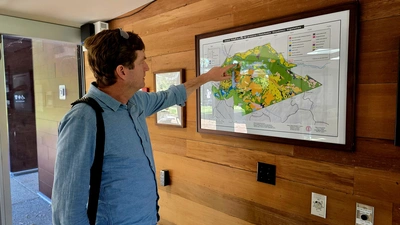
Jeffrey Dukes consults the map on the wall of the Jasper Ridge Biological Field Station
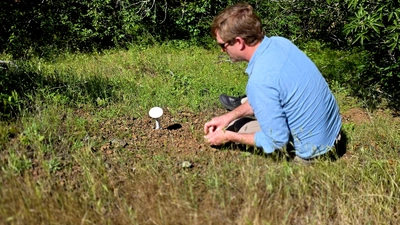
Jeffrey Dukes cleans the area around one of his sensors, which is placed on a sunny hillside in Jasper Ridge.
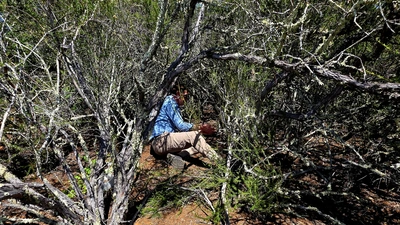
Jeffrey Dukes checks in on one of his experimental sensors that is in a shaded spot in Jasper Ridge's chaparral.
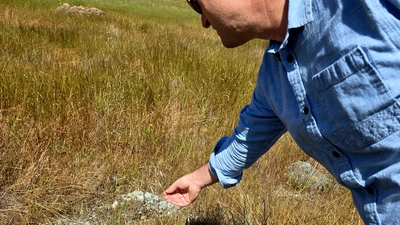
Jeffrey Dukes points out flowers growing in Jasper Ridge's serpentine grassland.
He didn't know it then, but in a few years, he would be running it.
After a postdoc at the University of Utah, Dukes returned to the Bay Area, where Chris Field, then at Carnegie, offered him a position coordinating the very experiment he had watched come together at the bottom of his hill.
He led the project for two years, from 2002 to 2003. One of its clearest findings was a surprise: the grassland didn't respond to elevated carbon dioxide the way researchers expected. Adding more resources—carbon dioxide, water—didn't make the plants grow faster. Instead, they preferred the environmental conditions they had adapted to over generations. It was a finding that could only have emerged from patient, sustained observation.
"You only get that by having many, many years of data," Dukes says.
Dukes himself wouldn’t return to the ridge until 2022, this time as a Staff Scientist at Carnegie Science’s new Biosphere Sciences and Engineering division. Jasper Ridge, it turns out, is the perfect place for his own long-term data collection project.
Across the preserve, Dukes is installing sensors designed to last up to 14 years, which will study microclimates—the differences in temperature and moisture that can exist between, for example, a shaded redwood grove and a sun-baked hilltop just a hundred meters apart. While those two spots would get the same treatment in a weather forecast (or a climate model), the reality is they are vastly different.
Dukes wants to know what that simplification costs us. Are the organisms in each microclimate adapted to their local conditions? Does ignoring that variation bias our predictions about how ecosystems will respond to a warming planet? These are questions that require knowing what is actually happening on the ground, and that means getting your hands dirty and installing sensors in the soil. It means walking the same trails year after year. It means standing on a hilltop as a graduate student, watching an experiment get built below you, and coming back years later to run it.
Now, with BSE’s recent move to Pasadena, the preserve isn’t a five-minute drive anymore.
"Right now, I could just jump in a vehicle and go up there anytime," he says. "It's gonna be more complicated."
But the sensors will keep measuring. The willows will keep growing over the water. The wildflowers will keep blooming on the serpentine ridge. And Dukes? He’ll keep coming back to see what's changed.
Related Stories