The Universe in Color

The "C" in our logo this month is a spectrum: the range of color you get when you break light apart by wavelength. It's also one of the most important tools in astronomy, and it's how Carnegie scientists figure out the composition of distant stars and planets.
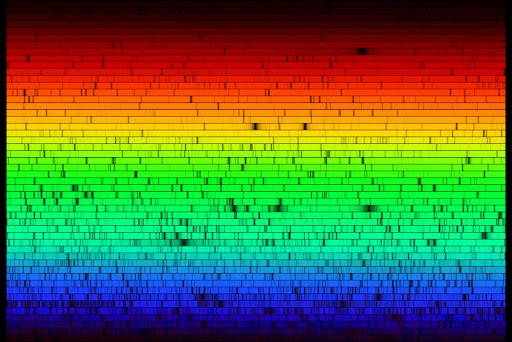
Here's the idea: the nuclear reactions occurring inside stellar cores emits radiation, including visible light, ultraviolet radiation, X-rays. When this starlight filters through an object’s atmosphere—including the star's own photosphere—the gases present there absorb light at specific wavelengths. Split that light into a spectrum, and you’ll see dark bands that indicate where light was absorbed by specific elements and molecules present in the atmosphere—or photosphere—of the object that the light filtered through.
Each gas has its own pattern, and astronomers can read those patterns to glean all sorts of information about different objects. Spectra reveal a galaxy’s history of star formation and many details about stellar properties, like a star’s composition, velocity, and rotation. Heavy elements, which astronomers call "metals," are of particular interest, because they can indicate how many stellar generations preceded and contributed to the the makeup of the star that is being observed. For planets, atmospheric gases like methane, water vapor, and carbon dioxide each leave a mark.
Whatever you're observing, you can atch the bands to the patterns, and you can start to understand the makeup of objects millions of light-years away. That’s a lot of information from a twinkle!
The catch is that most of that signal falls outside the colors our eyes can see. In many cases, the richest vein of information is the near-infrared, just past red, where human vision quits.
The Henrietta Infrared Spectrograph—named for Carnegie astronomer Henrietta Hill Swope—is the first ground-based spectrograph designed specifically to study exoplanet atmospheres in the near-infrared. Installed on the Swope Telescope at Carnegie’s Las Campanas Observatory in late April 2026, the team expects to catalog the atmospheres of roughly 50 exoplanets in its first year. Until recently, this was the kind of work that would take the better part of a decade.
As Henrietta's lead, Jason Williams, puts it: size and mass alone barely tell you anything. Measure Earth and Venus that way, and they'd look like near-twins. The atmosphere is where the real story lives.
We've already had a preview of how much that story can surprise us. Last winter, a Carnegie-led team used JWST to find the strongest evidence yet of an atmosphere on a rocky planet beyond our Solar System—an ultra-hot super-Earth, TOI-561 b, likely covered in an ocean of magma—a world scientists had assumed was far too hot and small to hold onto any atmosphere at all.
The same technique reaches far beyond planets. A team including Carnegie astrophysicist Juna Kollmeier, who leads the sky-mapping Sloan Digital Sky Survey's fifth generation, recently helped identify the most pristine star known, a survivor from just the second generation of stars to form after the Big Bang. What makes it "pristine" is what its spectrum is missing: almost none of the dark lines that heavier elements leave behind. With less than 0.005 percent of the Sun's heavy elements, its nearly blank spectrum is a snapshot of a universe that had barely begun forging anything heavier than hydrogen and helium.
On the flip side of this technique, Carnegie's Gwen Rudie and her colleagues turned JWST on 33 "teenage galaxies” as they appeared 2 to 3 billion years after the Big Bang. This time the signatures weren't dark absorption gaps but bright emissions—elements announcing themselves in the light the galaxies give off. The spectra held some surprises: these early galaxies ran unexpectedly hot and glowed with elements astronomers rarely catch, including nickel. Read carefully, that light is a record of how the first generations of stars lived and died.
But it’s not all distant galaxies and faraway planets. The rainbow in our logo was inspired by the real spectrum our neighborhood star, shown below. The Sun has been throwing that rainbow at us for as long as anyone has looked up; it just took the right instruments to see that it contained our Solar System's secret code.
This month, join us as we celebrate the full spectrum: in our science, and in our community.