Understanding Photosynthesis in a Changing World: Q&A with Adrien Burlacot

A physicist and engineer by training, Burlacot brings a systems-level approach to biology, combining genetic tools, biophysical measurements, and high-throughput screens to understand how tiny photosynthetic organisms manage energy.
In this Q&A, he discusses why algae are such powerful model systems, what makes photosynthesis more complex than many people realize, and why understanding these microscopic organisms could have global significance.
Q: What sparked your interest in photosynthesis?
Burlacot: I grew up in Auvergne, in the French countryside, in a small town. I’m the only scientist in my family, so they’ve always been curious about what drew me to studying photosynthesis.
It really started when I was cycling in the crop fields as a child and I realized that, unlike us, plants and photosynthetic organisms are just using sunlight energy to grow instead of having to eat three times a day like we do. That got me very excited about the potential of plants and their photosynthetic capacity to basically power themselves, grow, and—with food and potentially with bioenergy—feed the world. And by fixing large amounts of carbon dioxide, they could also help address climate change.
Q: What question is your research trying to answer?
Burlacot: The question we are asking is: How does photosynthesis respond to the environment? Performing such a complex chemical reaction—transforming sunlight and carbon dioxide into sugars and, eventually, plant tissue—is not straightforward. And when the light is changing, the carbon dioxide is changing. One day you get freezing temperatures and the next day it is very hot. How do you keep growing using photosynthesis?
Q: Why are algae such an important system for understanding photosynthesis?
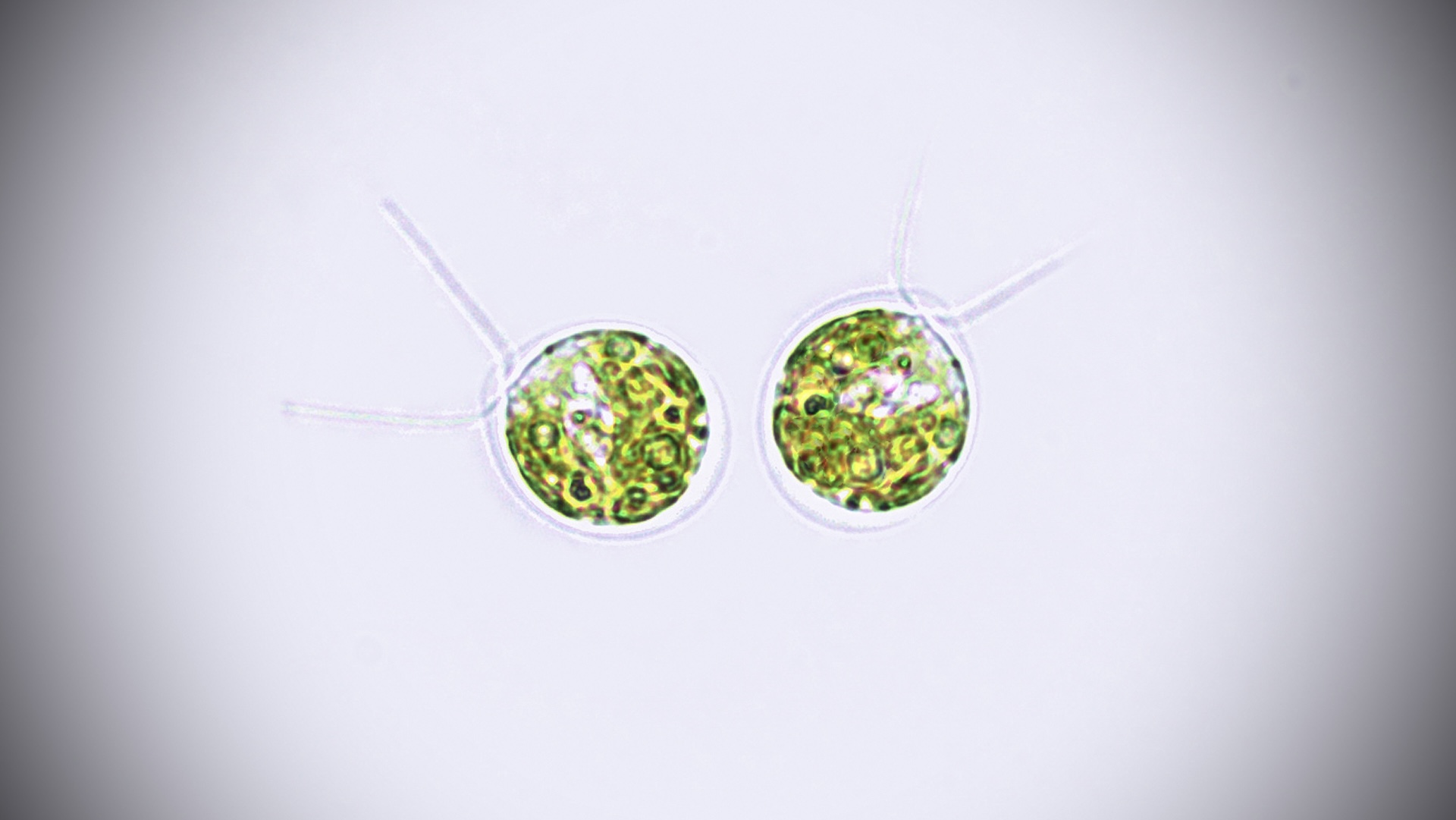
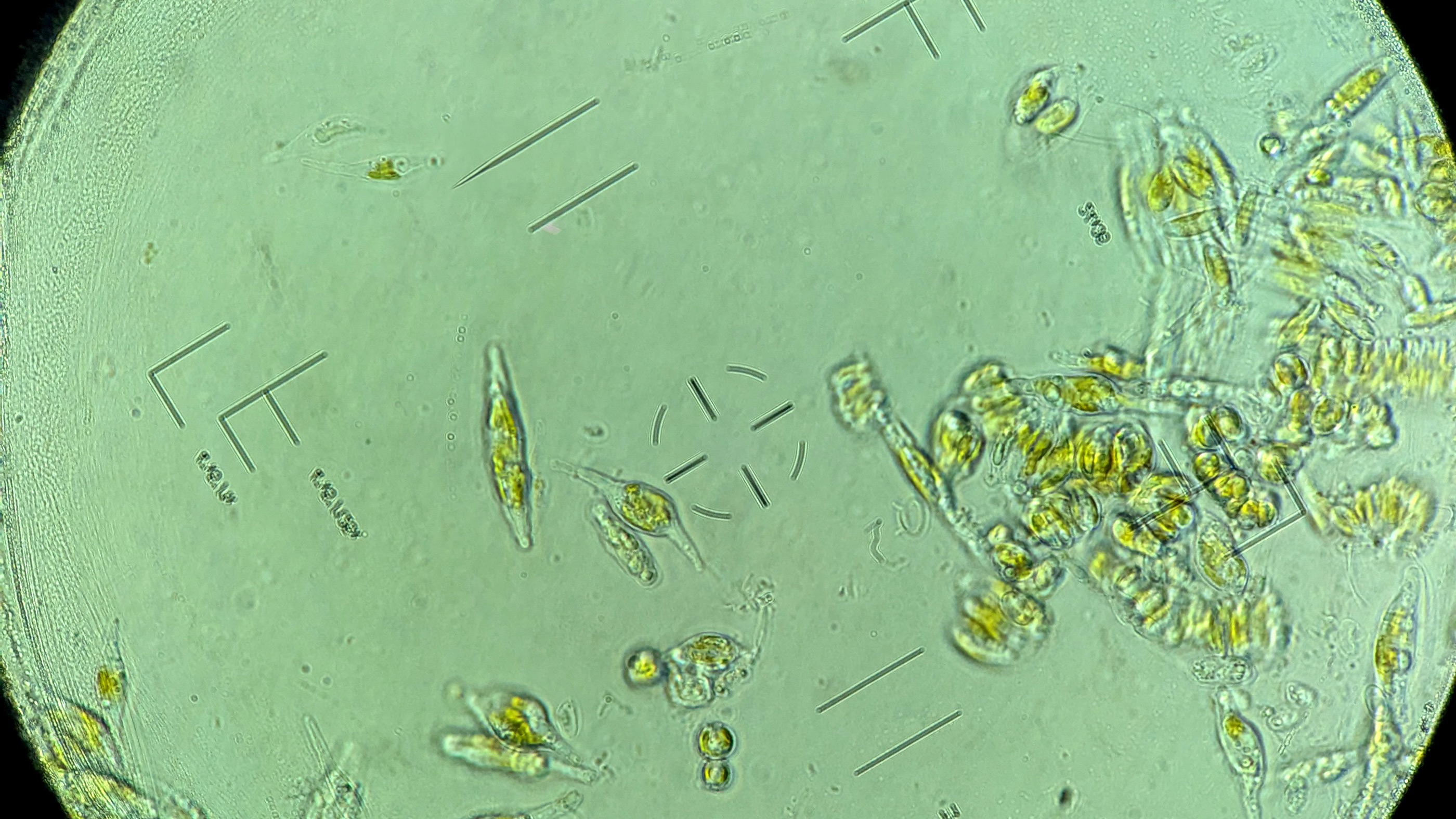
Burlacot: The algae we mostly study is called Chlamydomonas reinhardtii. It reproduces very quickly. In 16 hours or less, you can double the population of Chlamydomonas in a tank. It has also been developed as what we call a model system for decades, which means it's an organism about which we have a huge amount of existing knowledge, as well as specially honed genetic tools to enable our work.
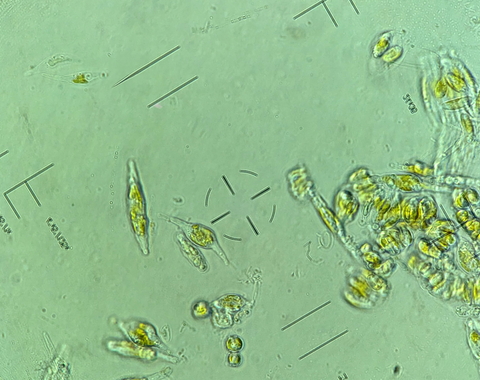
The more practical reason is that microalgae sustain about half of photosynthesis on Earth. They are not restricted to the ocean. If you dig up dirt in your backyard and put it under a microscope, you will find algae. They live in soil, sea ice, lakes, ponds, and oceans, and they can perform photosynthesis in very harsh conditions. That diversity makes them a powerful system for understanding the mechanisms that make photosynthesis robust.
Q: What makes photosynthesis more complicated than people might realize?
Burlacot: The textbook view is already fairly complex, but it is simple compared to reality.
Many photosynthetic organisms share the same basic principles: they receive light energy and transform it into chemical energy that metabolism can use to produce biomass. But what makes photosynthesis much more complex are the myriad of proteins and regulatory activities that they undertake to maintain this process.
There are many proteins that make sure the amount of photosynthetic energy generated matches the requirements of the cell. You do not want to produce too much energy, because that can damage the cell. But if you produce too little, you are basically going to die. All these proteins are there to control this energy production and make sure it fits what the cell needs, and that fitting becomes very complicated when the environment fluctuates all the time.
A simple example is light intensity. A cloud comes by and suddenly there is too little light. When the cloud leaves, the cell is back in full sunlight and suddenly has too much energy. We know a few of the proteins that help control this, but I believe we are still pretty far from understanding all the knobs that tune photosynthesis so the cell gets exactly what it needs.
Q: How do algae respond when light levels change?
Burlacot: It depends on the timescale.
In the very short term, if they go from low light to high light, they very quickly activate mechanisms that allow them to get rid of extra energy. They stop using as much light to produce chemical energy, or they discard much of the chemical energy they are producing.
On a longer timescale, they change the amount of proteins they have. For example, they change the number of light-absorbing structures they have to better match the environment.
One funny thing about Chlamydomonas is that it has flagella—small arms that allow it to swim around. So on a timescale of minutes, cells can swim toward where the light is optimal for them. They try to find the right spot. If they can swim to where the light is proper for them, that is easier than having to constantly get rid of excess energy or rebuild their photosynthetic machinery.
Q: What is the carbon concentrating mechanism, and why is it so important?
Burlacot: Algae live in water, and carbon dioxide is difficult to dissolve in water. That is part of the reason why seltzer bubbles: the carbon dioxide does not want to stay dissolved. But photosynthesis needs carbon dioxide. So over the course of evolution, many microorganisms independently evolved a mechanism that physically pumps it from the aquatic environment into the cell. For some photosynthetic bacteria, this can increase carbon dioxide concentration inside the cell by 1,000 times compared to outside. Without it, most cells would just die or not grow.
What got me interested is that an algae's concentrating carbon dioxide mechanism probably has a quite high energy requirement. We are exploring the hypothesis that there are dedicated energetic factories surrounding the place where carbon dioxide is concentrated, producing energy locally to keep CO2 from leaking out. That gets at a broader principle in biology: when something costs a lot of energy, do you need energy factories localized close to where that energy is consumed?
Q: How could a better understanding of algal photosynthesis help with sustainability?
Burlacot: Algal photosynthesis is responsible for about half of photosynthesis on Earth. What I would like to see is algal photosynthesis used for large-scale carbon capture, energy production, and food production. Right now that is not economically viable. Fossil fuels are cheap and it is very hard to make algae-based systems competitive. But if we understand how algal photosynthesis works, we can improve productivity, tune photosynthesis for its environment, and potentially make these approaches viable in the future.
If we could understand how to transform fixed carbon dioxide into a form of carbon that stays stored—perhaps at the bottom of the ocean—technologies based on algae could potentially be used at a scale large enough to offset human CO2 emissions.
Q: Why is Carnegie a good place to do this work?
Burlacot: The number one reason is the amount of freedom we have.
I have the ability to switch what I am studying without questions being asked. I think this is probably the way science should be done, because in science it is very hard to predict exactly what will be important or what discovery will be impactful for the future. When you have reports to write every six months on one specific dedicated project and you do not have flexibility, it is hard to redirect your energy toward what you think is actually important rather than what you thought would be important at the beginning.
We had a recent paper that is exactly this kind of example. A Ph.D. student at Stanford University came to me and said he wanted to study diatoms, another type of microalga. Without thinking too much about where the money would come from, I said yes, because it seemed important. We took a tool from mammalian cell technologies, applied it to diatoms, and used it to understand how they respond to fluctuating light intensities. It ended up leading to the discovery of a completely new protein that nobody really knows the function of yet, but that is super critical for surviving fluctuating light in a large fraction of phytoplankton on Earth.
Because we are supported over the long run, we also have the ability to fail and take risks. Sometimes a project does not give exactly the results you expected, but it teaches you what the next step should be. Carnegie gives me the freedom to test, try, and grow toward better things at the frontier of science.