The Trees of Stanford Weave a Rich Tapestry

A little over a decade ago, Carnegie plant biologist Devaki Bhaya chanced upon a whimsical and fascinating guide to the trees on the Stanford University campus by the late Professor of engineering, Ron Bracewell. It planted a seed that eventually germinated into a freshman seminar course called “Party with Trees,” which evolved into a loosely planned experiment in outdoor learning and an education in paying thoughtful attention to one’s surroundings, especially nature.
“I walked through university grounds with a load of books and the unstinting help of colleagues who knew the campus history which helped me design the course,” she reminisced. “In 2022, I revived the class so that students who had been through the worst of COVID isolation could spend time outdoors with fellow explorers. Last year, by popular request I organized the class again, now renamed "Peregrinations With Trees" to reflect the wandering-and-wondering aspect of the walks.”
Bhaya explained that every week, the class met for an hour of lecture followed by two hours of strolling under shady trees, often with a local expert. The students examined leaves, tried unusual fruits, and learned to read the living landscape that they may have walked past a thousand times without pausing to look closely.
“In the great tradition of naturalists like Thoreau and Tagore, we embraced the idea that true learning often starts with keen observation of nature and questions,” Bhaya added.

Carnegie plant scientist Devaki Bhaya seated in her Stanford University office looking over course materials for "Party with Trees" and "Peregrinations With Trees," which she taught for several years between 2015 and 2026.

Devaki Bhaya was delighted to find pressed leaves inside one of the books she used for her courses on the trees of the Stanford University campus.

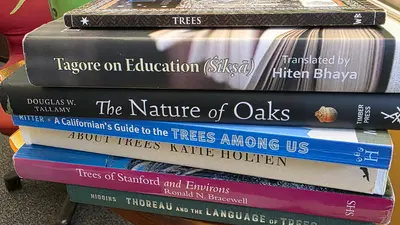
A stack of books shows the broad approach to Devaki Bhaya took in her outdoor learning classes about Stanford campus trees.

Students and instructors from one of Devaki Bhaya's "Party With Trees" classes, before it was re-vamped as "Peregrinations With Trees." The group included undergraduates with a variety of academic interests and specialties, all learning from each other.
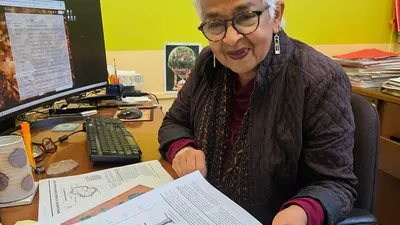
Devaki Bhaya in her office. Courtesy: Carnegie Science.
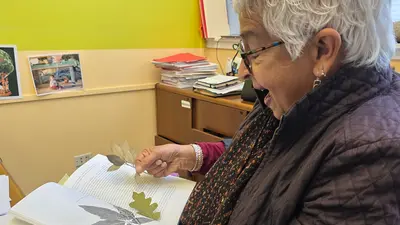
Devaki Bhaya looks at book from her Party With Trees class. Courtesy: Carnegie Science.
Syllabus for Stanford trees classes. Courtesy: Carnegie Science.
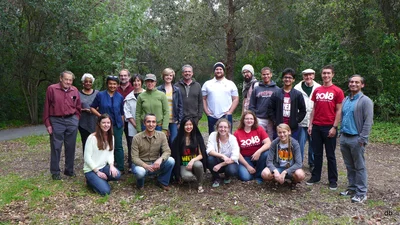
"Party With Trees" class. Courtesy: Devaki Bhaya
Undergraduate students who registered for the course represented a wide breadth of interests ranging from computer science, mathematics, and ecology to art, sustainability, and poetry. Bhaya said she really enjoyed the mix of students because it allowed the group to frame their observations of nature across different perspectives and learn from each other.
“The syllabus included a few well-thumbed books,” said Bhaya. “Bracewell’s, of course, but also tree guides by Matt Ritter, a professor at Cal Poly San Luis Obispo, which provided rigorous methods for identifying tree species, as well as more artistic and poetic material, such as an illustrated alphabet of trees by Katie Holten and a reading at the Stanford Quad selected from Richard Powers novel The Overstory, which is set on the campus!”
By using the spectacular Frederick Law Olmstead-designed Stanford campus as a living museum of trees, science, and art, Bhaya’s “Peregrinations With Trees” allowed students to appreciate the richness of their surroundings. For Bhaya, one of the successes of the course was the final project for which students developed their own ideas by doing research and speaking to experts on campus.
“If I can inspire even a few young people through such a course, I feel I have achieved something valuable,” she emphasized.
The breadth of subjects was truly impressive, from students researching canopy soils to tree shapes and how trees inspire poetry.
Students learned about the different species of oak, eucalyptus, and redwoods that thrive in the region. Visits to the campus’ Arizona Gardens and the university’s expansive field research facility Jasper Ridge Biological Preserve made them realize how micro-climates can dramatically shift ecologies over short distances and they developed an appreciation of native trees,invasive species, drought tolerance, fire ecology, and resilience.

A blue oak towers over the Carnegie Science Department of Plant Biology building on the Stanford campus. These trees are recognizable by their waxy blue-green leaves.

Fruit of the Dawn redwood, Metasequoia glyptostroboides, on the Stanford campus. This redwood species was thought extinct before being rediscovered in the 1940s.

Fruit of the Lithraea caustica or Chilean "litre" tree on the Stanford campus near Carnegie's former research base. It may be the offspring of a tree planted decades ago by Stanford biologist Harold "Hal" Mooney.

Fruit and flowers of Chilean soapbark tree, Quillaja saponaria, which can be found near the former Carnegie home base on Stanford University's campus.
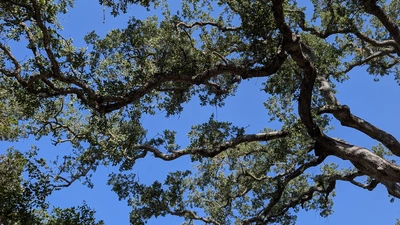
A Stanford blue oak. Courtesy: Devaki Bhaya
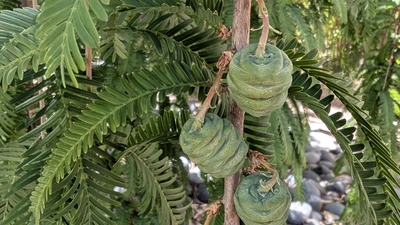
Dawn redwood fruit at Stanford. Courtesy: Devaki Bhaya.
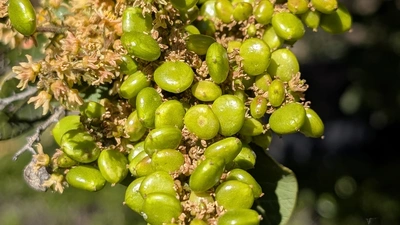
Tree of Chilean origin on the Stanford campus. Courtesy: Devaki Bhaya.
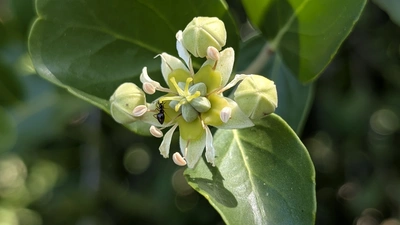
Chilean soapbark tree. Courtesy: Devaki Bhaya.
Recently, we joined Bhaya for a stroll of the Stanford University campus as Carnegie biologists prepared to say goodbye and relocate to Pasadena as part of Carnegie Science’s expanded alliance with Caltech.
Over a meandering two-hour walk, Bhaya pointed out blue oaks with their waxy, blue-green leaves, majestic coastal live oaks that overlook storied campus buildings, and cork oaks with their soft, squishy bark that is used to stopper wine bottles.
She shared an identification guide for differentiating the three majestic members of the redwood family, all found on the Stanford campus and Carnegie grounds: coast redwoods, giant sequoias, and dawn redwoods, once thought to be extinct and then re-discovered in China in 1944.
She also showed us a few trees of Chilean origin, possibly offspring from those that Stanford biologist Hal Mooney planted years ago on Carnegie’s footprint within the campus. These were recently rediscovered by Sairus Patel, who maintains the updated Trees of Stanford website, and others. They provide a delightful example of how trees reflect and reveal past history, Bhaya said.
The tour indulged our senses as we crunched through layers of crisp leaf litter and listened to the wind shake the leaves in a shaded grove where in the 1990s, sculptors from Papua New Guinea visited campus and carved intricate structures. We crushed leaves and inhaled the sharp, clean scents of eucalyptus and camphor. Perhaps it is no surprise that the ancient Japanese concept of “shinrin yoku,” which literally means “forest bathing” and the growing evidence that walking in nature is good for “brain health” is gaining acceptance, Bhaya added.

Devaki Bhaya's Stanford campus tree-walk courses were full sensory experiences. Students were encouraged to crush and smell fragrant leaves like those from this camphor tree.

Devai Bhaya demonstrates how to differentiate between the three members of the redwood family, all of which are present on the Stanford campus, using a tree-identification guide.

Devaki Bhaya touches the soft, squishy bark of a cork oak, which is used to for wine bottle stoppers, flooring, and the interiors of cricket balls.

Devaki Bhaya with a Chilean soapbark tree, Quillaja saponaria, growing at the edge of Carnegie's former hub on the Stanford University campus. She is interested in learning more about the Chilean trees that decended from those first planted by Stanford biologist Harold "Hal" Mooney.
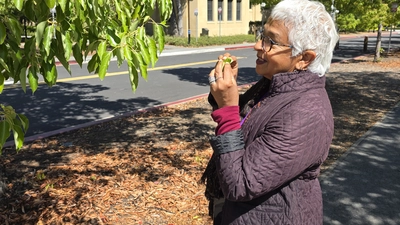
Devaki Bhaya with a camphor tree. Courtesy: Carnegie Science.
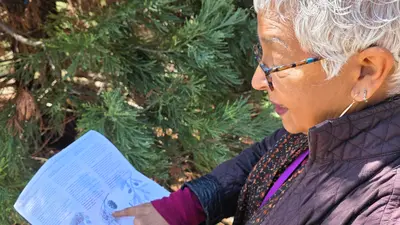
Devaki Bhaya with a redwood guide. Courtesy: Carnegie Science.
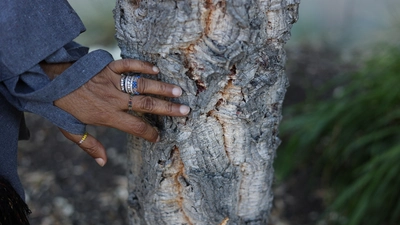
Devaki Bhaya's hand on a cork oak. Courtesy: Carnegie Science
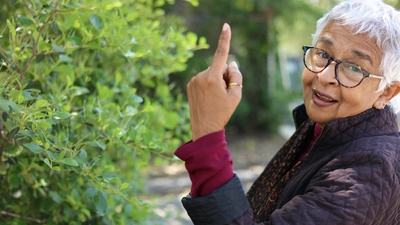
Devaki Bhaya with Chilean soapbark. Courtesy: Carnegie Science.
“Once you learn how to read bark and leaf to identify these trees, you are on your path to a lifelong engagement with them,” Bhaya reflected. “You start to wonder about the stories they can tell and how to steward them for future generations.”
As she looked to the future of biology at Carnegie Science, Bhaya’s mind was on community building and growing an appreciation for the natural world among science enthusiasts from all walks of life and at all ages. In her current research, Bhaya delves into the evolution and diversity of an ancient and resilient group of microorganisms that gave rise to all the green life we see around us. She mused that science allows one to see the invisible connections from the smallest of organisms to the redwood giants.
“Hands-on programs in science museums or in gardens and forests, where you get dirt on your shoes or under your fingers, where children and families can muck about and explore scientific ideas, are so critical for inspiring future generations about the living and resilient world around them,” Bhaya concluded.
In 2015, she transformed the serendipitous discovery of a guidebook into a popular Stanford course that has been written about and appreciated by many. Her path ahead—whatever form of communication it includes—is sure to weave together curiosity, discovery, storytelling and memory into a rich tapestry of learning.

Devaki Bhaya at the entrance to Stanford's Papua New Guinea Sculpture Garden. She said it is one of her absolute favorite spots on the sprawling campus, although it is less visited than some of the other garden spots.

Carnegie Science Editorial Director Natasha Metzler stands with one of the intricately carved in one of the garden's intricately carved sculptures.

In the mid-1990s, 10 artists from the Sepik River region of Papua New Guinea spent time on the Stanford campus creating this art from wood and stone.
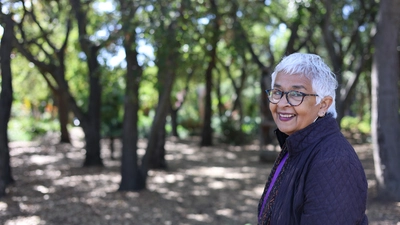
Devaki Bhaya in the Papua New Guinea Sculpture Garden. Courtesy: Carnegie Science.
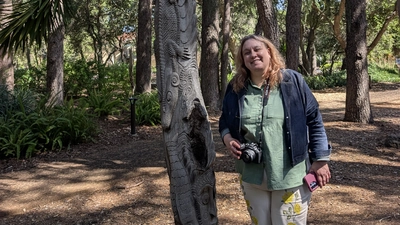
Natasha Metzler in the Papau New Guinea sculpture garden. Courtesy: Devaki Bhaya.
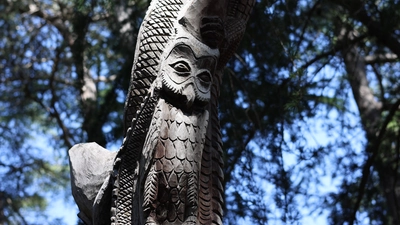
An owl is seen as part of a piece in the Papua New Guinea Sculpture Garden. Courtesy: Carnegie Science.
Keep Exploring
🌳 The Tree Party Reading List
- Trees of Stanford and Environs by Ronald N. Bracewell — the whimsical campus guide that started it all, now living on as the searchable Trees of Stanford website, complete with tree maps and a "what's in bloom" feature
- A Californian's Guide to the Trees Among Us by Matt Ritter — rigorous, approachable methods for identifying California's tree species
- About Trees by Katie Holten — an artist's illustrated tree alphabet that lets you write in trees
- Trees in Paradise by Jared Farmer — how redwoods, eucalypts, oranges, and palms shaped California's landscape and identity
- The Nature of Oaks by Douglas W. Tallamy — a month-by-month look at the ecosystems oaks sustain
- Thoreau and the Language of Trees by Richard Higgins — the naturalist tradition of learning by looking
- Tagore on Education (Śikṣā) — reflections on learning rooted in nature, translated by Hiten Bhaya, Devaki's father
Explore further: Wander the Jasper Ridge Biological Preserve ('Ootchamin 'Ooyakma) on a docent-led tour, or trace campus trees on the Trees of Stanford interactive maps.