Object 18 | Robert S. Woodward Portrait

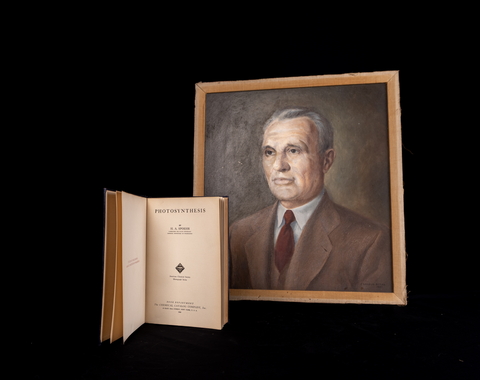
Historians have called Robert S. Woodward "the first modern manager of science" and he remains one of the most influential figures in shaping Carnegie Science's early policies. This oil portrait by artist Nicholas Richard Brewer, which once hung in the Board Room of Carnegie's historic Washington, D.C., headquarters, honors the institution's second president, who led Carnegie from 1904 to 1920. It is Object 18 in our #Carnegie125 series.
Woodward's path to Carnegie's presidency ran through decades of public service and academic research. A civil engineer turned applied mathematician, he worked for the federal government's Lake Survey, Coast and Geodetic Survey, Geological Survey, and the Naval Observatory before joining Columbia University in 1893 and becoming dean of its College of Pure Science in 1895. He was already chairing Carnegie's advisory committees on physics and geophysics when the institution’s founding president, Daniel Coit Gilman—the elderly president emeritus of Johns Hopkins who had assumed the role with the intention of handing it off quickly—announced his retirement after just a year in office. Woodward succeeded him in January 1904.

Historians have called Robert S. Woodward "the first modern manager of science" and he remains one of the most influential figures in shaping Carnegie Science's early policies.

The oil portrait by artist Nicholas Richard Brewer honoring Carnegie Science's second president once hung in the Board Room of Carnegie's historic Washington, D.C., headquarters.
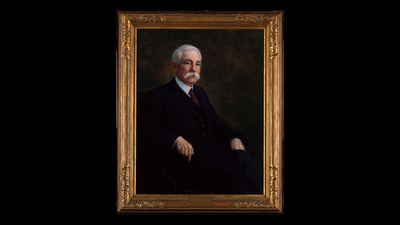
Woodward portrait on a black background
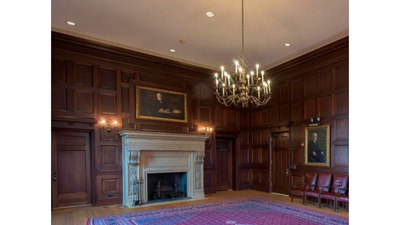
Board Room
Woodward inherited an institution still defining itself. Andrew Carnegie had endowed the organization with an enormous fortune and a sweeping mission but had left the details of how it should function undefined. Woodward later likened the process of settling on the institution's purpose to the struggle of an organism "trying at once to discover its proper functions and to adjust itself to the conditions of its environment." Over the 16 years he led Carnegie Science, Woodward would do more than anyone to resolve that struggle, steering the institution onto a course it has followed ever since.
Among Woodward's most consequential decisions was how he redirected the institution's approach to funding research. In its earliest years, the Trustees had followed Andrew Carnegie's directive to seek out the "exceptional man" by scattering "minor grants" of a few thousand dollars across academic scientists nationwide. Woodward concluded that the approach was inefficient and hard to make accountable. In its place, he championed a smaller number of long-term "research associateships," committing sustained support to proven investigators—figures like geneticist Thomas Hunt Morgan, an eventual Nobel Prize winner—who would be responsible to Carnegie rather than to their home universities. The Trustees did not immediately embrace his plan, but Woodward pressed ahead, steadily cutting back on minor grants in favor of the new approach. The number of active grants fell from a peak of 75 in 1905 to a steady 32 by 1909. Later institution leaders continued this trend, eventually phasing out external grants entirely.

Among Woodward's most consequential decisions was how he redirected the institution's approach to funding research. He championed a smaller number of long-term "research associateships," committing sustained support to proven investigators who would be responsible to Carnegie rather than to their home universities.

Woodward at Carnegie's Desert Laboratory in Tucson, Arizona, photographed with the department's staff during a visit in 1905 or 1906. Within his first three years as president, Woodward secured the board's approval for four new departments.

Woodward on board the Department of Terrestrial Magnetism's research vessel the Carnegie in 1910. Woodward was committed to building up Carnegie’s own in-house departments.
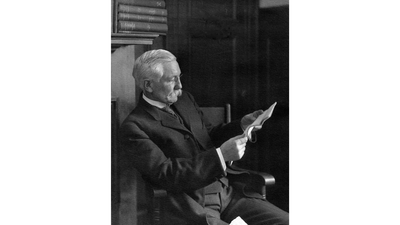
Woodward
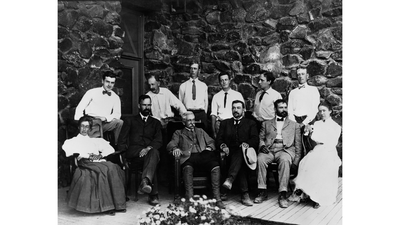
Department of Plant Biology
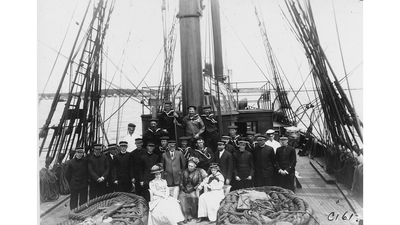
Department of Terrestrial Magnetism
Woodward was equally committed to building up Carnegie’s own in-house departments. He saw the Geophysical Laboratory and the Mount Wilson Observatory, respectively under the scientifically visionary and administratively capable leadership of Arthur L. Day and George Ellery Hale, as models of organized research. The institution’s departments had clear missions and were fully accountable to the organization for the resources they used. Within his first three years as president, he secured the board's approval for four new departments. A proponent of in-house research, Woodward described Carnegie as "a university in which there are no students." As historian Nathan Reingold later put it, the institution "was not to be merely a 'disbursing agency' but a real participant in research."
Andrew Carnegie took notice of what Woodward had built. Pleased with the growth and productivity of the institution's departments, he doubled his original endowment with additional gifts of $2 million in 1907 and $10 million in 1911. By the time Woodward retired in 1920, he had transformed Carnegie from a two-year-old organization still finding its footing into a well-organized enterprise whose basic philosophy of science management, favoring proven investigators and mission-driven departments over scattered grants, would guide Carnegie Science for generations to come.