Object 13 | OSRD Coat Rack

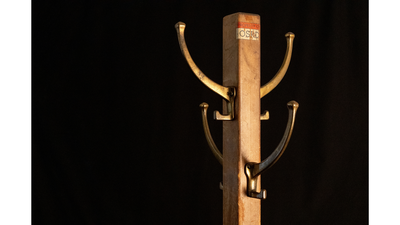
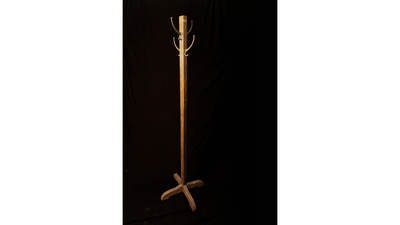
It's not the kind of object that stops you in your tracks. A simple coat rack, sturdy but worn by decades of use, has stood in unassuming corners of different Carnegie Science office buildings for as long as anyone on staff can remember. But the label affixed to it—an orange and black "Property of OSRD"—opens a window onto one of the most consequential chapters in the history of American science.


OSRD Coat Rack
OSRD Coat Rack Full
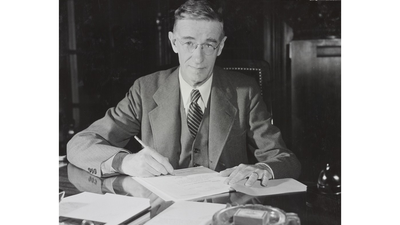
The man at the center of that story was Vannevar Bush, who arrived in January 1939 at Carnegie's historic headquarters building on P Street, just blocks from the White House. Prior to his appointment as Carnegie Science President, Bush had served as vice president and dean of engineering at MIT, earned election to the National Academy of Sciences, and served on several national advisory boards, developing a reputation as one of America's foremost scientific thought leaders.
Carnegie's presidency appealed to Bush for good reasons. The role carried enormous discretion over research funding at one of the nation's leading scientific institutions, and Carnegie’s president moved in the highest circles of Washington's scientific and policy establishment.
He set to work putting his stamp on the organization. Throughout his tenure, Bush would reshape Carnegie’s research portfolio decisively in favor of the physical and biological sciences, tapering and terminating programs in archaeology, the history of science, nutrition, and other areas. He had only begun this work, however, when deepening conflict in Europe pulled his attention toward a far larger problem: how American science could rally to meet the demands of a global conflict.
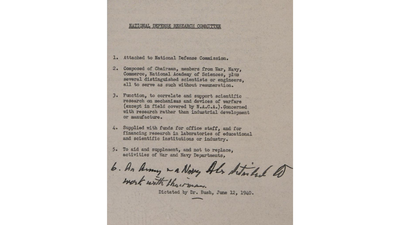
When Germany invaded France in May 1940, Bush concluded that the United States was dangerously unprepared for the war on the horizon and that mobilization of the country's scientific resources could not wait. He and colleagues from the National Research Council began sketching the outlines of an agency that could coordinate the U.S. scientific enterprise for the coming war. The document Bush eventually presented to President Roosevelt on June 12, 1940 contained just six bullet points. The president approved it in 10 minutes. Three days later, Roosevelt appointed Bush as chairman of the new National Defense Research Committee, which would be renamed by executive order the following year to the Office of Scientific Research and Development (OSRD)

Throughout his tenure as president of Carnegie Science, Bush would reshape the institution’s research portfolio decisively in favor of the physical and biological sciences. He had only begun this work, however, when deepening conflict in Europe pulled his attention toward a far larger problem: how American science could rally to meet the demands of a global conflict. Credit: Library of Congress Prints and Photographs Division. https://www.loc.gov/pictures/item/2005691441/

As conflict deepened in Europe, Bush and colleagues from the National Research Council began sketching the outlines of an agency that could coordinate the U.S. scientific enterprise for the coming war. The document Bush eventually presented to President Roosevelt on June 12, 1940 contained just six bullet points. The president approved it in 10 minutes. Credit: The Franklin D. Roosevelt Library, Hyde Park, New York
Vannevar Bush
Proposal
Reflecting on the establishment of the OSRD, Bush would later comment: "There were those who protested that the action…was an end run by which a small company of scientists and engineers…got hold of authority and money for the program of developing new weapons. That, in fact, is exactly what it was."
With time of the essence, and office space scarce in the nation’s capital, Bush offered Carnegie’s historic headquarters building as OSRD’s central office. Uniformed guards were stationed at the doors, the great rotunda was partitioned into office cubicles, and the hallways soon hummed with the urgent business of coordinating the country’s scientific war effort. The mahogany-paneled boardroom became Bush's own office. Stories recount how he used the room's length to his advantage, making visitors travel the full distance before reaching his desk, gaining a psychological upper hand before a word was exchanged. Among the desks and filing cabinets at least one OSRD-labeled coat rack stood as a silent witness to the transformation of Carnegie's headquarters into the command center of the nation's wartime research enterprise.
The agency that operated out of those partitioned rooms would engage tens of thousands of American scientists and oversee major developments in a wide range of war-related technologies, including the mass production of penicillin, advances in radar and jet propulsion, the proximity fuze—developed at Carnegie's own Department of Terrestrial Magnetism—and the early stages of the Manhattan Project.
In addition to advancing many scientific and military breakthroughs, the OSRD pioneered a new approach to public-private collaboration. Research was contracted to existing university and industrial laboratories—a model Bush had championed from the start. This meant that Bush’s sphere of influence was enormous. It is estimated that at one point, over two-thirds of the country’s physicists were working under his supervision.

With time of the essence, and office space scarce in the nation’s capital, Bush offered Carnegie’s historic headquarters building as OSRD’s central office. Uniformed guards were stationed at the doors, the great rotunda was partitioned into office cubicles, and the hallways soon hummed with the urgent business of coordinating the country’s scientific war effort. Credit: Carnegie Science

The Office of Scientific Research and Development Advisory Council, with Bush at the head of the table, seated in the board room of Carnegie’s historic headquarters building in 1946. Credit: Official U.S. Navy photo

The OSRD would engage tens of thousands of American scientists and oversee major developments in a wide range of war-related technologies, including the mass production of penicillin, advances in radar and jet propulsion, the proximity fuze—pictured here—and the early stages of the Manhattan Project. Credit: Carnegie Science.
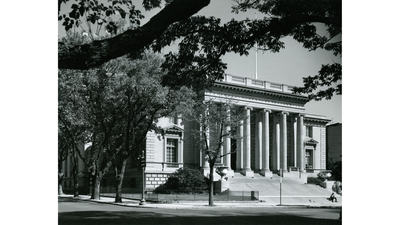
Headquarters Building
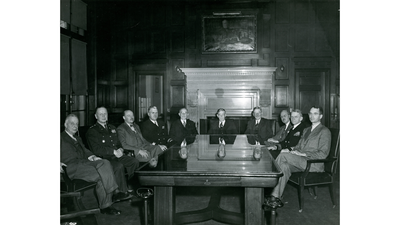
OSRD Group
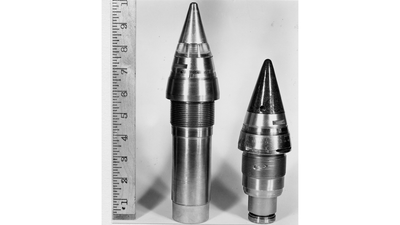
Proximity Fuzes
With the war won, the OSRD was wound down, its staff dispersed, its offices vacated. Carnegie reclaimed its historic building. The coat rack stayed and Bush returned his full focus to Carnegie’s scientific mission, continuing to serve as president until 1955 and as a trustee until his death in 1974.
The scientific advances that emerged from the OSRD had peacetime applications that advanced the country’s technological progress and postwar economy.
In his seminal 1945 report to the president, Science: The Endless Frontier, Bush made the case for sustained federal investment in basic research and laid the intellectual groundwork for the eventual creation of the National Science Foundation. The model he had pioneered at the OSRD—contracting research to independent universities and laboratories rather than building government science from scratch—became the template for American science for the next 80 years.
