Object 12 | Herman Spoehr Portrait

For decades, an oil painting of a scientist who dedicated his career to understanding how plants sustain themselves watched over a library and meeting space in Carnegie Science’s Department of Plant Biology building on the Stanford University campus. The subject is Herman Spoehr, a chemist turned plant physiologist who arrived at Carnegie in 1910 as virtually the only person in America seriously studying photosynthesis. Over a 40-year career at the institution, Spoehr would put American photosynthesis research on the map and build Carnegie’s Department of Plant Biology into a world-class research center. The portrait, donated to Carnegie by Spoehr’s family after his death, is object No. 12 in our #Carnegie125 series.
Spoehr came to photosynthesis by way of sugar. His father ran a sugar and chocolate manufacturing business in Chicago, and the younger Spoehr developed an early fascination with plant sugars—the ultimate natural source of the refined product his family knew well. As an undergraduate at the University of Chicago, he chose what his chemistry professors called an "impossible combination" of chemistry and botany as his dual focus. He went on to study in the laboratory of noted carbohydrate chemist Emil Fischer in Germany before returning to the University of Chicago where he earned his Ph.D. in 1909. For Spoehr, the leap from sugar chemistry to photosynthesis was a natural one. Photosynthesis, after all, is nature's primary producer of sugar—what Spoehr himself would later call the "mother reaction" of life.
When Spoehr arrived at Carnegie’s Desert Laboratory in Tucson in 1910, photosynthesis research remained almost exclusively a European enterprise, dominated by laboratories in England and Germany. Spoehr was the first American to pursue photosynthesis research on an ongoing, systematic basis, and the group he assembled at Carnegie remained one of only two in the U.S. devoted to the subject until the mid-1930s. In those early years at the Desert Laboratory, he was quite possibly the sole scientific link between American and European researchers in the field.

This portrait of Herman Spoehr, a chemist turned plant physiologist who arrived at Carnegie in 1910 as virtually the only person in America seriously studying photosynthesis, is object No. 12 in our #Carnegie125 series.

Over a forty-year career with the institution, Spoehr would put American photosynthesis research on the map and built Carnegie’s Department of Plant Biology into a world-class research center.

Spoehr's 1926 book, Photosynthesis, offered a comprehensive account of the field’s experimental foundation and would serve as the standard reference on the subject for over a decade, guiding a generation of photosynthesis researchers.
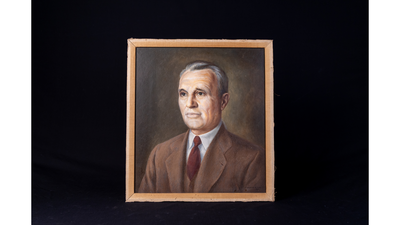
Portrait
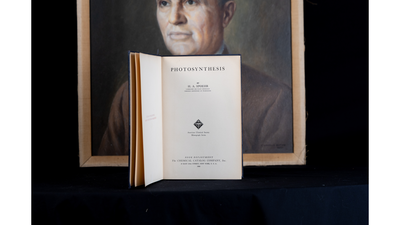
Portrait and Photosynthesis
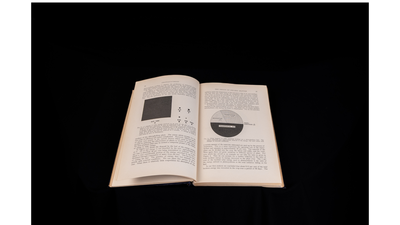
Photosynthesis
The work was challenging. Photosynthesis was, at that point, the scientific equivalent of a black box. Researchers knew what went in—carbon dioxide, water, and sunlight—and they knew what came out—oxygen and carbohydrates. But the internal machinery was invisible.
In Tucson, Spoehr began by measuring sunlight intensities at the Desert Laboratory and on nearby Mount Lemmon. He then turned to cacti, sampling their tissues across multiple seasons to map how molecular concentrations shifted with temperature and water content. His book on that work, The Carbohydrate Economy of the Cacti, became a classic.
In pursuit of the hidden machinery of photosynthesis common to every plant, Spoehr then shifted to sunflower and bean leaves, and eventually to the green algae Chlorella.
By the mid-1920s, Spoehr had become the nation's leading authority on the photosynthetic process. His 1926 book, Photosynthesis, offered a comprehensive account of the field’s experimental foundation and would serve as the standard reference on the subject for over a decade, guiding a generation of plant researchers.
In 1928, when Carnegie reorganized its scattered plant science operations—the Desert Laboratory in Tucson, along with labs in the mountains of Colorado and Carmel, California— into a new Division of Plant Biology (later renamed the Department of Plant Biology—now part of the institution’s Biosphere Science and Engineering division), Spoehr was made its inaugural chairman. The following year, the department moved into a new purpose-built laboratory on the campus of Stanford University. The charismatic Spoehr set out to put the new department on a coherent scientific course, building it into a center of excellence in plant research.

Spoehr dedicated his career to unraveling one of biology's greatest mysteries: how plants turn sunlight into life.

In 1928, when Carnegie reorganized its scattered plant science operations into a new Division of Plant Biology, Spoehr was made its chairman. The following year, the department moved into a new purpose-built laboratory on the campus of Stanford University.

The staff of the Division of Plant Biology in front of the new building in 1929. The charismatic Spoehr (third from the left) set out to put the new department on a coherent scientific course, building it into a center of excellence in plant research.
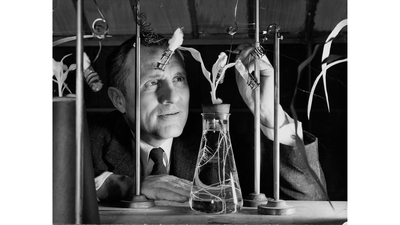
Herman Spoehr
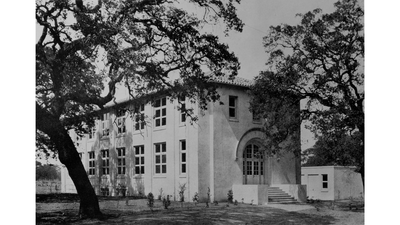
Building
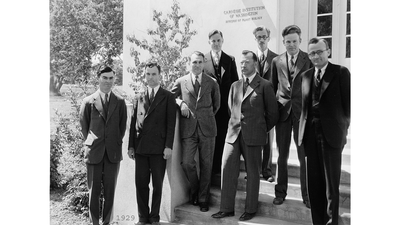
Staff Group
At the new laboratory, Spoehr led a team of experts—including James Smith, Harold Strain, and Harold Milner—who made a series of fundamental advances during the 1930s. They worked out the complex chemical structures of yellow leaf pigments involved in photosynthesis and made key measurements of the energy required to process carbon dioxide. Working with instrument makers at Carnegie’s Mount Wilson Observatory, they built specialized apparatus to generate and measure light in photosynthetic reactions—and used it to demonstrate that the energy required by the process was far greater than anyone had suspected, confirming that photosynthesis involved many more steps than previously imagined.
It was a fitting confirmation of something Spoehr had come to accept openly by 1923: photosynthesis was not the simple process he and many others had once hoped it would be. The black box had yielded hints, but not its secrets. When Spoehr stepped down as director in 1947 and retired in 1950, the mystery of photosynthesis remained fundamentally unsolved. "Time and time again," as the department’s centennial history put it, "he had opened areas of investigation in photosynthesis only to find he did not have the tools to pursue them."
But opening those areas mattered enormously. Spoehr was instrumental in making Carnegie’s Department of Plant Biology an intellectual home for photosynthesis in America. His successor, Stacy French, would lead the department into the heart of the mid-century photosynthesis revolution, making Carnegie a destination for researchers in the field.
This summer, almost a century after Spoehr led the Department of Plant Biology in its relocation to the Stanford campus, Carnegie’s plant biologists will relocate again to new Biosphere Sciences and Engineering division laboratories in Pasadena as part of the institution’s deepening alliance with Caltech. The move marks a new chapter in a scientific enterprise that Spoehr played a central role in shaping.
