The Giant Magellan Telescope Promises a Giant Leap Forward

Before a next-generation telescope’s pristine mirrors reflect light from the farthest reaches of the universe for the first time, how many hands will touch its mechanisms and how many minds will probe its possibilities? How many conversations will occur between scientists, advocates, and funders to conceive of the possibilities such an instrument holds and secure the capital needed to bring the project to fruition? How many eyes will pore over designs and prototypes to ensure it will deliver on the promise of its potential? How many hands will clear the dirt, cast the hardware, and assemble the puzzle from its pieces?
When the Giant Magellan Telescope project sees first light at Carnegie’s Las Campanas Observatory in Chile, it will be thanks to the efforts of hundreds of people across the United States and around the world. Once completed, the project will enable generations of breakthrough research on stars, galaxies, planets, our cosmic origins, and more.
The telescope achieved a major milestone in June 2025, when the National Science Foundation advanced the Giant Magellan Telescope to the Major Facilities Final Design Phase. Carnegie Science and the consortium of Giant Magellan Telescope partners took a giant step toward finally knowing for certain. The agency’s determination was based on a combination of considerations, including the project’s scientific merit, continuous progress toward construction, and alignment with national priorities in science and technology.
“Though many Americans have never heard of the Giant Magellan Telescope, the NSF’s decision to advance the project into this new phase is a massive step for American scientific elitism,” said Carnegie Science President John Mulchaey. Though the GMT will focus on the crystal-clear skies of the Southern Hemisphere, this project stands as a symbol of American innovation: 10 of the 16 partner institutions—including Carnegie Science—are based in the United States, and major components of the telescope are being manufactured and tested in facilities across 36 states. “When it finally comes online, it will change the face of astronomy in the U.S. and around the world. The size and scale of the instrument means that a public-private funding partnership was always going to be the surest path forward to completion. This is an exciting, encouraging step toward a future where the GMT is the standard-bearer for American astronomical capabilities.”
One of the premier facilities in the planned class of Extremely Large Telescopes identified as a top priority by the U.S. astronomical community in its most recent decadal study, the GMT will be 200 times more powerful than today’s best telescopes and will help reveal the fundamental physics underpinning the cosmos and advance the search for life beyond Earth. The flower-shaped configuration of seven 8.4-meter primary mirrors will offer unprecedented spatial resolution that is four times that of JWST and 10 times sharper than the Hubble Space Telescope. And it will be outfitted with special instruments and cameras to expand the data it can collect, benefiting traditional observational astronomers, but also giving astrophysicists the ability to dig into such mysterious phenomena as dark matter, dark energy, and black holes. This power all adds up to getting closer to understanding the mystery of how the universe came to be.
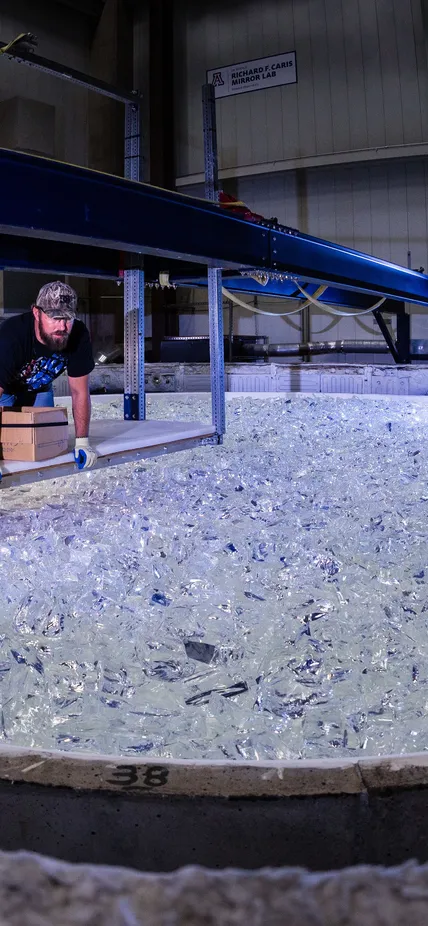
While advancing to the Final Design Phase offers no guarantee that the federal government will ultimately provide the funding needed to complete the multibillion-dollar project, this step is a requisite for eventually securing such funding. The decision elevates the telescope to a place of high prioritization among all projects seeking federal support. Beyond federal funding, it is an important endorsement of the scientific value of the instrument that could have ripple effects for other potential funding partners.
In September, MIT became one such partner by investing in the project and joining the consortium as a Founder. Its investment expands the community of scientists who will have access to the telescope when it is completed. In addition to Carnegie Science and MIT, the consortium includes Arizona State University, the University of Arizona, The University of Texas at Austin, Texas A&M University, the University of Chicago, Northwestern University, Harvard University, the Smithsonian Institution, the São Paulo Research Foundation, the Australian National University, Astronomy Australia Limited, the Weizmann Institute of Science, the Korea Astronomy and Space Science Institute, and the Academia Sinica Institute of Astronomy and Astrophysics.
Despite this growing network, Carnegie Science’s early support for the project has forever entwined the telescope with the institution’s own history. The idea for the telescope was born at the Observatories in Pasadena, and several Carnegie researchers, including Staff Scientist and GMT Chief Scientist Rebecca Bernstein, continue to make major contributions to its technical and scientific development.

“Beginning with George Ellery Hale and the Mount Wilson Observatory, Carnegie Science has been one of the world’s foremost proponents of telescope technology for the last century,” said Bernstein. “We’ve designed the GMT with capabilities that can unlock discoveries that have been unattainable with current technology. We have a good idea of what some of those discoveries will be. But part of the excitement of bringing a new instrument of this scale online is that it will collect data that enables discoveries we haven’t yet anticipated and, when it does, everyone who had a hand in bringing the telescope to fruition will have also had a hand in that scientific history. That extends to every scientist and supporter, and every builder and technician. We’re prepared to change the course of science history with the GMT.”
