Neighborhood Lecture Recap: A New Law of Nature?

Carnegie scientists Robert Hazen and Michael Wong took the stage at a Neighborhood Lecture this spring to argue that the laws governing the natural world are missing something: informational complexity. The idea started as a paper in the Proceedings of the National Academy of Sciences and has since grown into a popular science book, Time's Second Arrow: Evolution, Order, and a New Law of Nature. To talk through how it squares with the second law of thermodynamics, the two sat down with NPR Shortwave host and physicist Regina G. Barber.
The "Arrow of Time" Problem
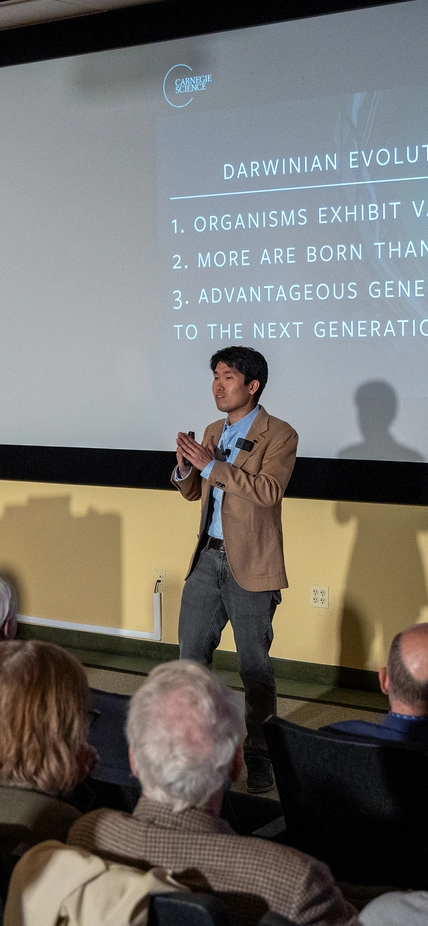
Here's the puzzle they're tackling. Most of the laws of physics work the same forward and backward, but our experience of time clearly doesn't. Eggs break, coffee cools, sandcastles wash away. We can remember the past but don’t know the future. The reason, according to the second law of thermodynamics, is that entropy—disorder—always increases. That one-way trend toward messiness is what physicists call the "arrow of time."
But Hazen and Wong point out that this is only part of what we observe. Yes, things fall apart, but the universe also visibly builds complexity. Stars forge new elements. Planets form thousands of new minerals. Life emerges from non-life and diversifies into endless forms.
The Proposed Law
Hazen and Wong claim that a system’s “functional information” will increase if many different configurations that it comprises undergo selection for one or more functions.
In plainer terms: any system made of many interacting parts, with mechanisms in place that generate variation, if subjected to selection pressure, will tend to evolve toward greater complexity. This applies whether the system is biological or not.
"There is absolutely no physical law today that describes, explains, quantifies, and predicts the behavior of the origin and evolution of life and of other complex systems, both living and non-living,” said Hazen.
The Evidence
The authors are quick to note that no proposed law can be definitively proven, only supported by accumulating evidence. They presented two lines of support:
Mineral evolution. Earth began with fewer than 100 mineral species. Today, there are more than 6,000. Hazen and Wong show that the functional information of Earth's mineralogy has increased steadily over 4.5 billion years, in a pattern that matches the law's predictions.
Independent applications. In the years since their original PNAS publication, experts in unrelated fields have started applying the framework to their own systems. Five published papers now model cancer evolution as a non-Darwinian process. They discuss tumors as autonomous systems that explore "configuration space" and stumble onto new functions like co-opting the circulatory system or metastasizing. Other papers apply the framework to Alzheimer's disease, heart disease, soil microbiomes, the early chemistry of life, internet evolution, and even AI.
Hazen explained: "A tumor is an autonomous object in your body. It's not evolving by a Darwinian process, but rather it's probing configuration space looking for ways to take advantage.”
The Implication: A Second Arrow of Time
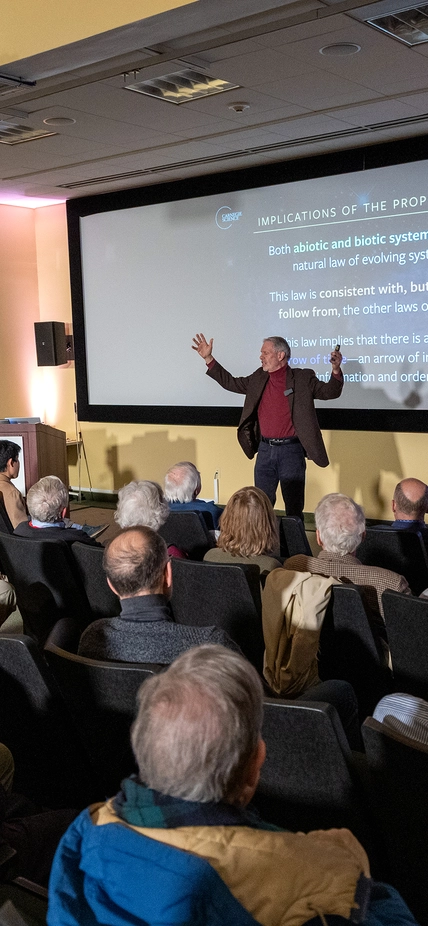
If the law holds, it suggests there are two arrows of time running in parallel: one pointing toward increasing entropy—decay—and another pointing toward increasing functional information—complexity, order, life. Both are real. Both are decoupled from each other. And both shape the universe we live in.
The Discussion
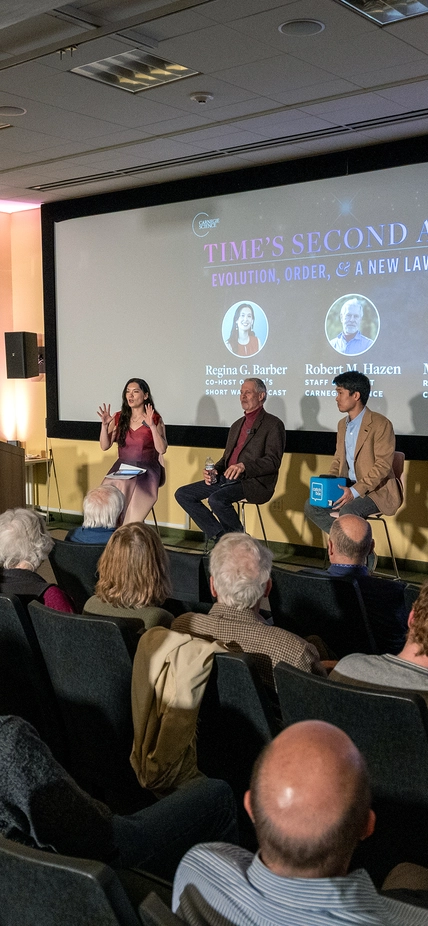
Barber, as a physicist, pushed back on several points, particularly regarding the question of whether entropy and information are truly independent, their proposed law’s relationship to existing work on emergence, and how the framework handles Laplace's demon—a classical thought experiment about predicting the universe's future from its current state.
Wong's response was that the law isn't trying to replace anything. It's a macroscopic description of patterns that fundamental physics doesn't capture, much like temperature or viscosity emerge only at scale.
Both authors closed by emphasizing that they expect their proposal to be revised, refined, or replaced as science progresses.
As Wong put it: "In 250 years, the laws of nature taught in schools will probably not look like the laws of nature that we take for granted here. I don't think it will even be our law of nature. I hope that as science progresses, we get closer and closer to approximating the way that the world works, and that our law is simply a helpful step toward whatever comes next."
Upcoming Events
Events

Postdoc William Frazer gives a Neighborhood Lecture about his research into the geological mystery of Bermuda.