Meet Marion Le Voyer: EPL’s First Outreach and Education Specialist

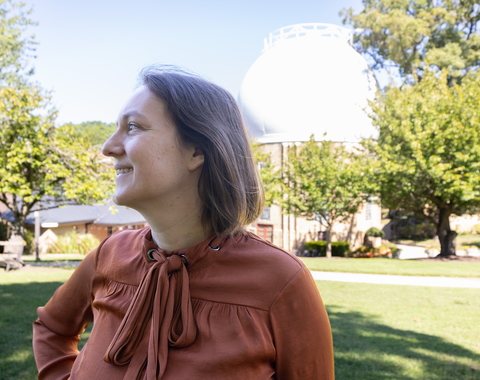
When Marion Le Voyer returned to the Earth and Planets Laboratory, muscle memory took over. She parked in the same spot she had used as a postdoctoral fellow more than a decade earlier. From there, she crossed the lawn at the center of campus, walking under big trees and the rounded white dome of the historic Atomic Physics Observatory.
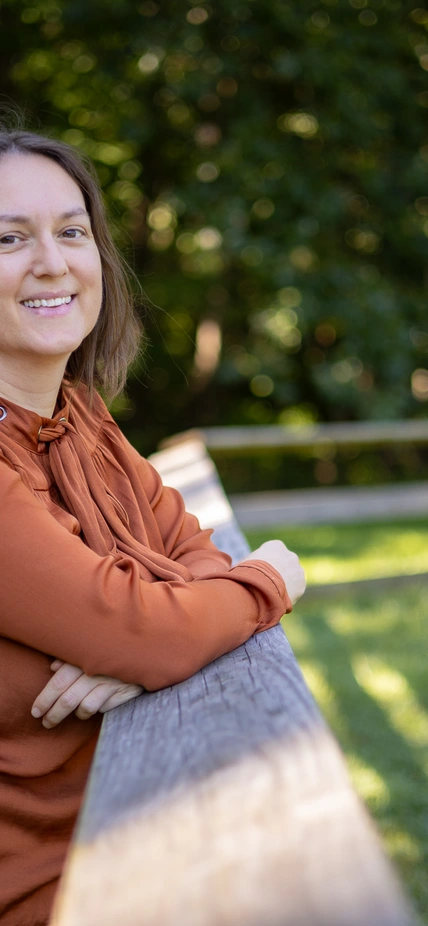
"I have this double feeling," she says, "of walking into the exact same place and a completely different place."
The setting was familiar, but the purpose was new. In September, Le Voyer returned to Carnegie Science as EPL's first Outreach and Education Specialist, helping scientists build connections between their work and communities beyond their fields.
A scientist and an educator
Le Voyer first arrived at Carnegie in 2012 through the Deep Carbon Observatory, a 10-year interdisciplinary effort to understand many roles the sixth element plays in our planet’s interior—from mineralogy to petrology and microbiology and climate change. Her postdoctoral appointment was shared with the Smithsonian Institution's National Museum of Natural History. She used volcanic glass to investigate carbon and other volatile elements in magmas and later studied water on the Moon. The independence and support given to Carnegie Postdocs empowered her to trust her authority as a researcher.
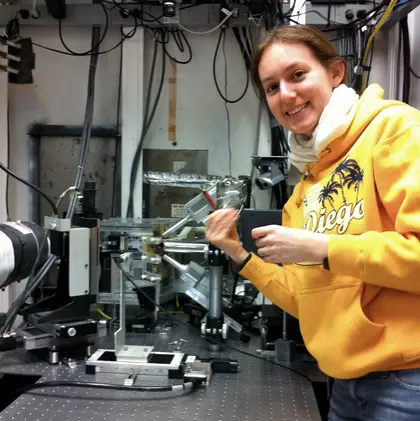
As her scientific confidence grew at Carnegie, the opportunities for public outreach at the Smithsonian piqued her interest in sharing her expertise with the next generation. Le Voyer volunteered for lectures, nonprofit public events, and school visits. One event stuck with her: the Hydrothermal Vent Extravaganza, where she and scientists from fields like microbiology and volcanology came together to talk to the public about these mysterious deep-sea ecosystems.
"I just had so much fun that day," she says, looking back on the pivotal opportunity. "I also felt like, 'Wow, I'm good at this. I would like to do more of it.'"
Deciding to change careers took years of deliberation. After teaching at the University of Maryland, Le Voyer realized that she enjoyed informal education more than formal classroom education. She returned to the Smithsonian, this time firmly on the education and outreach side of the institution.
In this new role, Le Voyer worked on developing a suite of public-facing initiatives and hands-on activities for various exhibits over the years, including the David H. Koch Hall of Fossils - Deep Time (launched in 2019) and the Cellphone: Unseen Connections Exhibition (launched in 2023). She especially enjoyed supporting scientist-led outreach efforts such as the Expert Is In Program, enabling members of the public to have informal “drop-in” conversations with researchers. As part of this effort, experts from the Smithsonian, the U.S. Geological Survey, or other local institutions received visitor engagement training, and support choosing objects to showcase as well as key messages to emphasize during their public engagement.
"Finding a personal connection makes all of the difference," she says.
She now describes herself as "a scientist and an educator." Her new position at EPL brings these identities together.
A new chapter for Carnegie outreach
Le Voyer's appointment comes as Carnegie shifts its D.C.-based outreach efforts from fixed programs that brought students and teachers to our campus for weekly courses or daily summer school to a more flexible model designed to increase access to Carnegie science and its research.
Last December, Carnegie wound down its Carnegie Academy for Science Education program, founded by our late President Maxine Singer in 1989. CASE programming ensured access to high-quality science learning for thousands of students in the nation's capital and provided professional development opportunities to thousands of D.C. teachers.
But learning environments have changed tremendously in recent years, and this change will enable Carnegie experts to build new connections that meet students, educators, and families in their comfort zones.
"It’s going to take some time to develop the vision, but it’s an exciting goal to increase the reach of Carnegie Science," Le Voyer says.
Le Voyer hopes her work will carry forward CASE's longstanding commitments to access, young people, and local communities. Her position also parallels the outreach work led by Jeff Rich at Carnegie Observatories in California, placing dedicated outreach staff closer to the researchers and communities they support.
From the inside out
Le Voyer sees two connected audiences for her work. She is starting by laying the groundwork with EPL's community of scientists and researchers.
She first wants to learn what researchers already do for outreach, what they would like to try, and what stands in their way. For scientists whose outreach projects are already self-sustaining, her message is simple: "How can I support your efforts and strengthen your program’s impact?”
For others, she hopes to make outreach easier by lowering common hurdles such as limited time, uncertainty about audiences, or difficulty translating their work.
"I'm hoping that I can break some of these barriers and have programs that are plug-and-play, easily accessible for any Carnegie staff who want to make an impact," she says.
Building relationships beyond EPL
Le Voyer's largest and most critical audience is the public beyond EPL. She wants to continue Carnegie’s relationship with its D.C. neighbors while developing sustained partnerships with communities that have less access to science. She does not yet know exactly where those partnerships will lead and considers that openness an important part of Carnegie’s new flexible model for outreach.
Some people are eager to visit EPL, but reaching others could mean taking the show on the road. Le Voyer sees a place for both approaches. Her rule for effective engagement is simple: "Meet them where they actually are."
That could mean working with museums and other partners, or bringing scientific content and educational materials into classrooms, clubs, and community organizations.
Wherever the encounter happens, Le Voyer does not want to arrive with a ready-made program based solely on Carnegie's expertise. She wants to begin by listening to the audience’s needs first.
"I am first working on identifying a specific school or community's needs and then seeing if we can answer their needs," she says. "If yes, let's build something together!"
Why outreach matters
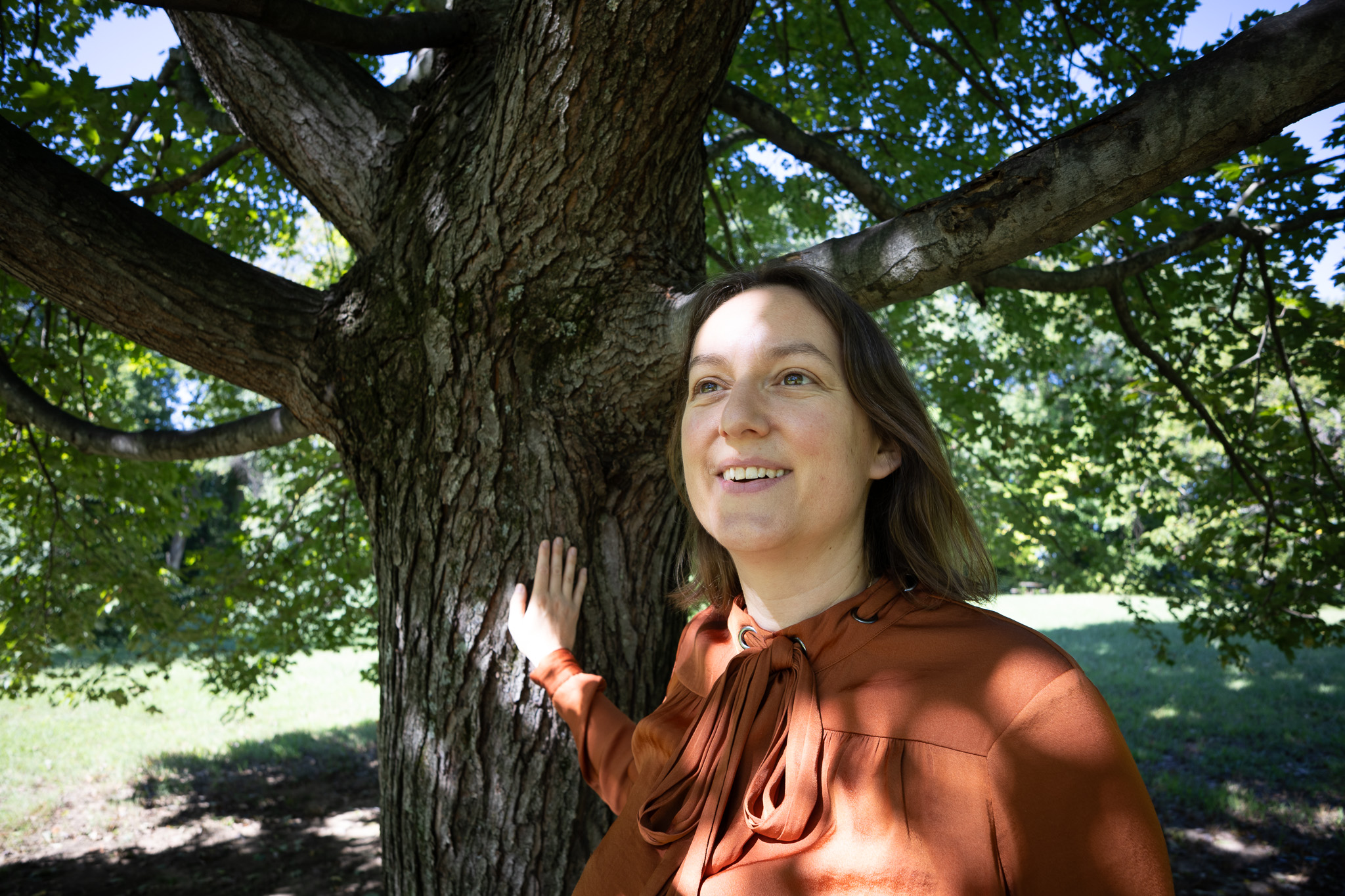
To Le Voyer, outreach is not an afterthought to be tacked onto a scientific endeavor after the research is finished. She wants to get EPL scientists to a place where outreach opportunities are considered as early as a project's planning phases.
"I think we can't separate scientific research from outreach," she says. "Research can't be done in a vacuum." Vacuum pun intended.
Public engagement makes the work—and the people doing it—more familiar, which she sees as important to strengthening public trust in science. The exchange can also benefit researchers: Questions and ideas from an audience may find their way back into scientific work.
"It goes both ways," she says.
Building relationships takes time. In the meantime, she will observe, test, and adjust.
"I'm going to use the scientific method," she says. "Trial and error is part of the process."
News