Guillermo Blanc named Director of Las Campanas Observatory

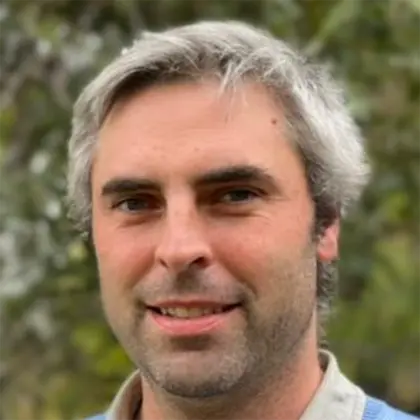
Pasadena, CA—Astronomer Guillermo Blanc has been named the Director of Carnegie Science’s Las Campanas Observatory (LCO) in Chile’s high Atacama Desert, home of the world-class twin Magellan telescopes and future site of the Giant Magellan Telescope. He succeeds Emeritus Director Leopoldo Infante, who retired at the end of 2025.
Blanc, who has served in an interim capacity since the beginning of the year, first joined Carnegie in 2011 as a postdoctoral fellow and has held a variety of positions over the ensuing years, including Head of Scientific Technical Development and Associate Director of Strategic Initiatives.
He has pursued an extensive research career, characterized by a combination of scientific leadership, innovation, and the development of influential observational programs in galactic and extragalactic astrophysics, while developing and maintaining the observatory’s scientific infrastructure. His efforts on the ground were critical to the successful installation of the Local Volume Mapper, a new facility that was built as part of the Sloan Digital Sky Survey’s (SDSS) fifth generation and is enabling a novel understanding of star-formation in the Milky Way and nearby dwarf galaxies.
“Guillermo has a deep understanding of every facility and instrument at the LCO site, as well as of the observatory’s importance to the international astronomical community and the prominence of astronomy in Chile’s national identity,” said President John Mulchaey. “He is the right choice to help us keep LCO and Carnegie at the cutting edge of our fields.”
Carnegie Science's Las Campanas Observatory is known worldwide for the quality of its dark skies, which remain clear and stable due to its location above the Atacama Desert—one of the most arid places on the planet.
The observatory was established in 1969 as a home to both 40-inch and 100-inch reflecting telescopes. In the early 2000s, the twin 6.5-meter reflectors saw first light, enabling scientific breakthroughs across every specialty of astronomy and astrophysics. It is also the Southern Hemisphere outpost for SDSS research, including the Local Volume Mapper and other survey efforts undertaken at the du Pont telescope. The next-generation Giant Magellan Telescope is currently under construction next door on the highest peak within Carnegie's LCO property, and other new cutting-edge research facilities are in the planning stages.
“Astronomy is advancing quickly and Carnegie needs to have a leader at LCO with the scientific and technical breadth to understand the new opportunities emerging from new technologies, new questions, and a more and more interconnected system of telescopes and collaborations,” said Michael Blanton, Director and Crawford H. Greenewalt Chair of the Carnegie Science Observatories. “Guillermo is that person and we’re thrilled to have him as the new LCO Director.”
Blanc’s own research focuses on how galactic ecosystems form and evolve as they interact with their surrounding environments. He is interested in the feedback systems that drive star formation and how the raw materials that supply this process change over time and what this means for the life cycles of the galaxies they inhabit.
He obtained his Ph.D. in astronomy at the University of Texas at Austin and master’s and bachelor’s degrees in the same from the Universidad de Chile in Santiago, where he currently holds an Adjunct Professor position.
“I am honored to step into this role and laser-focused on identifying opportunities to further burnish the incredible legacy of Carnegie’s jewel in the Southern Hemisphere,” Blanc concluded. “LCO has the best observatory staff in all of Chile, perhaps in the entire world, and I feel privileged to lead them as we prepare for an exciting future of new discoveries.”

Guillermo Blancs presenting information about light pollution to the Chilean government. Preserving dark skies in Chile has been a key component of Blanc's work for many years.

Carnegie astronomer Guillermo Blanc speaking at the conference "First Light: The Astronomy Century in California, 1917-2017." The conference, presented by The Huntington and the Carnegie Science Observatories, marked the centennial of the completion of the 100-inch Hooker telescope on Mount Wilson.

Guillermo Blanc leads a tea time talk on Las Campanas Observatory's efforts to combat light pollution. Blanc has been a leader on this issue for more than a decade.

Carnegie Science partnered with the Perot Museum of Nature and Science to celebrate the Great North American Eclipse in Dallas, Texas. Eclipse trip guests attend an eclipse eve celebration at the exclusive Circle T Ranch. Attendees enjoyed a complimentary custom hat experience, live music, farm-to-table supper, and remarks from Perot Museum and Carnegie Science hosts.
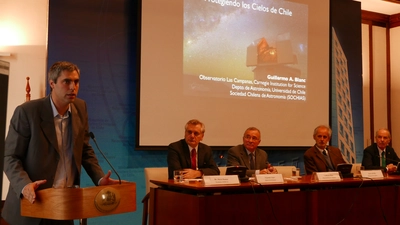
Guillermo Blanc leads the fight against light pollution in Chile. Courtesy Carnegie Science.
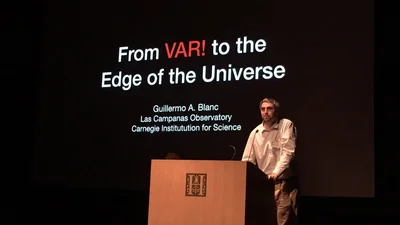
Guillermo Blanc speaking at the First Light conference courtesy Carnegie Science.
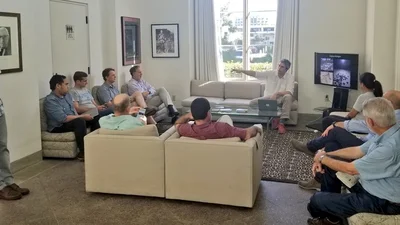
Guillermo Blanc at Carnegie Science Observatories tea. Courtesy Carnegie Science.
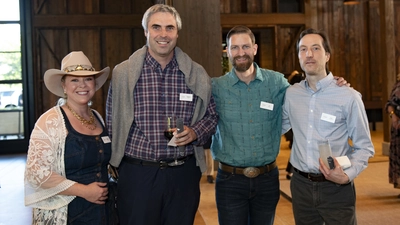
Guillermo Blanc and other members of the Carnegie Science staff at the Great North American Eclipse eve celebration at the Circle T Ranch. Courtesy Tamytha Cameron Photography/Carnegie Science.
Spanish Language Version
Pasadena, California— El astrónomo Guillermo Blanc ha sido nombrado Director del Observatorio Las Campanas (LCO) de Carnegie Science, ubicado en el desierto de Atacama, en Chile, sede de los dos telescopios Magallanes y futuro emplazamiento del Giant Magellan Telescope. Blanc sucede al Director Emérito Leopoldo Infante, quien se jubiló a fines de 2025.
Blanc, quien se desempeñaba como director interino desde comienzos de este año, se incorporó por primera vez a Carnegie en 2011 como investigador postdoctoral. Desde entonces ha ocupado diversos cargos, entre ellos el de Jefe de Desarrollo Científico-Técnico y Director Asociado de Iniciativas Estratégicas.
Ha desarrollado una extensa carrera de investigación, caracterizada por una combinación de liderazgo científico, innovación y desarrollo de programas de observación en astrofísica galáctica y extragaláctica, junto con el desarrollo y mantención de la infraestructura científica del observatorio. Su trabajo en terreno fue decisivo para la instalación exitosa del Local Volume Mapper, una nueva instalación construida como parte de la quinta generación del Sloan Digital Sky Survey (SDSS), que está permitiendo estudiar de una manera novedosa la formación estelar en la Vía Láctea y en galaxias enanas cercanas.
“Guillermo posee un profundo conocimiento de cada una de las instalaciones e instrumentos de LCO, así como de la importancia del observatorio para la comunidad astronómica internacional y del lugar destacado que ocupa la astronomía en la identidad nacional de Chile”, señaló el presidente de Carnegie Science, John Mulchaey. “Es la persona adecuada para ayudarnos a mantener a LCO y a Carnegie a la vanguardia de nuestras disciplinas”, agregó.
El Observatorio Las Campanas de Carnegie Science es reconocido en todo el mundo por la calidad de sus cielos oscuros, que se mantienen despejados y estables gracias a su ubicación sobre el desierto de Atacama, una de las regiones más áridas del planeta.
El observatorio fue establecido en 1969 y originalmente albergó telescopios reflectores de 40 y 100 pulgadas. A comienzos del 2000, dos telescopios de 6,5 metros vieron su primera luz, haciendo posibles importantes avances científicos en prácticamente todas las áreas de la astronomía y la astrofísica. Las Campanas también es la sede del SDSS en el hemisferio sur, donde se desarrollan proyectos como el Local Volume Mapper y otros programas de cartografiado realizados con el telescopio du Pont. El Giant Magellan Telescope, de próxima generación, se encuentra actualmente en construcción en las cercanías, en la cumbre más alta dentro de la propiedad de Carnegie en LCO, mientras que otras nuevas instalaciones de investigación se encuentran en etapa de planificación.
“La astronomía avanza rápidamente y Carnegie necesita en LCO un líder con la amplitud científica y técnica necesaria para comprender las nuevas oportunidades que surgen de las nuevas tecnologías, las nuevas preguntas y de un sistema de telescopios y colaboraciones cada vez más interconectado”, señaló Michael Blanton, Director y titular de la Cátedra Crawford H. Greenewalt de Carnegie Science Observatories. “Guillermo es esa persona y estamos muy contentos de contar con él como nuevo Director de LCO”, añadió.
La investigación de Blanc se centra en cómo se forman y evolucionan los ecosistemas galácticos a medida que interactúan con sus entornos. Está especialmente interesado en los procesos de retroalimentación que regulan la formación estelar, en cómo cambian con el tiempo las materias primas que alimentan este proceso y en las implicancias que estos cambios tienen para los ciclos de vida de las galaxias que los albergan. Obtuvo su doctorado en astronomía en la Universidad de Texas en Austin, y sus grados de magíster y licenciatura en la misma disciplina en la Universidad de Chile, en Santiago, donde actualmente se desempeña como profesor adjunto.
“Es un honor asumir este cargo y estoy completamente enfocado en identificar oportunidades que permitan seguir fortaleciendo el extraordinario legado de esta joya de Carnegie en el hemisferio sur”, indicó Blanc. “LCO cuenta con el mejor equipo de observatorio de Chile, quizás incluso del mundo, y me siento privilegiado de poder liderarlo mientras nos preparamos para un futuro lleno de nuevos descubrimientos”, concluyó.
